For millennia, geography has defined human civilizations. As our communications capability increases, as measured by technical specifications if not necessarily emotional ones, the need to be physically located in a certain place to do a job, support a social movement, or complete a business transaction is becoming less of an absolute constraint. Mobile phones, cloud computing, and other tools (such as lightweight project management software or online social networks) allow people and resources to be organized without physical contact; this might be called the emerging domain of space, as in "cyber." People can put up virtual storefronts on eBay, let Amazon be their supply chain, rent computing from Google to run code written in India, and let PayPal be their treasury system. Salesforce.com keeps track of customers and prospects; ADP runs payroll once enough employees sign on. Thus, the actual "business" could physically be the size of a laptop PC.
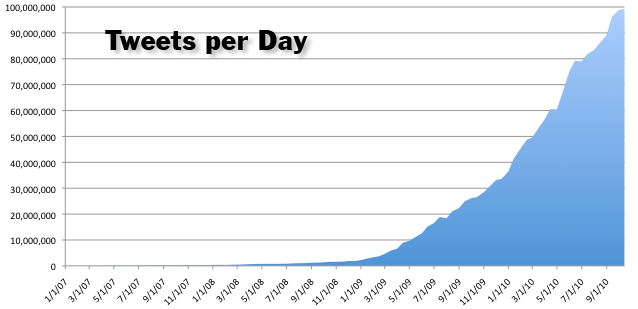
As place becomes negotiable, so does time. Asynchronous television viewing, for example, is reshaping the cable TV landscape. Comcast bought NBC Universal, which in turn was part of the Hulu joint venture. Apart from sports, college students watch very little television at its scheduled time, or over its traditional channel for that matter. Shopping has also become time-shifted: one can easily walk into Sears, shop at a kiosk, and have the item delivered to physical address, or else shop on line and drive to the store for faster pickup than FedEx can manage. At the other end of the time spectrum, tools like Twitter are far faster than TV news, not to mention print newspapers. Voicemail seems primitive now that it's roughly 30 years old, a time-shifting capability now taken for granted.
Place and time increasingly interconnect. Real-time package tracking for a routine Amazon purchase contrasts dramatically with a common scene at an automobile dealership: a customer saw a vehicle on the website earlier in the week and none of the sales people know what happened to it. UPS can track more than a million packages per day while a car dealer can lose a $15,000 two-ton vehicle, one of a few dozen, from a fenced concrete lot. Customer expectations are set by the former experience and are growing increasingly intolerant of the latter.
The corollary of that place/time flexibility, however, is being tracked: everybody with digital assets is plugged into some kind of information grid, and those grids can be mapped. Sometimes it's voluntary: Foursquare, Shopkick, and Facebook Places turn one's announced location into games. More often Big Brother's watch is without consent: London's security cameras are controlled by the same police department accused of using official assets in the service of the Murdoch newspapers' snooping on innocent citizens. Unplugged from the Internet but still needing to distribute directives and communiqués, Osama Bin Laden relied on a USB-stick courier who proved to be his undoing. As we have seen elsewhere, the entire idea of digital privacy, its guarantees and redresses, for bad guys and for everyday folk, is still primitive.
Examples are everywhere: Google Streetview has proved more controversial in Europe, and Germany in particular. Local "open records" laws have yet to be rethought in the age of instant global access: it's one thing for the neighbors to stop by town hall to see how much the new family paid for their house, but something else entirely (we don't really know what) when tens of millions of such transactions are searchable -- especially within overlays of Streetview, Bing's Bird's eye aerial (as opposed to satellite) imagery, and other potentially intrusive mechanisms.
In 2009, a WIRED magazine reporter attempted to vanish using a combination of physical disguises and digital trickery: pre-paid cell phones, proxy servers for IP address masking, cash-purchased gift cards. He was found though a combination of old-fashioned detective work and sophisticated network analysis: he was signing on to Facebook with an alias, and the alias had few real friends. The Facebook group he was lurking in was comprised of people trying to find him. The intersections of place and space are growing more curious every year.
Virtuality
From its origins as a network perimeter tunnel (Virtual Private Network, the ability to see computing resources inside the firewall while being physically remote from the corporate facility), virtualization has become a major movement within enterprise computing. Rather than dedicating a piece of hardware to a particular piece of software, hardware becomes more fungible. In a perfect virtual world, people with applications they need to run can schedule the necessary resources (possibly priced by an auction mechanism), do their work, then retreat from the infrastructure until they next need computing. In this way, the theory goes, server utilization is improved: all the downtime associated with captive hardware can go offline, freeing computing to be used to the current work, whatever its size, shape, or origin.
Once again, physical presence (in this case, big computers in a temperature-controlled facility with expensive redundant network and power connections, physical security, and specialized technicians tending the machines) is disconnected from data and/or application logic. In many consumer scenarios, people act this way without thinking twice: looking at Google Maps instead of Rand McNally, using the online version of Turbotax, or even reading Facebook is similar: no software package resides on the user's machine, and the physical location of the actual computing is both invisible and irrelevant.
From the world of computing, it's a short hop to the world of work. People no longer need to come to the physical assets if they're not doing work on somebody else's drill presses and assembly lines: brain work, a large component of the services economy, is often independent of physical capital, and thus of scheduled shifts. "Working from home" is commonplace, and with the rise of the smartphone, work becomes an anytime/anywhere proposition for more and more people. What this seamlessness means for identity, for health, for family and relationships, and for business performance has yet to be either named or sorted out.
Another dimension of virtuality is personal. Whether in Linden Labs' Second Life, World of Warcraft, or any number of other venues, millions of people play roles and interact through a software persona. As processing power and connection quality increase, these avatars will get more capable, more interesting, and more common. One fascinating possibility relates to virtual permanence: even if the base-layer person dies or quits the environment, the virtual identity can age (or, like Bart Simpson, remain timeless), and can either grow and learn or remain blissfully unaware of change in its own life or the various outside worlds.
Practical applications of virtualization for everyday life seem to be emerging. In South Korea, busy commuters can shop for groceries at transparencies of store shelves identical to those at their nearby Tesco Homeplus store; the photos of the products bear 2D barcodes which, when scanned and purchased, generate orders that are bundled together for home delivery. Picking up ingredients for dinner on the way home from work is a time-honored ritual; here, the shopper chooses the items but never touches them until arriving at his or her residence.
Cisco is making a major play toward virtual collaboration in enterprise videoconferencing; their preferred term, "telepresence," hasn't caught on, but the idea has. Given the changes to air travel in the past ten years (longer check-in times, fewer empty seats, higher fares), compounded by oil price shocks, many people dislike flying more than they used to. Organizations on lean budgets also look to travel as an expense category ripe for cutting, so videoconferencing is coming into its own at some firms. Cisco reports that it has used the technology to save more than $800 million over five years; productivity gains add up, by their math, to another $350 million.
Videoconferencing is also popular with individuals, but it isn't called that: in July 2011 Skype's CEO said that users make about 300 million minutes of video calls per month, which is about the same as pure voice connections. when measured as web traffic; since video consumes more bandwidth, the number of voice-to-voice calls might well be higher. The point for our purposes is that rich interaction can facilitate relationships and collaboration in the absence of physical proximity, at very low cost in hardware, software, and connection. As recently as 2005, a corporate videoconference facility could cost more than a half million US dollars to install; monthly connection charges were another $18,000, or $216,000 annually. In 2011, Apple iPads and many laptop PCs include cameras, and Skype downloads are free.
Organizations
Given that vertical integration has its limits in speed and the cost of capital investment (both in dollars and in opportunity costs), partnering has become a crucial capability. While few companies can emulate the lightweight, profit-free structure of a hacker's collective like Anonymous, of Wikipedia, or of Linux, neither can many firms assume that they control all necessary resources under their own roof. Thus the conventional bureaucracy model is challenged to open up, to connect data and other currencies to partners. Whether it involves sharing requirements documents, blueprints for review, production schedules, regulatory signoffs, or other routine but essential categories of information, few companies can quickly yet securely vet, map, and integrate a partner organization. Differences in nomenclature, in signing authority or span of control, time zones, language and/or currency, and any number of other characteristics complicate the interaction. So-called onboarding -- granting a partner appropriate data access -- can be a months-long process, particularly in secure (aerospace and defense) or regulated settings. Creating a selectively permeable membrane to let in the good guys, let out the proper information, turn off the faucet when it's not being used, and maintain trade secrets throughout has proven to be non-trivial.
Automata
What would happen if a person's avatar could behave independently? If an attractive bargain comes up at Woot, buy it for me. If someone posts something about me on a social network, notify me or, better yet, correct any inaccuracies. If the cat leaves the house through the pet door and doesn't return within two hours, call the petsitter. Who would bear responsibility for the avatar's actions? The person on whose behalf it is "working"? The software writer? The environment in which it operates?
Once all those avatars started interacting independently, unpredictable things might happen, the equivalent of two moose getting their antlers stuck together in the wild, or of a DVD refusing to play on some devices but not others because of a scratch on the disc. Avatars might step out of each other's way, or might trample each other in mobs. They might adapt to new circumstances or they might freeze up in the face of unexpected inputs. Some avatars might stop and wait for human guidance; other might create quite a bit of havoc given a particular set of circumstances.
It's one thing for a person's physical butler, nanny, or broker to act on his or her behalf, but something else quite new for software to be making such decisions. Rather than being a hypothetical thought experiment, the above scenarios are already real. Software "snipers" win eBay auctions with the lowest possible winning bid at the last possible moment. Google Alerts can watch for web postings that fit my criteria and forward them.
More significantly, Wall Street transactions generated by the jacketed floor traders waving their hands furiously are a dying breed. So-called algorithmic trading is a broad category that includes high-frequency trading, in which bids, asks, and order cancellations are computer-to-computer interactions that might last less than a second (and thus cannot involve human traders). By itself, HFT is estimated to generate more than 75% of equities trading volume; nearly half of commodity futures (including oil) trading volume is also estimated to be computer-generated in some capacity. The firms that specialize in such activity are often not well known, and most prefer not to release data which may expose sources of competitive advantage. Thus the actual numbers are not widely known.
What is known is that algorithms can go wrong, and when they go wrong at scale, consequences can be significant. The May 6, 2010 "Flash Crash" is still not entirely understood, but the source of the New York Stock Exchange's biggest, fastest loss (998 points) in history lies in large measure in the complex system of competing algorithms running trillions of dollars of investment. The long-time financial fundamentalist John Bogle -- founder of the Vanguard Group -- pulled no punches in his analysis: "The whole system failed. In an era of intense technology, bad things can happen so rapidly. Technology can accelerate things to the point that we lose control."
Artifacts of the algorithmic failure were just plain weird. Apple stock hit $100,000 a share for a moment; Accenture, a computer services provider, instantaneously dropped from $40 to a cent only to bounce back a few seconds later. Circuit-breakers, or arrangements to halt trading once certain limits are exceeded, were tripping repeatedly. For example, if a share price moves more than 10% in a five minute interval, trading can be halted for a five-minute break. A bigger question relates to the HFT firms that, in good times, provide liquidity, but that can withdraw from the market without notice and in doing so make trading more difficult. Technically, the exchanges' information systems were found to have shortcomings: some price quotes were more than two seconds delayed, which represents an extreme lag in a market where computer-generated actions measure in the millions (or more) per second.
Implications
What does it mean to be somewhere? As people sitting together both text other people in college cafeterias, what does it mean to be physically present? What does it mean to "be at work"? Conversely, what does it mean to be "on vacation"? If I am at my job, how is my output or lack thereof measured? Counting lines of code proved to be a bad way to measure software productivity; how many jobs measure performance by the quality of ideas generated, the quality of collaboration facilitated, the quality of customer service? These are difficult to instrument, so industrial-age measures, including physical output, remain popular even as services (which lend themselves to extreme virtualization) grow in importance and impact.
What is a resource? Who creates it, gets access to it, bears responsibility for its use or misuse? Where do resources "live"? How are they protected? What is obsolescence? How are out-of-date resources retired from service? Enterprise application software, for example, often lives well past its useful life; ask any CIO how many zombie programs he or she has running. Invisible to the naked eye, software can take on a life of its own, and once another program connects to it (the output of a sales forecasting program might be used in HR scheduling, or in marketing planning), the life span likely increases: complexity makes pruning more difficult since turning off an application might have dire consequences at the next quarterly close, the next annual performance review, or the next audit. Better to err on the side of safety and leave things running.
What does it mean for information to be weightless, massless, and infinitely portable? Book collections are becoming a thing of the past for many readers, as Kindle figures and Google searches can attest: having a reference collection near the dining room used to be essential in some academic households, to settle dinnertime contests. Music used to weigh a lot, in the form of LP records. Compact discs were lighter, but the plastic jewel box proved to be a particularly poor storage solution. MP3 downloads eliminated the software, but still needed bits to be stored on a personal hard drive. Now that's changing, to the point where physical books, newspapers, music, and movies all share a cloud-based solution. The result is a dematerialization of many people's lives: book collections, record collections, sheet music -- artifacts that defined millions of people are now disappearing, for good ecological reasons, but with as yet undetermined ramifications for identity, not to mention decorating.
What does it mean to bear personal responsibility? If software operating in my name does something bad, did I do anything? If I am not physically present at my university, my workplace, or my political organization, how loosely or tightly am I connected to the institution, to its people, to its agenda? Harvard sociologist Robert Putnam worried about the implications of the decline in the number of American bowling leagues; are Facebook groups a substitute for, or an improvement on, physical manifestations of civic engagement? If so, which groups, and which forms of engagement? In other words, at the scale of 700-plus million users, saying anything about Facebook is impossible, given the number of caveats, exceptions, and innovations: Facebook today is not what it will be a year from now, whereas bowling leagues have been pretty stable for decades.
Thus the fluidity of (cyber) space, (physical) place, and time has far-reaching implications for getting work done, for entrepreneurial opportunity, and for personal identity. As with so many other innovations, the technologists who are capable of writing code and designing and building breakthrough devices have little sense of what those innovations will mean. The sailing ship meant, in part, that Britain could establish a global empire; the first century of the automobile meant wars for oil, environmental degradation, new shapes for cities, the post-war rise of Japan, and unprecedented personal mobility, to start a very long list. What barely a quarter century of personal computing, 20 years of the commercial Internet, and a few months of smartphones might mean is impossible to tell so far, but it looks like they could mean a lot.
Friday, July 29, 2011
Thursday, June 30, 2011
Early Indications June 2011: Identity and privacy
With the soft launch of Google Plus, it's an opportune time to think
about digital privacy, insofar as Google is explicitly targeting
widespread user dissatisfaction with Facebook's treatment of their
personal information. The tagging feature, for example, that was used
to build a massive (hundreds of millions of users) facial recognition
database has important privacy implications, for example. In standard
Facebook fashion, it's turned on by default, and opting out once may
not guarantee that a user is excluded from the next wave of changes.
If a government did that, controversy would likely be intense, but in
Facebook's case, people seem to be resigned to the behavior.
According to a 2010 poll developed at the University of Michigan and
administered by the American Customer Satisfaction Index, Facebook
scored in the bottom 5%, in the range of cable operators, airlines,
and the IRS. Even as Facebook is rumored to be holding off user-base
announcements for now-mundane 100-million intervals, users are
defecting. While the service is said to be closing in on 750 million
users globally, reports of 1% of that population in the U.S. and
Canada defecting in one month were not confirmed by the company, but
neither were they denied. A Google search on "Facebook fatigue"
returned 23 million hits. At the same time, Facebook delivers 31% of the 1.1 trillion ads served in the U.S. each quarter (Yahoo is a distant second at 10% share); those ads are expected to represent $4 billion in 2011 revenue.
With the Facebook IPO still impending, the questions about privacy
take on more urgency. What, really, is privacy? It's clearly a
fundamental concept, typically conceived of as a human or civil right.
According to the Oxford English Dictionary, privacy is "the state or
condition of being alone, undisturbed, or free from public attention,
as a matter of choice or right; seclusion; freedom from interference
or intrusion." It's an old word, dating to the 14th century, that is
constantly being reinvented as times change.
Being left alone in a digital world is a difficult concept, however.
Here, NYU's Helen Nissenbaum is helpful: "What people care most about
is not simply restricting the flow of information but ensuring that it
flows appropriately. . . ." Thus she does not wade further into the
definitional swamp, but spends a book's worth of analysis* on the issue
of how people interact with the structures that collect, parse, and
move their information. (*Privacy in Context: Technology, Privacy, and the Integrity of Social Life)
Through this lens, the following artifacts are not able to be judged
as public or private, good or bad, acceptable or unacceptable, but
they can be discussed and considered in the context of people's
values, choices, and autonomy: when I use X, is my information handled
in a way that I consent to in some reasonably informed way? The
digital privacy landscape is vast, including some familiar tools, and
for all the privacy notices I have received, there is a lot I don't
know about the workings of most of these:
-loyalty card programs
-Google streetview
-toll-pass RFID tags
-surveillance cameras
-TSA no-fly lists
-Facebook data and actions
-credit-rating data
-Amazon browsing and purchase history
-Google search history
-Foursquare check-ins
-digital camera metadata
-expressed preferences such as star ratings, Facebook Likes, or eBay
seller feedback
-searchable digital public records such as court dates, house
purchases, or bankruptcy
-cell phone location and connection records
-medical records, electronic or paper
-Gmail correspondence
-TSA backscatter X-ray
Does such lack of knowledge mean that I have conceded privacy, or that
I am exposing aspects of my life I would rather not? Probably both.
In addition, the perfection of digital memory -- handled properly,
bits don't degrade with repeated copying -- means that what these
entities know, they know for a very long time. The combination,
therefore, of lack of popular understanding of the mechanics of
personal information and the permanence of that information makes
privacy doubly suspect.
Scale
Given the climate of the past ten years in relation to privacy, the
events of 9/11 have conditioned the debate to an extraordinary degree.
The U.S. government was reorganized, search and seizure rules were
broadened, and rules of the game got more complicated: not only were
certain entities ordered to turn over information related to their
customers, they were obligated to deny that they had done so. More
centrally, the FBI's well-documented failure to "connect the dots"
spurred a reorganization of multiple information silos into a vast and
possibly suboptimally sprawling Department of Homeland Security.
Governments have always wanted more information than people typically
wanted to give them. Given the new legal climate along with
improvements in the technologies of databases, information retrieval,
and image processing, for example, more is known about U.S.
individuals than at any time heretofore. (Whether it is known by the
proper people and agencies is a separate question.) At the 2000 Super
Bowl, for example, the entire crowd was scanned and matched against an
image database. Note the rhetoric employed even before the terrorist
attack on the twin towers and the Pentagon:
"[Tampa detective Bill] Todd is excited about the biometric
crimestopper aid: The facial recognition technology is an extremely
fast, technologically advanced version of placing a cop on a corner,
giving him a face book of criminals and saying, Pick the criminals out
of the crowd and detain them. It's just very fast and accurate."
Note that the category of "criminals" can be conveniently defined: the
definition in Yemen, Libya, or Pakistan might be debatable, depending
on one's perspective. In Tampa, civil liberties were not explicitly
addressed, nor was there judicial oversight:
"Concerned first and foremost with public safety, the Tampa police
used its judgment in viewing the images brought up on the monitor. Although the cameras permitted the police to view crimes captured by the cameras and apprehend suspects for pick-pocketing and other petty
crimes, their real goal was to ensure crowd safety. The Tampa Police were involved in forming the database and determining by threat level who was added to the database." (emphasis added)
Letting a police force, which in any given locality may have
corruption issues as in large areas of Mexico, use digital records to
figuratively stand on a corner and pick "the criminals out of the
crowd" without probable cause is scary stuff. Also in this week's
news, a major story concerns an FBI agent who protected his informant
from murder charges. And police officers might not be corrupt:
Mexican drug gangs are now being said to threaten U.S. law enforcement
officers with harm. Once the information and the technology exist,
they will be abused: the issue is how to design safeguards to the
process.
Consider RFID toll passes. According to a transportation industry
trade journal,
"The first case of electronic toll record tracking may have been in
September 1997, when the New York City Police Department used E-Z Pass toll records to track the movements of a car owned by New Jersey millionaire Nelson G. Gross who had been abducted and murdered. The police did not use a subpoena to obtain these records but asked the Metropolitan Transportation Authority and they complied."
Again, the potential for privacy abuse emerged before protections did.
I could find no statistics for the number of EZpass and similar
tokens in current use, but it could well be in the tens of millions.
As only one in a number of highly revealing artifacts attached to a
person's digital identity, toll tokens join a growing number of
sensors of which few people are aware. The OBD system in a car,
expanded from a mechanic's engine diagnostic, has become a "black box"
like those recovered from airplane crashes. Progressive Insurance is
experimenting with data logging from the devices as a premium-setting
tool, which does not, significantly, include GPS information; the firm
discontinued a GPS-based experiment in 2000.
Invisibility
In its excellent "What They Know" investigative series in 2010, the
Wall Street Journal concluded that "they" know a lot. Numbers only
scratch the surface of the issues:
-Dictionary.com installed 234 tracking cookies in a single visit.
WSJ.com itself came in below average, at 60. Wikipedia.org was the
only site of 50 tested to install zero tracking software files.
-When Microsoft relaunched Internet Explorer in 2008, corporate
interests concerned about ad revenue vetoed a plan to make privacy
settings persistent. Thus users have to reset the privacy preferences
with every browser restart, and few people are aware of the settings
console in the first place.
-The Facebook Like button connects a behavior (an online vote, a
pursuit of a coupon, or an act of whim) to a flesh-and-blood person:
the Facebook profile's presumably real name, real age, real sex, and
real location. Again according to the Journal,
"For example, Facebook or Twitter know when one of their members reads
an article about filing for bankruptcy on MSNBC.com or goes to a blog
about depression called Fighting the Darkness, even if the user
doesn't click the "Like" or "Tweet" buttons on those sites.
For this to work, a person only needs to have logged into Facebook or
Twitter once in the past month. The sites will continue to collect
browsing data, even if the person closes their browser or turns off
their computers, until that person explicitly logs out of their
Facebook or Twitter accounts, the study found."
-Few people realize how technologies can be used to follow them from
one realm to another. The giant advertising firm WPP recently
launched Xaxis, which, according to the Wall Street Journal (in a
story separate from its "What They Know" series), "will manage what it describes as the 'world's largest' database of profiles of individuals that includes demographic, financial, purchase, geographic and other information collected from their Web activities and brick-and-mortar transactions. The database will be used to personalize ads consumers see on the Web, social-networking sites, mobile phones and ultimately, the TV set."
In each of these examples, it's pretty clear that all of these
companies ignored, or at least lightly valued, Nissenbaum's notion of
contextual integrity as it relates to the individual. Given the lack
of tangible consequences, it makes economic sense for them to do so.
Identity
Given that digital privacy seems almost to be a quaint notion in the
U.S. (European live and are legally protected differently), a deeper
question emerges: if that OED sense of freedom from intrusion is being
reshaped by our many digital identities, who are we and what do we
control? Ads, spam, nearly continuous interruption (if we let
ourselves listen), and an often creepy sense of "how did they know
that?" as LinkedIn, Amazon, Google, Facebook, and Netflix hone in our
most cherished idiosyncrasies -- all of these are embedded in the
contemporary connected culture. Many sites such as Lifehacker
recommend frequent pruning: e-mail offers, coupon sites, Twitter
feeds, and Facebook friends can multiply out of control, and saying no
often requires more deliberation than joining up.
Who am I? Not to get metaphysical, but the context for that question
is in flux. My fifth-grade teacher was fond of saying "tell me who
your friends are and I'll tell you who you are." What would he say to
today's fifth-grader, who may well text 8,000 times a month and have a
public Facebook page?
Does it matter that a person's political alignment, sexual
orientation, religious affiliation, and zip code (a reasonable proxy
for household income) are now a matter of public, searchable record?
Is her identity different now that some many facets of it are
transparent? Or is it a matter of Mark Zuckerberg's vision -- people
have one identity, and transparency is good for relationships -- being
implicitly shared more widely across the planet? Just today, a review
of Google Plus argued that people don't mind having one big list of
"friends," even as Facebook scored poorly in this year's customer
satisfaction index.
Indeed, one solution to the privacy dilemma is to overshare: if
nothing can possibly be held close, secrets lose their potency,
perhaps. (For an example, see the story of Hasan Elahi and his
Trackingtransience website in the May 2007 Wired and in Albert-László
Barabási's book Bursts.) The recent fascination with YouTube
pregnancy-test videos is fascinating: one of life's most meaningful,
trajectory-altering moments is increasingly an occasion to show the
world the heavy (water) drinking, the trips to the pharmacy and the
toilet, and the little colored indicator, followed by the requisite
reaction shots. (For more, see Marisa Meltzer's piece on Slate,
wonderfully titled "WombTube.")
The other extreme, opting out, is difficult. Living without a mobile
phone, without electronic books, without MP3 music files, without
e-mail, and of course without Facebook or Google is difficult for many
to comprehend. In fact, the decision to unplug frequently goes
hand-in-hand with a book project, so unheard-of is the notion.
At the same time, the primacy of the word represented by these massive
information flows leaves out at least 10% of the adult U.S.
population: functional illiteracy, by its very nature, is difficult to
measure. One shocking statistic, presented without attribution by the
Detroit Literacy Coalition, pegs the number in that metro area at a
stunning 47%. Given a core population of about 4 million in the
3-county area, that's well over 1 million adults who have few concerns
with Twitter feeds, Google searches, or allocating their 401(k)
portfolio.
In the middle, where most Americans now live, there's an abundance of
grey area. As "what they know," in the Journal's words, grows and
what they can do with it expands, perhaps the erosion of analog
notions of privacy will be steady but substantial. Another
possibility is some high-profile, disproportionately captivating event
that galvanizes reaction. The fastest adoption of a technology in
modern times is not GPS, or DVD, or even Facebook: it was the U.S.
government's Do Not Call registry. Engineering privacy into browsers,
cell phones, and very large data stores is unlikely; litigation is,
unfortunately, a more likely outcome. Just today a U.S. federal judge
refused to halt a class-action suit against Google's practice of
using its Streetview cars for wi-fi sniffing. The story of privacy,
while old, is entering a fascinating, and exasperating, new phase, and
much remains to be learned, be tested, and be accepted as normal.
about digital privacy, insofar as Google is explicitly targeting
widespread user dissatisfaction with Facebook's treatment of their
personal information. The tagging feature, for example, that was used
to build a massive (hundreds of millions of users) facial recognition
database has important privacy implications, for example. In standard
Facebook fashion, it's turned on by default, and opting out once may
not guarantee that a user is excluded from the next wave of changes.
If a government did that, controversy would likely be intense, but in
Facebook's case, people seem to be resigned to the behavior.
According to a 2010 poll developed at the University of Michigan and
administered by the American Customer Satisfaction Index, Facebook
scored in the bottom 5%, in the range of cable operators, airlines,
and the IRS. Even as Facebook is rumored to be holding off user-base
announcements for now-mundane 100-million intervals, users are
defecting. While the service is said to be closing in on 750 million
users globally, reports of 1% of that population in the U.S. and
Canada defecting in one month were not confirmed by the company, but
neither were they denied. A Google search on "Facebook fatigue"
returned 23 million hits. At the same time, Facebook delivers 31% of the 1.1 trillion ads served in the U.S. each quarter (Yahoo is a distant second at 10% share); those ads are expected to represent $4 billion in 2011 revenue.
With the Facebook IPO still impending, the questions about privacy
take on more urgency. What, really, is privacy? It's clearly a
fundamental concept, typically conceived of as a human or civil right.
According to the Oxford English Dictionary, privacy is "the state or
condition of being alone, undisturbed, or free from public attention,
as a matter of choice or right; seclusion; freedom from interference
or intrusion." It's an old word, dating to the 14th century, that is
constantly being reinvented as times change.
Being left alone in a digital world is a difficult concept, however.
Here, NYU's Helen Nissenbaum is helpful: "What people care most about
is not simply restricting the flow of information but ensuring that it
flows appropriately. . . ." Thus she does not wade further into the
definitional swamp, but spends a book's worth of analysis* on the issue
of how people interact with the structures that collect, parse, and
move their information. (*Privacy in Context: Technology, Privacy, and the Integrity of Social Life)
Through this lens, the following artifacts are not able to be judged
as public or private, good or bad, acceptable or unacceptable, but
they can be discussed and considered in the context of people's
values, choices, and autonomy: when I use X, is my information handled
in a way that I consent to in some reasonably informed way? The
digital privacy landscape is vast, including some familiar tools, and
for all the privacy notices I have received, there is a lot I don't
know about the workings of most of these:
-loyalty card programs
-Google streetview
-toll-pass RFID tags
-surveillance cameras
-TSA no-fly lists
-Facebook data and actions
-credit-rating data
-Amazon browsing and purchase history
-Google search history
-Foursquare check-ins
-digital camera metadata
-expressed preferences such as star ratings, Facebook Likes, or eBay
seller feedback
-searchable digital public records such as court dates, house
purchases, or bankruptcy
-cell phone location and connection records
-medical records, electronic or paper
-Gmail correspondence
-TSA backscatter X-ray
Does such lack of knowledge mean that I have conceded privacy, or that
I am exposing aspects of my life I would rather not? Probably both.
In addition, the perfection of digital memory -- handled properly,
bits don't degrade with repeated copying -- means that what these
entities know, they know for a very long time. The combination,
therefore, of lack of popular understanding of the mechanics of
personal information and the permanence of that information makes
privacy doubly suspect.
Scale
Given the climate of the past ten years in relation to privacy, the
events of 9/11 have conditioned the debate to an extraordinary degree.
The U.S. government was reorganized, search and seizure rules were
broadened, and rules of the game got more complicated: not only were
certain entities ordered to turn over information related to their
customers, they were obligated to deny that they had done so. More
centrally, the FBI's well-documented failure to "connect the dots"
spurred a reorganization of multiple information silos into a vast and
possibly suboptimally sprawling Department of Homeland Security.
Governments have always wanted more information than people typically
wanted to give them. Given the new legal climate along with
improvements in the technologies of databases, information retrieval,
and image processing, for example, more is known about U.S.
individuals than at any time heretofore. (Whether it is known by the
proper people and agencies is a separate question.) At the 2000 Super
Bowl, for example, the entire crowd was scanned and matched against an
image database. Note the rhetoric employed even before the terrorist
attack on the twin towers and the Pentagon:
"[Tampa detective Bill] Todd is excited about the biometric
crimestopper aid: The facial recognition technology is an extremely
fast, technologically advanced version of placing a cop on a corner,
giving him a face book of criminals and saying, Pick the criminals out
of the crowd and detain them. It's just very fast and accurate."
Note that the category of "criminals" can be conveniently defined: the
definition in Yemen, Libya, or Pakistan might be debatable, depending
on one's perspective. In Tampa, civil liberties were not explicitly
addressed, nor was there judicial oversight:
"Concerned first and foremost with public safety, the Tampa police
used its judgment in viewing the images brought up on the monitor. Although the cameras permitted the police to view crimes captured by the cameras and apprehend suspects for pick-pocketing and other petty
crimes, their real goal was to ensure crowd safety. The Tampa Police were involved in forming the database and determining by threat level who was added to the database." (emphasis added)
Letting a police force, which in any given locality may have
corruption issues as in large areas of Mexico, use digital records to
figuratively stand on a corner and pick "the criminals out of the
crowd" without probable cause is scary stuff. Also in this week's
news, a major story concerns an FBI agent who protected his informant
from murder charges. And police officers might not be corrupt:
Mexican drug gangs are now being said to threaten U.S. law enforcement
officers with harm. Once the information and the technology exist,
they will be abused: the issue is how to design safeguards to the
process.
Consider RFID toll passes. According to a transportation industry
trade journal,
"The first case of electronic toll record tracking may have been in
September 1997, when the New York City Police Department used E-Z Pass toll records to track the movements of a car owned by New Jersey millionaire Nelson G. Gross who had been abducted and murdered. The police did not use a subpoena to obtain these records but asked the Metropolitan Transportation Authority and they complied."
Again, the potential for privacy abuse emerged before protections did.
I could find no statistics for the number of EZpass and similar
tokens in current use, but it could well be in the tens of millions.
As only one in a number of highly revealing artifacts attached to a
person's digital identity, toll tokens join a growing number of
sensors of which few people are aware. The OBD system in a car,
expanded from a mechanic's engine diagnostic, has become a "black box"
like those recovered from airplane crashes. Progressive Insurance is
experimenting with data logging from the devices as a premium-setting
tool, which does not, significantly, include GPS information; the firm
discontinued a GPS-based experiment in 2000.
Invisibility
In its excellent "What They Know" investigative series in 2010, the
Wall Street Journal concluded that "they" know a lot. Numbers only
scratch the surface of the issues:
-Dictionary.com installed 234 tracking cookies in a single visit.
WSJ.com itself came in below average, at 60. Wikipedia.org was the
only site of 50 tested to install zero tracking software files.
-When Microsoft relaunched Internet Explorer in 2008, corporate
interests concerned about ad revenue vetoed a plan to make privacy
settings persistent. Thus users have to reset the privacy preferences
with every browser restart, and few people are aware of the settings
console in the first place.
-The Facebook Like button connects a behavior (an online vote, a
pursuit of a coupon, or an act of whim) to a flesh-and-blood person:
the Facebook profile's presumably real name, real age, real sex, and
real location. Again according to the Journal,
"For example, Facebook or Twitter know when one of their members reads
an article about filing for bankruptcy on MSNBC.com or goes to a blog
about depression called Fighting the Darkness, even if the user
doesn't click the "Like" or "Tweet" buttons on those sites.
For this to work, a person only needs to have logged into Facebook or
Twitter once in the past month. The sites will continue to collect
browsing data, even if the person closes their browser or turns off
their computers, until that person explicitly logs out of their
Facebook or Twitter accounts, the study found."
-Few people realize how technologies can be used to follow them from
one realm to another. The giant advertising firm WPP recently
launched Xaxis, which, according to the Wall Street Journal (in a
story separate from its "What They Know" series), "will manage what it describes as the 'world's largest' database of profiles of individuals that includes demographic, financial, purchase, geographic and other information collected from their Web activities and brick-and-mortar transactions. The database will be used to personalize ads consumers see on the Web, social-networking sites, mobile phones and ultimately, the TV set."
In each of these examples, it's pretty clear that all of these
companies ignored, or at least lightly valued, Nissenbaum's notion of
contextual integrity as it relates to the individual. Given the lack
of tangible consequences, it makes economic sense for them to do so.
Identity
Given that digital privacy seems almost to be a quaint notion in the
U.S. (European live and are legally protected differently), a deeper
question emerges: if that OED sense of freedom from intrusion is being
reshaped by our many digital identities, who are we and what do we
control? Ads, spam, nearly continuous interruption (if we let
ourselves listen), and an often creepy sense of "how did they know
that?" as LinkedIn, Amazon, Google, Facebook, and Netflix hone in our
most cherished idiosyncrasies -- all of these are embedded in the
contemporary connected culture. Many sites such as Lifehacker
recommend frequent pruning: e-mail offers, coupon sites, Twitter
feeds, and Facebook friends can multiply out of control, and saying no
often requires more deliberation than joining up.
Who am I? Not to get metaphysical, but the context for that question
is in flux. My fifth-grade teacher was fond of saying "tell me who
your friends are and I'll tell you who you are." What would he say to
today's fifth-grader, who may well text 8,000 times a month and have a
public Facebook page?
Does it matter that a person's political alignment, sexual
orientation, religious affiliation, and zip code (a reasonable proxy
for household income) are now a matter of public, searchable record?
Is her identity different now that some many facets of it are
transparent? Or is it a matter of Mark Zuckerberg's vision -- people
have one identity, and transparency is good for relationships -- being
implicitly shared more widely across the planet? Just today, a review
of Google Plus argued that people don't mind having one big list of
"friends," even as Facebook scored poorly in this year's customer
satisfaction index.
Indeed, one solution to the privacy dilemma is to overshare: if
nothing can possibly be held close, secrets lose their potency,
perhaps. (For an example, see the story of Hasan Elahi and his
Trackingtransience website in the May 2007 Wired and in Albert-László
Barabási's book Bursts.) The recent fascination with YouTube
pregnancy-test videos is fascinating: one of life's most meaningful,
trajectory-altering moments is increasingly an occasion to show the
world the heavy (water) drinking, the trips to the pharmacy and the
toilet, and the little colored indicator, followed by the requisite
reaction shots. (For more, see Marisa Meltzer's piece on Slate,
wonderfully titled "WombTube.")
The other extreme, opting out, is difficult. Living without a mobile
phone, without electronic books, without MP3 music files, without
e-mail, and of course without Facebook or Google is difficult for many
to comprehend. In fact, the decision to unplug frequently goes
hand-in-hand with a book project, so unheard-of is the notion.
At the same time, the primacy of the word represented by these massive
information flows leaves out at least 10% of the adult U.S.
population: functional illiteracy, by its very nature, is difficult to
measure. One shocking statistic, presented without attribution by the
Detroit Literacy Coalition, pegs the number in that metro area at a
stunning 47%. Given a core population of about 4 million in the
3-county area, that's well over 1 million adults who have few concerns
with Twitter feeds, Google searches, or allocating their 401(k)
portfolio.
In the middle, where most Americans now live, there's an abundance of
grey area. As "what they know," in the Journal's words, grows and
what they can do with it expands, perhaps the erosion of analog
notions of privacy will be steady but substantial. Another
possibility is some high-profile, disproportionately captivating event
that galvanizes reaction. The fastest adoption of a technology in
modern times is not GPS, or DVD, or even Facebook: it was the U.S.
government's Do Not Call registry. Engineering privacy into browsers,
cell phones, and very large data stores is unlikely; litigation is,
unfortunately, a more likely outcome. Just today a U.S. federal judge
refused to halt a class-action suit against Google's practice of
using its Streetview cars for wi-fi sniffing. The story of privacy,
while old, is entering a fascinating, and exasperating, new phase, and
much remains to be learned, be tested, and be accepted as normal.
Monday, May 30, 2011
Early Indications May 2011: Firms, Ecosystems, and Collaboratives
The Internet and mobility are changing how resources can be organized to do work. The limited liability joint stock corporation remains useful for assembling capital at scale, which helps build railroads, steel mills, and other industrial facilities. But with manufacturing growing less important in the U.S. economy in the past 50 years, and new tools facilitating coordination and collaboration at scale without need for 20th century firms, we are witnessing some fascinating new sizes, shapes, and types of organizations. As Erik Brynolfsson noted in Sloan Management Review, we need to rethink the very nature of firms, beginning with Ronald Coase's famous theory: "The traditionally sharp distinction between markets and firms is giving way to a multiplicity of different kinds of organizational forms that don't necessarily have those sharp boundaries." Rather than try to construct a typology or theory of these non-firm entities, I will give a series of examples in which people can get things done outside traditional governmental and company settings, then try to draw some preliminary conclusions.
Kickstarter.com
How do art and creativity find funding? The answers have varied tremendously throughout human history: rich patrons, family members, credit card debt, and many forms of government funding. David Bowie issued an asset-backed security with the future revenue streams of the albums he recorded before 1990 as collateral. Given the decline in the audience for buying recorded music, Moody's downgraded the $55 million in debt to one step above junk bonds: Prudential, the buyer of the notes, looks to be the loser here while Bowie was either smart or lucky (but hasn't created much art of note since 1997 when the transaction occurred).
In 2009, a new model emerged: Kickstarter allows artists and other creators to post projects to which donors (not lenders) can commit. If I want to make an independent film, or catalog the works of a graffiti artist, or write a book, I can post the project, and any special rewards to funders, on the site. Donors might receive a signed copy of the finished work, or pdf updates while the work is in process, or tickets to the film's premiere, or other reciprocation.
Donors and artists alike are protected by a threshold requirement: if the required sum is not raised, the project never launches. Kickstarter takes 5% of the funds and Amazon Payments receives another 5% cut. Once completed, the works are permanently archived on the site. The site attracted some notice in 2010 when a user-controlled alternative to Facebook, called Diaspora, raised $200,000.
While it's too early to judge the longevity or scope of the model, Time named it one of the 50 best inventions of 2010.
Software developer networks
Microsoft enjoyed a huge competitive advantage here in the 1990s. As of 2002, one estimate showed about 3.25 million developers in the Microsoft camp. None of these men and women were employees, but were often trained, certified, and equipped with tool sets by Microsoft. The developers, in turn, could sense market demand for applications large and small and build solutions in the Windows environments for customers conditioned to seek out the Windows branding in the service provider.
More recently, the App Store model has attracted developers who seek a more direct path to monetization. Apple has hundreds of thousands of applications for the iPhone and iPad; Google's Android platform has nearly as many, depending on counting methodology. Tools are still important, but rather than certification programs, the app store model relies on the market for validation of an application. Obviously dry cleaners and other small businesses still need accounting programs, or whatever, and Google can't compete with Microsoft for this slice of the business. Even so, enterprise software vendors such as Adobe, Autodesk, Oracle, and SAP must navigate new territory as the app store model, along with Software as a Service, make such competitors as Salesforce.com and its Force.com developer program a new kind of market entrant.
The app store developers aren't really a network in any meaningful sense of the word: they don't meet, don't know each other, don't exist in a directory of members, affiliates, or prospects. There are developer conferences, of course, but not in the same form that Microsoft pioneered. The networks, particularly the app store developers, certainly aren't even remotely an extension of Apple's, Google's, or HTC's corporate organization: the market model is much more central than any org chart an be.
The market sifts winners from the mass of losers. According to Dutch app counters at Distimo, "We found that only two paid applications have been downloaded more than half a million times in the Google Android Market worldwide to date, while six paid applications in the Apple App Store for iPhone generate the same number of downloads within a two month timeframe in the United States alone." This model shifts risk away from the platform company, which gets a slice no matter which applications emerge as winners and invests nothing in losers.
Not all of these developer networks play inside the lines, as it were. Despite robust security technologies, Sony PlayStations and Apple iPhones have been "unlocked" by 3rd-party teams. The iPhone Dev Team, described by the Wall Street Journal as "a loose-knit but exclusive group of highly-skilled technologists who are considered to be the leaders among iPhone hackers," has contributed a steady stream of software kits for Apple customers to "jailbreak" their devices. The procedure is not illegal but can void certain warranty provisions. The benefit to the user is greater control over the device, access to software not necessarily approved by Apple, and sometimes features not supported by the official operating system.
Because they create value for the user base at the same time they have developed deep understanding of the technical architecture, the Dev Team and similar groups cannot be attacked too vigorously by the platform owners, as Sony is discovering in the PlayStation matter: the online group Anonymous explicitly connected the attacks (while denying that the group conducted them) to Sony's efforts to stop users from unlocking PS3s. Thus far Sony has stated that the attacks have cost $170 million.
The iPhone Dev Team, meanwhile, is so loosely organized that it functioned quite effectively, solving truly difficult technical challenges in elegant ways, even if its members did not physically meet until they were invited to a German hackers conference.
Kiva.org
Founded in 2005, Kiva.org is a non-profit microlending effort. The organization, headquartered in San Francisco, recruits both lenders and entrepreneurial organizations around the world. The Internet connects the individuals and groups who lend money to roughly 125 lending partners (intermediaries) in developing countries and in the United States, and the lending partners disburse and collect the loans. Kiva does not charge any interest, but the independent field partner for each loan can charge interest.
After six years, Kiva has loaned more than $200 million, with a repayment rate of 98.65%. More than 500,000 donations have come in, and nearly 300,000 loans have been initiated, at an average size of slightly under $400 US. While the recipients often are featured on the Kiva website, lenders can no longer choose the recipients of their
loan, as was formerly the case. Still, the transparency of seeing the effect of money for a farmer's seeds, or a fishing boat repair, or a village water pump is strong encouragement to the donors, so most money that people give to Kiva is reloaned multiple times.
Kiva and other microfinance organizations challenge the conventional wisdom of economic development, as embodied in large capital projects funded by the World Bank and similar groups. Instead of building massive dams, for example, Kiva works at the individual or small-group level, with high success rates that relate in part to the emotional
and economic investment of the people rather than a country's elites, the traditional point of contact for the large aid organizations. Make no mistake: the scale of the macro aid organizations is truly substantial, and Kiva has never billed itself as a replacement for traditional economic development.
At the current time, Kiva faces substantial challenges:
• the quality of the local lending partners
• currency risk
• balancing supply and demand for microcredit at a global scale
• transparency into lending partners' practices.
Still, the point for our purposes relates to $200 million in loans to the world's poorest, with low overhead and emotional linkages between donors and recipients. 15 years ago such a model would have been impossible even to conceive.
Internet Engineering Task Force (IETF)
More than a decade ago, the Boston Globe's economics editor (yes, daily newspapers once had economics editors) David Warsh contrasted Microsoft's pursuit of features to the Internet Engineering Task Force. In the article, the IETF was personified by Harvard University's Scott Bradner, a true uber-geek who embraces a minimalist, functionalist perspective. "Which system of development," Warsh asked, "[Bill] Gates's or Bradner's, has been more advantageous to consumers? . . . Which technology has benefited you more?" Bradner contends that, like the Oxford English Dictionary, the IETF serves admirably as a case study in open-source methodology, though the people making both models work didn't call it that at the time.
Companies in any realm of intellectual property, especially, should consider Warsh's conclusion:
"Simpler standards [in contrast to those coming from governmental or other bureaucratic entities or lowest-common-denominator consensus, and in contrast to many proprietary standards that emphasize features over function] mean greater success. And it was the elegant standards of the IETF, simply written and speedily established, that have made possible the dissemination of innovations such as the World Wide Web and its browsers. . . ."
The IETF's structure and mission are straightforward and refreshingly apolitical:
"The IETF's mission is 'to make the Internet work better,' but it is the Internet _Engineering_ Task Force, so this means: make the Internet work better from a engineering point of view. We try to avoid policy and business questions, as much as possible. If you're interested in these general aspects, consider joining the Internet Society."
A famous aspect of its mission statement commits the group to "Rough consensus and running code." That is, the IETF makes "standards based on the combined engineering judgment of our participants and our real-world experience in implementing and deploying our specifications." The IETF has meetings, to be sure, and a disciplined process for considering and implementing proposed changes, but it remains remarkable that such a powerful and dynamic global communications network is not "owned" by any corporation, government, or individual.
There are several conclusions to this line of thinking.
Infrastructure
The emergence of powerful information networks is shifting the load traditionally borne by public or other forms of infrastructure. The power grid, roads, schools, Internet service providers (ISPs) -- all will be utilized differently as the capital base further decentralizes. In addition, given contract manufacturing, offshore programming, cloud computing, and more and more examples of software as a service, the infrastructure requirements for starting a venture have plummeted: leadership, talent, and a few laptops and smartphones are often sufficient.
Rethinking size
The importance of scale can at times be diminished. For example, Jeff Vinik didn't need the resources of Fidelity Investments to run his hedge fund after he quit managing the giant Magellan mutual fund. In the 1950s, one reason a hotel investor would affiliate with Holiday Inn was for access to the brand and, later, the reservations network. Now small inns and other lodging providers can work word-of-mouth and other referral channels and be profitable standing alone.
Talent
As Linux and other developer networks grow in stature and viability, managing the people who remain in traditional organizations will likely become more difficult. What Dan Pink reasonably calls "the purpose motive" is a powerful spur to hard work: as grand challenges have shown, people will work for free on hard, worthy problems. Outside of those settings, bureaucracies are not known for proving either worthy challenges or worthy purposes.
One defining fact of many successful startups -- Netflix, Zappos, and Skype come to mind -- is their leaders' ability to put profitability in the context of doing something "insanely great," in the famous phrasing of Steve Jobs. Given alternatives to purpose-challenged cubicle-dwelling, an increasing number of attractive job candidates will opt out of traditional large organizations. Harvard Business School and other institutions are seeing strong growth of a cadre of students who resist traditional employment and more importantly, traditional motivation. Both non-profits and startups are challenging investment banking and consulting for ambitious, capable leaders of the next generation.
Revisiting Coase
In the end, the purpose of a firm, to be an alternative to market transactions, is being rescaled, rethought, and redefined. Firms will always be an option, to be sure, but as the examples have shown, no longer are they a default for delivering value. One major hint points to the magnitude of the shift that is well underway: contrasted to "firm," the English vocabulary lacks good words to describe Wikipedia, Linux, Skype, and other networked entities that can do much of what commercial firms might once have been formed to undertake.
Kickstarter.com
How do art and creativity find funding? The answers have varied tremendously throughout human history: rich patrons, family members, credit card debt, and many forms of government funding. David Bowie issued an asset-backed security with the future revenue streams of the albums he recorded before 1990 as collateral. Given the decline in the audience for buying recorded music, Moody's downgraded the $55 million in debt to one step above junk bonds: Prudential, the buyer of the notes, looks to be the loser here while Bowie was either smart or lucky (but hasn't created much art of note since 1997 when the transaction occurred).
In 2009, a new model emerged: Kickstarter allows artists and other creators to post projects to which donors (not lenders) can commit. If I want to make an independent film, or catalog the works of a graffiti artist, or write a book, I can post the project, and any special rewards to funders, on the site. Donors might receive a signed copy of the finished work, or pdf updates while the work is in process, or tickets to the film's premiere, or other reciprocation.
Donors and artists alike are protected by a threshold requirement: if the required sum is not raised, the project never launches. Kickstarter takes 5% of the funds and Amazon Payments receives another 5% cut. Once completed, the works are permanently archived on the site. The site attracted some notice in 2010 when a user-controlled alternative to Facebook, called Diaspora, raised $200,000.
While it's too early to judge the longevity or scope of the model, Time named it one of the 50 best inventions of 2010.
Software developer networks
Microsoft enjoyed a huge competitive advantage here in the 1990s. As of 2002, one estimate showed about 3.25 million developers in the Microsoft camp. None of these men and women were employees, but were often trained, certified, and equipped with tool sets by Microsoft. The developers, in turn, could sense market demand for applications large and small and build solutions in the Windows environments for customers conditioned to seek out the Windows branding in the service provider.
More recently, the App Store model has attracted developers who seek a more direct path to monetization. Apple has hundreds of thousands of applications for the iPhone and iPad; Google's Android platform has nearly as many, depending on counting methodology. Tools are still important, but rather than certification programs, the app store model relies on the market for validation of an application. Obviously dry cleaners and other small businesses still need accounting programs, or whatever, and Google can't compete with Microsoft for this slice of the business. Even so, enterprise software vendors such as Adobe, Autodesk, Oracle, and SAP must navigate new territory as the app store model, along with Software as a Service, make such competitors as Salesforce.com and its Force.com developer program a new kind of market entrant.
The app store developers aren't really a network in any meaningful sense of the word: they don't meet, don't know each other, don't exist in a directory of members, affiliates, or prospects. There are developer conferences, of course, but not in the same form that Microsoft pioneered. The networks, particularly the app store developers, certainly aren't even remotely an extension of Apple's, Google's, or HTC's corporate organization: the market model is much more central than any org chart an be.
The market sifts winners from the mass of losers. According to Dutch app counters at Distimo, "We found that only two paid applications have been downloaded more than half a million times in the Google Android Market worldwide to date, while six paid applications in the Apple App Store for iPhone generate the same number of downloads within a two month timeframe in the United States alone." This model shifts risk away from the platform company, which gets a slice no matter which applications emerge as winners and invests nothing in losers.
Not all of these developer networks play inside the lines, as it were. Despite robust security technologies, Sony PlayStations and Apple iPhones have been "unlocked" by 3rd-party teams. The iPhone Dev Team, described by the Wall Street Journal as "a loose-knit but exclusive group of highly-skilled technologists who are considered to be the leaders among iPhone hackers," has contributed a steady stream of software kits for Apple customers to "jailbreak" their devices. The procedure is not illegal but can void certain warranty provisions. The benefit to the user is greater control over the device, access to software not necessarily approved by Apple, and sometimes features not supported by the official operating system.
Because they create value for the user base at the same time they have developed deep understanding of the technical architecture, the Dev Team and similar groups cannot be attacked too vigorously by the platform owners, as Sony is discovering in the PlayStation matter: the online group Anonymous explicitly connected the attacks (while denying that the group conducted them) to Sony's efforts to stop users from unlocking PS3s. Thus far Sony has stated that the attacks have cost $170 million.
The iPhone Dev Team, meanwhile, is so loosely organized that it functioned quite effectively, solving truly difficult technical challenges in elegant ways, even if its members did not physically meet until they were invited to a German hackers conference.
Kiva.org
Founded in 2005, Kiva.org is a non-profit microlending effort. The organization, headquartered in San Francisco, recruits both lenders and entrepreneurial organizations around the world. The Internet connects the individuals and groups who lend money to roughly 125 lending partners (intermediaries) in developing countries and in the United States, and the lending partners disburse and collect the loans. Kiva does not charge any interest, but the independent field partner for each loan can charge interest.
After six years, Kiva has loaned more than $200 million, with a repayment rate of 98.65%. More than 500,000 donations have come in, and nearly 300,000 loans have been initiated, at an average size of slightly under $400 US. While the recipients often are featured on the Kiva website, lenders can no longer choose the recipients of their
loan, as was formerly the case. Still, the transparency of seeing the effect of money for a farmer's seeds, or a fishing boat repair, or a village water pump is strong encouragement to the donors, so most money that people give to Kiva is reloaned multiple times.
Kiva and other microfinance organizations challenge the conventional wisdom of economic development, as embodied in large capital projects funded by the World Bank and similar groups. Instead of building massive dams, for example, Kiva works at the individual or small-group level, with high success rates that relate in part to the emotional
and economic investment of the people rather than a country's elites, the traditional point of contact for the large aid organizations. Make no mistake: the scale of the macro aid organizations is truly substantial, and Kiva has never billed itself as a replacement for traditional economic development.
At the current time, Kiva faces substantial challenges:
• the quality of the local lending partners
• currency risk
• balancing supply and demand for microcredit at a global scale
• transparency into lending partners' practices.
Still, the point for our purposes relates to $200 million in loans to the world's poorest, with low overhead and emotional linkages between donors and recipients. 15 years ago such a model would have been impossible even to conceive.
Internet Engineering Task Force (IETF)
More than a decade ago, the Boston Globe's economics editor (yes, daily newspapers once had economics editors) David Warsh contrasted Microsoft's pursuit of features to the Internet Engineering Task Force. In the article, the IETF was personified by Harvard University's Scott Bradner, a true uber-geek who embraces a minimalist, functionalist perspective. "Which system of development," Warsh asked, "[Bill] Gates's or Bradner's, has been more advantageous to consumers? . . . Which technology has benefited you more?" Bradner contends that, like the Oxford English Dictionary, the IETF serves admirably as a case study in open-source methodology, though the people making both models work didn't call it that at the time.
Companies in any realm of intellectual property, especially, should consider Warsh's conclusion:
"Simpler standards [in contrast to those coming from governmental or other bureaucratic entities or lowest-common-denominator consensus, and in contrast to many proprietary standards that emphasize features over function] mean greater success. And it was the elegant standards of the IETF, simply written and speedily established, that have made possible the dissemination of innovations such as the World Wide Web and its browsers. . . ."
The IETF's structure and mission are straightforward and refreshingly apolitical:
"The IETF's mission is 'to make the Internet work better,' but it is the Internet _Engineering_ Task Force, so this means: make the Internet work better from a engineering point of view. We try to avoid policy and business questions, as much as possible. If you're interested in these general aspects, consider joining the Internet Society."
A famous aspect of its mission statement commits the group to "Rough consensus and running code." That is, the IETF makes "standards based on the combined engineering judgment of our participants and our real-world experience in implementing and deploying our specifications." The IETF has meetings, to be sure, and a disciplined process for considering and implementing proposed changes, but it remains remarkable that such a powerful and dynamic global communications network is not "owned" by any corporation, government, or individual.
There are several conclusions to this line of thinking.
Infrastructure
The emergence of powerful information networks is shifting the load traditionally borne by public or other forms of infrastructure. The power grid, roads, schools, Internet service providers (ISPs) -- all will be utilized differently as the capital base further decentralizes. In addition, given contract manufacturing, offshore programming, cloud computing, and more and more examples of software as a service, the infrastructure requirements for starting a venture have plummeted: leadership, talent, and a few laptops and smartphones are often sufficient.
Rethinking size
The importance of scale can at times be diminished. For example, Jeff Vinik didn't need the resources of Fidelity Investments to run his hedge fund after he quit managing the giant Magellan mutual fund. In the 1950s, one reason a hotel investor would affiliate with Holiday Inn was for access to the brand and, later, the reservations network. Now small inns and other lodging providers can work word-of-mouth and other referral channels and be profitable standing alone.
Talent
As Linux and other developer networks grow in stature and viability, managing the people who remain in traditional organizations will likely become more difficult. What Dan Pink reasonably calls "the purpose motive" is a powerful spur to hard work: as grand challenges have shown, people will work for free on hard, worthy problems. Outside of those settings, bureaucracies are not known for proving either worthy challenges or worthy purposes.
One defining fact of many successful startups -- Netflix, Zappos, and Skype come to mind -- is their leaders' ability to put profitability in the context of doing something "insanely great," in the famous phrasing of Steve Jobs. Given alternatives to purpose-challenged cubicle-dwelling, an increasing number of attractive job candidates will opt out of traditional large organizations. Harvard Business School and other institutions are seeing strong growth of a cadre of students who resist traditional employment and more importantly, traditional motivation. Both non-profits and startups are challenging investment banking and consulting for ambitious, capable leaders of the next generation.
Revisiting Coase
In the end, the purpose of a firm, to be an alternative to market transactions, is being rescaled, rethought, and redefined. Firms will always be an option, to be sure, but as the examples have shown, no longer are they a default for delivering value. One major hint points to the magnitude of the shift that is well underway: contrasted to "firm," the English vocabulary lacks good words to describe Wikipedia, Linux, Skype, and other networked entities that can do much of what commercial firms might once have been formed to undertake.
Wednesday, April 27, 2011
April 2011 Early Indications: The iPad as a Teaching Tool
Last year I was given an iPad by my university with which to
experiment. Here are my impressions at the end of the school year.
As a media consumption device, the iPad excels. I have written about
this previously, but in the interim the Economist has begun
simultaneous publication of iPad and print magazines, and I am
surprised by how little attention I now give the print book even as I
remain a dedicated reader: the iPad presentation of the magazine's
signature content is, on the whole, excellent. (Sometimes print pages
and tablet pages are a weird multiple, so half-sentence "widows" are
not uncommon.) I appreciate the eye candy of Flipboard but seldom
read it. Movies are a treat, and the combination of print and video
makes the iPad a perfect travel companion. As Walt Mossberg noted, it
can also do enough e-mail (given wi-fi access) to serve as a business
tool for lightweight communications on the road.
Similarly, gaming can become addictive given the intimacy of the
device. Much like the Kindle for bedtime reading, the iPad is compact
enough to live on the nightstand. Versus the machine I am 609-7
lifetime in Scrabble, and willingly demo it for word-addicted seat
mates on airplanes. Zynga's Words with Friends is far easier on the
tablet than on the iPhone.
The demands of teaching, however, are of a different sort, and here,
the iPad gets poor reviews. In part, I hasten to add, this grade
reflects the state of the surrounding infrastructure. Even so, there
are three serious hurdles to professorial adoption of the tool.
1) Even though I have the proper expensive dongle, the iPad does not
easily drive an external projector. At the time the control panel
lacked a video out control, so a separate app is necessary. I taught
the Harvard Business School case on the MLB iPad app development and
wanted to demo it for my class. I brought the tablet in the week
before with the cable only to find that no signal left the device.
Plan B was to use the document camera on the podium, so I came in
early to set that up, reduce the glare as much as possible, and get
ready to demo At Bat. This time, my undoing was the wireless network
in my building, a known issue that I had failed to test beforehand.
Fortunately my class included some sports fans whose raves about the
iPhone app carried the discussion.
2) I am typing this on the docking station, my first encounter with
the keyboard, whose action I particularly like as I work at the
kitchen table. In a future/retro juxtaposition, the portrait
orientation recalls decades-old word processors. The problem is the
lack of a mouse: mixing touch-screen and keyboard input is awkward.
To Apple's credit, however, the dock holds the iPad securely enough to
peck at it for corrections, even if the cover had to come off for the
dock to accept the tablet. I did not purchase the slideware app, and
am happy with my usual desktop rig for such purposes. Maybe the iPad
would work better on a plane than a laptop, given the tiny workspace
on most airline tray tables, but I build few enough decks that I never
performed that experiment.
3) My original goal was to replicate some of the benefits of grease
pencil with transparencies: I wanted preprinted slides that could be
marked up with underlining, emendations, updates, dramatic gestures,
and other tools to increase student engagement. My former colleague
Steve Sawyer used a circa-2005 Microsoft tablet to good effect in this
regard, but I have yet to make my finger-dragging look good in an iPad
app. Dan Bricklin's Note Taker is well designed, but my efforts at
freehand input were awkward at best and often illegible. Replicating
such scrawl in front of students was an unappealing prospect, so I
continue to wait for a tool that merges presentation slides, ease of
use, and real-time interaction. For all of the iPad's many strengths,
for handwriting capture, the stylus was the right tool for the job.
Stepping back, it's amazing how a general-purpose platform with great
form factor, battery life, graphical vividness, and wireless access is
transforming the hardware market. Single-function devices, whether
for gaming, automobile diagnostics, bedside patient care, GPS, or even
test instruments, now must be re-envisioned not as appliances but as
applications. The speed of this transformation is truly stunning: I
saw a full-feature oscilloscope the other day that basically makes the
tablet into a peripheral. And what can it mean when test instruments
can be networked, effortlessly, across geography? Just as with
medical diagnostics -- real-time EKG via the iPhone is old news --
being able to collaboratively troubleshoot without being tethered to
AC or Ethernet will bring new ways for teams to work.
Links:
Previous iPad reactions:
http://earlyindications.blogspot.com/2010_07_01_archive.html
Mossberg: http://ptech.allthingsd.com/20100922/an-american-in-paris-says-au-revoir-to-his-laptop/
VGA adapter: http://store.apple.com/us/product/MC552ZM/B?fnode=MTc0MjU4NjE&mco=MTc5MzExNTI
Portrait word processor screen:
http://www.utexas.edu/lbj/sites/default/files/image/37-Xerox-Alto.gif
Oscilloscope app:
http://www.appscout.com/2011/04/oscium_imso_app_and_connector.php
EKG: http://articles.latimes.com/2011/apr/04/business/la-fi-medical-device-20110404
experiment. Here are my impressions at the end of the school year.
As a media consumption device, the iPad excels. I have written about
this previously, but in the interim the Economist has begun
simultaneous publication of iPad and print magazines, and I am
surprised by how little attention I now give the print book even as I
remain a dedicated reader: the iPad presentation of the magazine's
signature content is, on the whole, excellent. (Sometimes print pages
and tablet pages are a weird multiple, so half-sentence "widows" are
not uncommon.) I appreciate the eye candy of Flipboard but seldom
read it. Movies are a treat, and the combination of print and video
makes the iPad a perfect travel companion. As Walt Mossberg noted, it
can also do enough e-mail (given wi-fi access) to serve as a business
tool for lightweight communications on the road.
Similarly, gaming can become addictive given the intimacy of the
device. Much like the Kindle for bedtime reading, the iPad is compact
enough to live on the nightstand. Versus the machine I am 609-7
lifetime in Scrabble, and willingly demo it for word-addicted seat
mates on airplanes. Zynga's Words with Friends is far easier on the
tablet than on the iPhone.
The demands of teaching, however, are of a different sort, and here,
the iPad gets poor reviews. In part, I hasten to add, this grade
reflects the state of the surrounding infrastructure. Even so, there
are three serious hurdles to professorial adoption of the tool.
1) Even though I have the proper expensive dongle, the iPad does not
easily drive an external projector. At the time the control panel
lacked a video out control, so a separate app is necessary. I taught
the Harvard Business School case on the MLB iPad app development and
wanted to demo it for my class. I brought the tablet in the week
before with the cable only to find that no signal left the device.
Plan B was to use the document camera on the podium, so I came in
early to set that up, reduce the glare as much as possible, and get
ready to demo At Bat. This time, my undoing was the wireless network
in my building, a known issue that I had failed to test beforehand.
Fortunately my class included some sports fans whose raves about the
iPhone app carried the discussion.
2) I am typing this on the docking station, my first encounter with
the keyboard, whose action I particularly like as I work at the
kitchen table. In a future/retro juxtaposition, the portrait
orientation recalls decades-old word processors. The problem is the
lack of a mouse: mixing touch-screen and keyboard input is awkward.
To Apple's credit, however, the dock holds the iPad securely enough to
peck at it for corrections, even if the cover had to come off for the
dock to accept the tablet. I did not purchase the slideware app, and
am happy with my usual desktop rig for such purposes. Maybe the iPad
would work better on a plane than a laptop, given the tiny workspace
on most airline tray tables, but I build few enough decks that I never
performed that experiment.
3) My original goal was to replicate some of the benefits of grease
pencil with transparencies: I wanted preprinted slides that could be
marked up with underlining, emendations, updates, dramatic gestures,
and other tools to increase student engagement. My former colleague
Steve Sawyer used a circa-2005 Microsoft tablet to good effect in this
regard, but I have yet to make my finger-dragging look good in an iPad
app. Dan Bricklin's Note Taker is well designed, but my efforts at
freehand input were awkward at best and often illegible. Replicating
such scrawl in front of students was an unappealing prospect, so I
continue to wait for a tool that merges presentation slides, ease of
use, and real-time interaction. For all of the iPad's many strengths,
for handwriting capture, the stylus was the right tool for the job.
Stepping back, it's amazing how a general-purpose platform with great
form factor, battery life, graphical vividness, and wireless access is
transforming the hardware market. Single-function devices, whether
for gaming, automobile diagnostics, bedside patient care, GPS, or even
test instruments, now must be re-envisioned not as appliances but as
applications. The speed of this transformation is truly stunning: I
saw a full-feature oscilloscope the other day that basically makes the
tablet into a peripheral. And what can it mean when test instruments
can be networked, effortlessly, across geography? Just as with
medical diagnostics -- real-time EKG via the iPhone is old news --
being able to collaboratively troubleshoot without being tethered to
AC or Ethernet will bring new ways for teams to work.
Links:
Previous iPad reactions:
http://earlyindications.blogspot.com/2010_07_01_archive.html
Mossberg: http://ptech.allthingsd.com/20100922/an-american-in-paris-says-au-revoir-to-his-laptop/
VGA adapter: http://store.apple.com/us/product/MC552ZM/B?fnode=MTc0MjU4NjE&mco=MTc5MzExNTI
Portrait word processor screen:
http://www.utexas.edu/lbj/sites/default/files/image/37-Xerox-Alto.gif
Oscilloscope app:
http://www.appscout.com/2011/04/oscium_imso_app_and_connector.php
EKG: http://articles.latimes.com/2011/apr/04/business/la-fi-medical-device-20110404
Sunday, March 27, 2011
March 2011 Early Indications: Reinventing Retail
Despite its unquestioned status as an innovator and a leader in
customer experience, Amazon isn't typically credited with business
model disruption on the scale of Napster, Skype, or online brokerages
like E-trade. While major retailers including Amazon and Wal-Mart
appear to be weathering the current economy reasonably well, many
stores are in for a wave of changes.
Four overlapping forces are at work, two of them moving extremely
rapidly: economics, demographics, mobility, and social media. Taken
together, these powerful waves of change are creating new
opportunities, threats, and leaders in a well-established industry.
I. Economics
Consumers have less money to spend, particularly on discretionary
purchases. Three main drivers come into play here.
A) Mortgage equity
From 2000 until 2008, Americans withdrew more than $40 billion of
mortgage equity per quarter, riding an updraft in housing prices to
turn that change in market value into vacations, cars, or kitchen
renovations. Now, equity is increasing: people are investing more in
their mortgages than they are pulling out. Foreclosures certainly
skew this number, but the bottom line is that consumers are not
converting mortgage equity into consumption at nearly the same rate.
Perhaps the most visible symbol of the transition is the change in the
upscale home decor market: Home Depot's 34 Expo Design Centers closed
in 2009. Interestingly, the website is still up. A sampling of the
text illustrates the transition from the heyday of renovations, a long
way from current days when dollar store and McDonalds stocks top the
leaderboard:
"EXPO Design Center offers homeowners professional design and
installation services, and carries the most luxurious and innovative
products picked from around the world.
Each of EXPO's 10 showrooms features unique lifestyle vignettes so
that customers can walk from one to the other, visualizing full-room
scenes while pulling all of the elements of an interior design project
together."
B) Wages and unemployment
In addition to the shutoff of mortgage equity cash withdrawals,
unemployment remains high: by Gallup's numbers, fully one fifth of the
workforce is either without work or working part-time when full-time
would be desired. For the employed, meanwhile, wage pressure is high:
according to Labor Department statistics, year-over-year wage and
benefit growth has been slowing for at least the last decade. On
average, a worker can expect to see his or her pay packet increase
only about 1-2% a year. To take a slice of the population I see every
day, 40% of Americans in their 20s move back in with parents, in part
because expenses are high and job prospects are limited. For their
part, the parents themselves may need help making the mortgage.
C) Price pressure
Oil prices have surged since the wave of democracy movements has
spread across the Arab oil states. Food prices will head up because
oil supplies fertilizer feedstocks and powers tractors, but also
because of short, medium, and long-term factors: climatic conditions
(Russian wildfires, Chinese drought, Mexican freezes), competition for
crops from ethanol production, and increased meat in the diets of the
developing world. When a family spends more for food and fuel, and
most likely doesn't see big raises (if they're not in the 20% of the
underemployed workforce), discretionary purchases will have to shrink.
II. Demographics
As smartphones become more and more prevalent, distinctions based on
about the separation of physical retail from cybershopping are quickly
disappearing. According to Nielsen, U.S. smartphone users 15-24
trended 55/45 female, unlike the rest of the world. Significantly,
Groupon says its customers' usage overlaps heavily with smartphones:
68% of users (as of 2010) were 18-34 years of age, and 49% were
single. Following the Groupon direction, 67% of smartphone users
under 35 use smartphones while shopping, according to Chadwick Martin
Bailey. As fast as U.S. consumers are buying smartphones, however,
they lag southern Europe. According to year-end 2010 figures from
comScore, U.S. smartphone penetration moved 50% in a year, from 17% at
the end of 2009 to 27% a year later. Spain, meanwhile, leads all
countries at 38% smartphone market share. Italy is growing more
slowly, but still ranks second to Spain at 35%.
It shouldn't be a surprise that women are more social than men, but
online, they are clearly in the ascendancy. Consider what the
following sites all share in common: Women drive 62% of Facebook
activity. 60% of Zynga gamers (Farmville et al) are women. 77% of
Groupon users are women. Women follow more people and post far more
than men at Twitter. Women are notably more active than men at
dining-related sites including Yelp and Opentable. Why does this
matter? Women control 80% on consumer spending in the U.S.
Overall, the statistics suggest that
*this is a global phenomenon
*women are in the vanguard in the U.S. particularly
*growth rates are extremely high.
III. Mobility
Once people go mobile, what do they do? Among smartphone users in the
U.S., the overwhelming leader in shopping tasks is price comparison.
eBay bought the Red Laser startup in 2010 and quickly rolled out its
capability to a) turn a smartphone into a barcode scanner and b)
compare the UPC of the physical good in the store to prices across
virtual merchants. The speed and power of the services are most
impressive: if you haven't tried it, this is game-changing behavior.
Nine million downloads were reported as of early 2011, and eBay has
licensed the technology to more than 150 firms, including Coupons.com
and Shopkick (about which more in a moment). Amazon offers the same
functionality. I have heard rumors -- that I can't yet confirm --
that retailers are defeating the bar codes on their own merchandise
(black magic markers are quick and effective) to prevent in-store
price comparison.
The logic of these merchants is easy to understand. Amazon has
massive buying power, enjoys a ~6% structural advantage because of its
sharply limited exposure to state sales tax, and has built a powerful
lens into various product categories with its affiliate sellers: shop
for a camera, and J&R or Adorama will likely be featured on the page,
while in athletic shoes, Road Runner Sports might show up. Through
these and other means, Amazon knows and likely often makes the market
for a given item.
Apart from these shopping-specific applications, the power of the
smartphone platform as a general-purpose computing platform is being
explored at a stunningly rapid pace. As mobility becomes more
powerful and more flexible, retails will continue to be pressed to
match the innovations of the smartphone. The Apple app store,
operating since 2008, has a section of about 350,000 titles; the
Android platform is growing faster and hit the 250,000 mark this
quarter. Consider the variety of single-purpose devices that
smartphones and tablets can be programmed to emulate:
-audio mixing board
-DJ turntables
-star map
-OBD "check engine" light decoder
-language lessons
-decibel meter
-GPS
-remote control
-e-reader
-handheld haptic game
-audio-based song identifier
all in addition to a broad range of audio, visual, and text-based
communications.
Having access to such power while in motion has the effect of lowering
coordination costs. Services that not long ago required a formal
organization can be accomplished on a people-to-people basis. AirBnB
(an air mattress in your spare room turns you into a bend and
breakfast, hence the name) has booked a million room nights, and now
has launched an appealing mobile app, for example. Square, a
potentially disruptive credit card reader attachment for smartphones,
allows anyone to become a merchant. Kiva has loaned more than
$200,000,000 to more than 500,000 entrepreneurs in in just over 5
years. Zipcar operates a short-term car rental service that would be
impossible without distributed wireless technology. Each of these
innovations holds challenges and lessons for physical retailers.
For example, access to smartphones changes game play. Check-in games
such as Foursquare and Gowalla allow patrons to become "mayor" of
businesses they frequent. Shopkick, a two-year-old startup, gives
shoppers reward points simply for checking into a retail location.
The service employs a proprietary radio technology that both works
indoors and is more accurate that GPS. Best Buy and Sports Authority
are both customers.
More recently, 2D (QR) barcodes allow the retailer to leverage the
mobile platform to raise customer service capabilities, manage
promotions, and otherwise use the same smartphone to help turn the
tide of price-comparison and the concomitant commoditization. The
Home Depot launched a program using bar codes to drive in-store
purchase behavior, in part through the kind of detailed product
information and person-to-person reviews familiar to anyone who's
shopped on line. Macys and Best Buy are also experimenting with the
technology in selected markets.
IV. Social media
Shopkick is also significant in that it marries location/mobility with
social media. Many users of Facebook and other networks are
interested in social change, so Shopkick piloted with CauseApp, which
was downloaded more than 500,000 times. It donated money to
non-profits based on a consumer checking into participating retailers.
(SocialVibe offers similar functionality to such clients as Disney,
GE, and Microsoft, but not specifically on mobile.)
Apart from social causes, shopping is an inherently social activity.
Groupon is an obvious example: deals are not merely broadcast, but
engineered to be shared by social networks. Blippy allows members to
update each other on purchase behavior. LivingSocial began as a
social sharing site (tell your friends what's on your bookshelf), but
later launched daily coupon deals.
Back in the retail domain, shopping is taking on a social dimension as
it overlaps with gaming and entertainment. Calling it
"shoppertainment" isn't elegant, but the description fits. While
people have long passed on news of deals to their friends
(coupon-sharing sites are more than a decade old), the trend toward
merging entertainment and commerce can be clearly seen in the rapid
rise of one-deal-at-a-time sites. The grandddaddy here is probably
Amazon: the Gold Box was introduced in 2002 and has been expanded and
refined in the years since. More recently, woot! launched in 2005,
offering one deal a day, with the new product available at midnight
Dallas time. The social dimension is key: contests, blogs, and
user-generated content abound. Facebook refers significant traffic.
Product descriptions are written in a mock-literary tone that can be
equally grating, snarky, and humorous: the FAQ expressly states they
are written for entertainment purposes. The site expanded from its
core in electronics to include parallel wine and t-shirt offerings.
Amazon acquired the firm in 2010.
In that same time, Gilt Groupe was getting serious publicity. The
one-deal-at-a-time firm, founded in 2007, specializes in luxury goods,
available only to members for 36 hours. Annual revenues are in the
$300 million range. Given the firm's New York offices and proximity
to the fashion industry, media attention has been plentiful. The firm
states it is contemplating an IPO in 2012.
Far from New York, another one-deal-at-a-time (ODAT) business has
expanded. Backcountry.com is headquartered in Salt Lake City and
carries roughly 1,000 brands. Its family of sites sell bike,
snowboard, ski, and outdoor gear, sometimes at aggressive discounts.
As opposed to Amazon (which hosts Gold Box deals for a few hours),
woot (24 hours), or Gilt (36 hours), SteepandCheap usually sells in
30-minute windows. Matching the inventory, the price, and the time is
akin to television programming: much as local stations rely on David
Letterman to bring viewers to their 11:00 p.m. newscasts,
SteepandCheap and its sister sites like Bonktown (for cycling gear)
need people to sit on the site for more than one bargain.
Several tools are helpful here. First, social media and texting allow
people to clue fellow enthusiasts in to new deals. Second, the site
can send alerts to mobile devices, and smartphone owners can purchase
from mobile devices. Finally, affiliate sites, some of them
aggregators, also help spread the word among deal-hunters. Given that
these are discretionary purchases, the game elements of the
presentation help provide incentive: counters convey the number of
people on the site (for the website version, not the app), the current
inventory levels, and the time remaining. Deals may show up multiple
times per day; something less than 48 unique products are featured.
But because of the randomness, an average of about 10,000-12,000 users
can be watching the site during daylight hours.
The model clearly works. In one 30-minute segment, 168 Oakley
sweatshirts came up at $16.99 each; 152 sold, for a net revenue of
$2582. In another block, 339 pairs of cold-weather boxer shorts sold
at $14.00 apiece; that netted $4746. Averaging those random examples
gives about $3600 per half-hour, $7200 per business hour, or maybe
$75,000-$100,000 per 24-hour day. Guesstimating $500,000 per 7-day
week would extrapolate to $25 million a year just for one site;
others, devoted to bigger-ticket items, would have different profiles.
All together, Backcountry.com is a $250 million business, according
to Wikipedia.
Adding it up
Where is retail heading? Three overall trends appear to be mutually
reinforcing:
1) Physical and virtual shopping are becoming indistinguishable.
Shoppers can touch and compare physical items at the same moment
they're accessing extensive price comparisons, researching detailed
descriptions of features and benefits, and weighing word of mouth
(either archived on review sites or real-time via Twitter).
2) Retailing, particularly for discretionary purchases, must transcend
price, selection, and service. Involvement, whether through game
elements (including the in-store promotions made possible with
smartphone bar-code readers), user-generated content (ski videos at
Backcountry, for example), clever ad copy, or other features, is
becoming more important in some categories.
3) Price and performance pressure will not relent. Groupon and
LivingSocial are conditioning bargain-hunters to expect 50% off as the
baseline. Amazon's volume purchasing, supply-chain excellence, and
tax-advantaged status make them difficult to beat. At the same time,
their sites load fast, their mobile apps are appealing, and surveys
rank them at the top of on- or off-line customer service polls.
Regardless of prime real estate, customer goodwill, or previous
isolation from competition, local retailers cannot avoid confronting
the long reach of the Seattle superstore. In addition, Amazon never
stands still, constantly innovating, acquiring, and refining, making
them a moving target for anyone else to benchmark, much less emulate.
customer experience, Amazon isn't typically credited with business
model disruption on the scale of Napster, Skype, or online brokerages
like E-trade. While major retailers including Amazon and Wal-Mart
appear to be weathering the current economy reasonably well, many
stores are in for a wave of changes.
Four overlapping forces are at work, two of them moving extremely
rapidly: economics, demographics, mobility, and social media. Taken
together, these powerful waves of change are creating new
opportunities, threats, and leaders in a well-established industry.
I. Economics
Consumers have less money to spend, particularly on discretionary
purchases. Three main drivers come into play here.
A) Mortgage equity
From 2000 until 2008, Americans withdrew more than $40 billion of
mortgage equity per quarter, riding an updraft in housing prices to
turn that change in market value into vacations, cars, or kitchen
renovations. Now, equity is increasing: people are investing more in
their mortgages than they are pulling out. Foreclosures certainly
skew this number, but the bottom line is that consumers are not
converting mortgage equity into consumption at nearly the same rate.
Perhaps the most visible symbol of the transition is the change in the
upscale home decor market: Home Depot's 34 Expo Design Centers closed
in 2009. Interestingly, the website is still up. A sampling of the
text illustrates the transition from the heyday of renovations, a long
way from current days when dollar store and McDonalds stocks top the
leaderboard:
"EXPO Design Center offers homeowners professional design and
installation services, and carries the most luxurious and innovative
products picked from around the world.
Each of EXPO's 10 showrooms features unique lifestyle vignettes so
that customers can walk from one to the other, visualizing full-room
scenes while pulling all of the elements of an interior design project
together."
B) Wages and unemployment
In addition to the shutoff of mortgage equity cash withdrawals,
unemployment remains high: by Gallup's numbers, fully one fifth of the
workforce is either without work or working part-time when full-time
would be desired. For the employed, meanwhile, wage pressure is high:
according to Labor Department statistics, year-over-year wage and
benefit growth has been slowing for at least the last decade. On
average, a worker can expect to see his or her pay packet increase
only about 1-2% a year. To take a slice of the population I see every
day, 40% of Americans in their 20s move back in with parents, in part
because expenses are high and job prospects are limited. For their
part, the parents themselves may need help making the mortgage.
C) Price pressure
Oil prices have surged since the wave of democracy movements has
spread across the Arab oil states. Food prices will head up because
oil supplies fertilizer feedstocks and powers tractors, but also
because of short, medium, and long-term factors: climatic conditions
(Russian wildfires, Chinese drought, Mexican freezes), competition for
crops from ethanol production, and increased meat in the diets of the
developing world. When a family spends more for food and fuel, and
most likely doesn't see big raises (if they're not in the 20% of the
underemployed workforce), discretionary purchases will have to shrink.
II. Demographics
As smartphones become more and more prevalent, distinctions based on
about the separation of physical retail from cybershopping are quickly
disappearing. According to Nielsen, U.S. smartphone users 15-24
trended 55/45 female, unlike the rest of the world. Significantly,
Groupon says its customers' usage overlaps heavily with smartphones:
68% of users (as of 2010) were 18-34 years of age, and 49% were
single. Following the Groupon direction, 67% of smartphone users
under 35 use smartphones while shopping, according to Chadwick Martin
Bailey. As fast as U.S. consumers are buying smartphones, however,
they lag southern Europe. According to year-end 2010 figures from
comScore, U.S. smartphone penetration moved 50% in a year, from 17% at
the end of 2009 to 27% a year later. Spain, meanwhile, leads all
countries at 38% smartphone market share. Italy is growing more
slowly, but still ranks second to Spain at 35%.
It shouldn't be a surprise that women are more social than men, but
online, they are clearly in the ascendancy. Consider what the
following sites all share in common: Women drive 62% of Facebook
activity. 60% of Zynga gamers (Farmville et al) are women. 77% of
Groupon users are women. Women follow more people and post far more
than men at Twitter. Women are notably more active than men at
dining-related sites including Yelp and Opentable. Why does this
matter? Women control 80% on consumer spending in the U.S.
Overall, the statistics suggest that
*this is a global phenomenon
*women are in the vanguard in the U.S. particularly
*growth rates are extremely high.
III. Mobility
Once people go mobile, what do they do? Among smartphone users in the
U.S., the overwhelming leader in shopping tasks is price comparison.
eBay bought the Red Laser startup in 2010 and quickly rolled out its
capability to a) turn a smartphone into a barcode scanner and b)
compare the UPC of the physical good in the store to prices across
virtual merchants. The speed and power of the services are most
impressive: if you haven't tried it, this is game-changing behavior.
Nine million downloads were reported as of early 2011, and eBay has
licensed the technology to more than 150 firms, including Coupons.com
and Shopkick (about which more in a moment). Amazon offers the same
functionality. I have heard rumors -- that I can't yet confirm --
that retailers are defeating the bar codes on their own merchandise
(black magic markers are quick and effective) to prevent in-store
price comparison.
The logic of these merchants is easy to understand. Amazon has
massive buying power, enjoys a ~6% structural advantage because of its
sharply limited exposure to state sales tax, and has built a powerful
lens into various product categories with its affiliate sellers: shop
for a camera, and J&R or Adorama will likely be featured on the page,
while in athletic shoes, Road Runner Sports might show up. Through
these and other means, Amazon knows and likely often makes the market
for a given item.
Apart from these shopping-specific applications, the power of the
smartphone platform as a general-purpose computing platform is being
explored at a stunningly rapid pace. As mobility becomes more
powerful and more flexible, retails will continue to be pressed to
match the innovations of the smartphone. The Apple app store,
operating since 2008, has a section of about 350,000 titles; the
Android platform is growing faster and hit the 250,000 mark this
quarter. Consider the variety of single-purpose devices that
smartphones and tablets can be programmed to emulate:
-audio mixing board
-DJ turntables
-star map
-OBD "check engine" light decoder
-language lessons
-decibel meter
-GPS
-remote control
-e-reader
-handheld haptic game
-audio-based song identifier
all in addition to a broad range of audio, visual, and text-based
communications.
Having access to such power while in motion has the effect of lowering
coordination costs. Services that not long ago required a formal
organization can be accomplished on a people-to-people basis. AirBnB
(an air mattress in your spare room turns you into a bend and
breakfast, hence the name) has booked a million room nights, and now
has launched an appealing mobile app, for example. Square, a
potentially disruptive credit card reader attachment for smartphones,
allows anyone to become a merchant. Kiva has loaned more than
$200,000,000 to more than 500,000 entrepreneurs in in just over 5
years. Zipcar operates a short-term car rental service that would be
impossible without distributed wireless technology. Each of these
innovations holds challenges and lessons for physical retailers.
For example, access to smartphones changes game play. Check-in games
such as Foursquare and Gowalla allow patrons to become "mayor" of
businesses they frequent. Shopkick, a two-year-old startup, gives
shoppers reward points simply for checking into a retail location.
The service employs a proprietary radio technology that both works
indoors and is more accurate that GPS. Best Buy and Sports Authority
are both customers.
More recently, 2D (QR) barcodes allow the retailer to leverage the
mobile platform to raise customer service capabilities, manage
promotions, and otherwise use the same smartphone to help turn the
tide of price-comparison and the concomitant commoditization. The
Home Depot launched a program using bar codes to drive in-store
purchase behavior, in part through the kind of detailed product
information and person-to-person reviews familiar to anyone who's
shopped on line. Macys and Best Buy are also experimenting with the
technology in selected markets.
IV. Social media
Shopkick is also significant in that it marries location/mobility with
social media. Many users of Facebook and other networks are
interested in social change, so Shopkick piloted with CauseApp, which
was downloaded more than 500,000 times. It donated money to
non-profits based on a consumer checking into participating retailers.
(SocialVibe offers similar functionality to such clients as Disney,
GE, and Microsoft, but not specifically on mobile.)
Apart from social causes, shopping is an inherently social activity.
Groupon is an obvious example: deals are not merely broadcast, but
engineered to be shared by social networks. Blippy allows members to
update each other on purchase behavior. LivingSocial began as a
social sharing site (tell your friends what's on your bookshelf), but
later launched daily coupon deals.
Back in the retail domain, shopping is taking on a social dimension as
it overlaps with gaming and entertainment. Calling it
"shoppertainment" isn't elegant, but the description fits. While
people have long passed on news of deals to their friends
(coupon-sharing sites are more than a decade old), the trend toward
merging entertainment and commerce can be clearly seen in the rapid
rise of one-deal-at-a-time sites. The grandddaddy here is probably
Amazon: the Gold Box was introduced in 2002 and has been expanded and
refined in the years since. More recently, woot! launched in 2005,
offering one deal a day, with the new product available at midnight
Dallas time. The social dimension is key: contests, blogs, and
user-generated content abound. Facebook refers significant traffic.
Product descriptions are written in a mock-literary tone that can be
equally grating, snarky, and humorous: the FAQ expressly states they
are written for entertainment purposes. The site expanded from its
core in electronics to include parallel wine and t-shirt offerings.
Amazon acquired the firm in 2010.
In that same time, Gilt Groupe was getting serious publicity. The
one-deal-at-a-time firm, founded in 2007, specializes in luxury goods,
available only to members for 36 hours. Annual revenues are in the
$300 million range. Given the firm's New York offices and proximity
to the fashion industry, media attention has been plentiful. The firm
states it is contemplating an IPO in 2012.
Far from New York, another one-deal-at-a-time (ODAT) business has
expanded. Backcountry.com is headquartered in Salt Lake City and
carries roughly 1,000 brands. Its family of sites sell bike,
snowboard, ski, and outdoor gear, sometimes at aggressive discounts.
As opposed to Amazon (which hosts Gold Box deals for a few hours),
woot (24 hours), or Gilt (36 hours), SteepandCheap usually sells in
30-minute windows. Matching the inventory, the price, and the time is
akin to television programming: much as local stations rely on David
Letterman to bring viewers to their 11:00 p.m. newscasts,
SteepandCheap and its sister sites like Bonktown (for cycling gear)
need people to sit on the site for more than one bargain.
Several tools are helpful here. First, social media and texting allow
people to clue fellow enthusiasts in to new deals. Second, the site
can send alerts to mobile devices, and smartphone owners can purchase
from mobile devices. Finally, affiliate sites, some of them
aggregators, also help spread the word among deal-hunters. Given that
these are discretionary purchases, the game elements of the
presentation help provide incentive: counters convey the number of
people on the site (for the website version, not the app), the current
inventory levels, and the time remaining. Deals may show up multiple
times per day; something less than 48 unique products are featured.
But because of the randomness, an average of about 10,000-12,000 users
can be watching the site during daylight hours.
The model clearly works. In one 30-minute segment, 168 Oakley
sweatshirts came up at $16.99 each; 152 sold, for a net revenue of
$2582. In another block, 339 pairs of cold-weather boxer shorts sold
at $14.00 apiece; that netted $4746. Averaging those random examples
gives about $3600 per half-hour, $7200 per business hour, or maybe
$75,000-$100,000 per 24-hour day. Guesstimating $500,000 per 7-day
week would extrapolate to $25 million a year just for one site;
others, devoted to bigger-ticket items, would have different profiles.
All together, Backcountry.com is a $250 million business, according
to Wikipedia.
Adding it up
Where is retail heading? Three overall trends appear to be mutually
reinforcing:
1) Physical and virtual shopping are becoming indistinguishable.
Shoppers can touch and compare physical items at the same moment
they're accessing extensive price comparisons, researching detailed
descriptions of features and benefits, and weighing word of mouth
(either archived on review sites or real-time via Twitter).
2) Retailing, particularly for discretionary purchases, must transcend
price, selection, and service. Involvement, whether through game
elements (including the in-store promotions made possible with
smartphone bar-code readers), user-generated content (ski videos at
Backcountry, for example), clever ad copy, or other features, is
becoming more important in some categories.
3) Price and performance pressure will not relent. Groupon and
LivingSocial are conditioning bargain-hunters to expect 50% off as the
baseline. Amazon's volume purchasing, supply-chain excellence, and
tax-advantaged status make them difficult to beat. At the same time,
their sites load fast, their mobile apps are appealing, and surveys
rank them at the top of on- or off-line customer service polls.
Regardless of prime real estate, customer goodwill, or previous
isolation from competition, local retailers cannot avoid confronting
the long reach of the Seattle superstore. In addition, Amazon never
stands still, constantly innovating, acquiring, and refining, making
them a moving target for anyone else to benchmark, much less emulate.
Sunday, February 27, 2011
Early Indications February 2011: An Earthquake Every Year
It's become a commonplace to state that we live in extraordinary
times. Rather than merely assert this, however, it doesn't take a lot
of digging to find data: in nearly every year for the past 15, a new
industry has been jump-started, an old one crippled, or a new way of
looking at the world propagated. Consider a quick timetable that
_ignores_ such developments as PayPal, Wikipedia, Twitter, Craigslist,
AOL, online mapping, or the iPod, and let me know what you think:
1995
The Netscape browser goes from 0 to 38 million users in 18 months, the
world's fastest technology adoption to date.
1996
Windows 95 sells 1 million copies in its first 4 days on the market,
and later serves as a launch pad to the Net for millions of users via
Internet networking support, CD-ROM, and native modem drivers.
1997
Dell focuses on supply-chain and related innovations as opposed to
lab-based R&D, the norm at IBM or HP. As the world's businesses and
households strive to join the online revolution, the build-to-order
model surges in popularity for desktop configuration. IBM soon exits
the business, while such manufacturers as Digital, Compaq, Gateway,
and others either fade or get absorbed in consolidations. From an
also-ran position in 1996, Dell more than doubled its global market
share in 5 years, becoming the #1 producer.
1998
Linux and Apache explode in market share for server operating systems
and web server software respectively. Linux shipments tripled, not
counting free downloads; Apache powered the majority of websites as
sampled by the Netcraft measurement firm, particularly as compared to
Microsoft's competing Internet Information Server. The fact that
neither product emerged from a traditional development process, from a
corporation, or from a monetary transaction stymied many industry
observers who contended that the open-source model simply could not
work.
1999
DVD player sales quadruple from 1 million to 4 million, an astonishing
rate of adoption for a physical product (as opposed to virtual
Netscape software downloads).
2000
Shortly after its launch in June 1999, Napster redefined the music
landscape. Rather than attempt to use the tool for promotion in the
manner of radio, the music industry wanted to shut down all
peer-to-peer file sharing. Because it employed a centralized
directory structure, Napster was vulnerable to legal action in ways
later distributed models were not; much of the enterprise's brief
history was spent in or around courtrooms. 25 million users, many of
them college students enjoying broadband speeds that few other
populations could access, flocked to the service, which shut down in
2001. In a fascinating secondary outcome to the ascendancy of MP3
music, manufacturers including Bose, Yamaha, and Harman International
witnessed a _93%_ drop in sales of standalone audio components over
the following four years -- an entire industry unrelated to the
much-maligned record companies essentially vaporized overnight.
2001
After indexing a billion Web documents and contracting with Yahoo to
power the latter's search bar in 2000, Google rapidly becomes
essential; the American Dialect Society called the verb its "word of
the year" for 2002 and the term entered both Merriam-Webster and the
Oxford English Dictionary in 2006. Counting partnerships, Google
handled about 85% of all web searches as of early 2004 before Yahoo
pulled out of the agreement and built its own capability. A
staggering succession of acquisitions -- including Pyra (Blogger),
Keyhole (Google Earth), YouTube, DoubleClick, and Hans Rosling's
Gapminder -- followed.
2002
According to Instat, wireless Local Area Network shipments rose 65%
from 2001 to 2002. Business shipments of 11.6 million units led the
way, and with home shipments of 6.8 million units, the total market
revenue of $2.2 billion. Given that the more familiar term for this
technology -- WiFi -- entered the Merriam-Webster dictionary in 2005,
it's no surprise that it became a multi-billion dollar industry only
three years after launch. Even more significantly, wireless
networking entered all those homes and businesses one at a time: there
was no "Sputnik moment," no tax credit, no policy mandate, no Big Blue
or Ma Bell. Instead, particularly on the consumer side, the rapid
adoption represents millions of trips to Best Buy or the equivalent.
Combined with wide deployment of cable modems and DSL connections in
this same period, the U.S. weaned itself off the acoustic modem in a
surprising short period of time, without anyone making much of a fuss.
2003
In yet another quiet transition that was barely remarked upon, cell
phones surpassed landline connections in the U.S., replicating the
norm in essentially every other country in the world. At about the
same moment, digital cameras overtook their analog equivalents (Kodak
stopped making film cameras entirely in 2004); soon the standalone
device would itself be usurped by cellphone cameras. In one brief
transition, two stable, ubiquitous technologies dating to the late
19th century were surpassed by digital counterparts.
2004
No technology can compare to the wireline phone for reach,
particularly in the U.S., where "universal service" is literally the
law of the land. After 100 years, more than 97% of households had
phone service; the average household had 1.3 lines. The 1-2 punch of
Voice over Internet Protocol (the phone service offered by Vonage,
Skype, and by cable operators' triple plays) and mobile changed that
in a hurry: wireline penetration is heading south of 40% less than 15
years after peaking. Equities markets took notice of the VoIP takeoff
and began depressing telecom valuations accordingly, their cellular
growth notwithstanding. Skype, meanwhile, has grown enormous: as of
March 2010, up to 23 million concurrent users are logged in. The
total installed base was roughly the same size as Facebook, with 560
million users at the end of 2009, at which time the service accounted
for 12% of all international calling minutes -- on the entire planet.
From launch through 2009, users had completed 250 billion minutes of
calls.
2005
GPS is another technology that seeped into mainstream adoption without
anyone making an editorial point of noticing a breakout year, yet its
ubiquity cannot be ignored. In 2004, GPS on a mobile phone was
successfully proven; it rapidly became a key component of the mobile
platform. The original $12 billion investment by the U.S. Department
of Defense spawned a commercial market worth $13 billion in 2003
alone; recent estimates predict a $70 billion market by 2013, with
location-based services comprising $10 billion by themselves.
2006
Following its launch the previous April, YouTube soared from 50
million page views per day after barely six months live to hit 7
billion on several days in August 2006. At the time of the Google
acquisition, 100 million videos had been uploaded. Every one of them
had the capacity to reach a worldwide audience for zero distribution
cost and minimal, if any, production expense.
2007
While Amazon refuses to release unit sales figures for the e-reader
launched in 2007, one statistic about electronic books merits
mentioning: Kindle book sales in the first quarter of 2010 were 1.8
times those of hardbacks. In other words, a technology dating back
nearly to Gutenberg was eclipsed in market share in about 30 months by
one retailer.
2008
According to Morgan Stanley analyst Mary Meeker's statistics, the
iPhone (counted along with its wi-fi-only iPod Touch sibling) reached
50 million customers faster than any piece of hardware in human
history and jump-started the entire smartphone market.
2009
Facebook claimed an incredible 600 million users in roughly six years
after launch. 2009 was the breakout year as membership surged from
about 150 million to 350 million.
2010
Apple sold three million iPads in less than one calendar quarter.
This matches the sales rate of the DVD after five years in the market.
Even more telling is the calculation by Deutsche Bank analyst Chris
Whitmore that if the iPad counted as a PC, it completely rewrites the
market share scoreboard, putting Apple on top by a comfortable margin.
In an unrelated corner of the industry, meanwhile, the Groupon online
coupon business went from revenues of $33 million to $760 million in
one year, making it most likely the fastest growing business in
history.
times. Rather than merely assert this, however, it doesn't take a lot
of digging to find data: in nearly every year for the past 15, a new
industry has been jump-started, an old one crippled, or a new way of
looking at the world propagated. Consider a quick timetable that
_ignores_ such developments as PayPal, Wikipedia, Twitter, Craigslist,
AOL, online mapping, or the iPod, and let me know what you think:
1995
The Netscape browser goes from 0 to 38 million users in 18 months, the
world's fastest technology adoption to date.
1996
Windows 95 sells 1 million copies in its first 4 days on the market,
and later serves as a launch pad to the Net for millions of users via
Internet networking support, CD-ROM, and native modem drivers.
1997
Dell focuses on supply-chain and related innovations as opposed to
lab-based R&D, the norm at IBM or HP. As the world's businesses and
households strive to join the online revolution, the build-to-order
model surges in popularity for desktop configuration. IBM soon exits
the business, while such manufacturers as Digital, Compaq, Gateway,
and others either fade or get absorbed in consolidations. From an
also-ran position in 1996, Dell more than doubled its global market
share in 5 years, becoming the #1 producer.
1998
Linux and Apache explode in market share for server operating systems
and web server software respectively. Linux shipments tripled, not
counting free downloads; Apache powered the majority of websites as
sampled by the Netcraft measurement firm, particularly as compared to
Microsoft's competing Internet Information Server. The fact that
neither product emerged from a traditional development process, from a
corporation, or from a monetary transaction stymied many industry
observers who contended that the open-source model simply could not
work.
1999
DVD player sales quadruple from 1 million to 4 million, an astonishing
rate of adoption for a physical product (as opposed to virtual
Netscape software downloads).
2000
Shortly after its launch in June 1999, Napster redefined the music
landscape. Rather than attempt to use the tool for promotion in the
manner of radio, the music industry wanted to shut down all
peer-to-peer file sharing. Because it employed a centralized
directory structure, Napster was vulnerable to legal action in ways
later distributed models were not; much of the enterprise's brief
history was spent in or around courtrooms. 25 million users, many of
them college students enjoying broadband speeds that few other
populations could access, flocked to the service, which shut down in
2001. In a fascinating secondary outcome to the ascendancy of MP3
music, manufacturers including Bose, Yamaha, and Harman International
witnessed a _93%_ drop in sales of standalone audio components over
the following four years -- an entire industry unrelated to the
much-maligned record companies essentially vaporized overnight.
2001
After indexing a billion Web documents and contracting with Yahoo to
power the latter's search bar in 2000, Google rapidly becomes
essential; the American Dialect Society called the verb its "word of
the year" for 2002 and the term entered both Merriam-Webster and the
Oxford English Dictionary in 2006. Counting partnerships, Google
handled about 85% of all web searches as of early 2004 before Yahoo
pulled out of the agreement and built its own capability. A
staggering succession of acquisitions -- including Pyra (Blogger),
Keyhole (Google Earth), YouTube, DoubleClick, and Hans Rosling's
Gapminder -- followed.
2002
According to Instat, wireless Local Area Network shipments rose 65%
from 2001 to 2002. Business shipments of 11.6 million units led the
way, and with home shipments of 6.8 million units, the total market
revenue of $2.2 billion. Given that the more familiar term for this
technology -- WiFi -- entered the Merriam-Webster dictionary in 2005,
it's no surprise that it became a multi-billion dollar industry only
three years after launch. Even more significantly, wireless
networking entered all those homes and businesses one at a time: there
was no "Sputnik moment," no tax credit, no policy mandate, no Big Blue
or Ma Bell. Instead, particularly on the consumer side, the rapid
adoption represents millions of trips to Best Buy or the equivalent.
Combined with wide deployment of cable modems and DSL connections in
this same period, the U.S. weaned itself off the acoustic modem in a
surprising short period of time, without anyone making much of a fuss.
2003
In yet another quiet transition that was barely remarked upon, cell
phones surpassed landline connections in the U.S., replicating the
norm in essentially every other country in the world. At about the
same moment, digital cameras overtook their analog equivalents (Kodak
stopped making film cameras entirely in 2004); soon the standalone
device would itself be usurped by cellphone cameras. In one brief
transition, two stable, ubiquitous technologies dating to the late
19th century were surpassed by digital counterparts.
2004
No technology can compare to the wireline phone for reach,
particularly in the U.S., where "universal service" is literally the
law of the land. After 100 years, more than 97% of households had
phone service; the average household had 1.3 lines. The 1-2 punch of
Voice over Internet Protocol (the phone service offered by Vonage,
Skype, and by cable operators' triple plays) and mobile changed that
in a hurry: wireline penetration is heading south of 40% less than 15
years after peaking. Equities markets took notice of the VoIP takeoff
and began depressing telecom valuations accordingly, their cellular
growth notwithstanding. Skype, meanwhile, has grown enormous: as of
March 2010, up to 23 million concurrent users are logged in. The
total installed base was roughly the same size as Facebook, with 560
million users at the end of 2009, at which time the service accounted
for 12% of all international calling minutes -- on the entire planet.
From launch through 2009, users had completed 250 billion minutes of
calls.
2005
GPS is another technology that seeped into mainstream adoption without
anyone making an editorial point of noticing a breakout year, yet its
ubiquity cannot be ignored. In 2004, GPS on a mobile phone was
successfully proven; it rapidly became a key component of the mobile
platform. The original $12 billion investment by the U.S. Department
of Defense spawned a commercial market worth $13 billion in 2003
alone; recent estimates predict a $70 billion market by 2013, with
location-based services comprising $10 billion by themselves.
2006
Following its launch the previous April, YouTube soared from 50
million page views per day after barely six months live to hit 7
billion on several days in August 2006. At the time of the Google
acquisition, 100 million videos had been uploaded. Every one of them
had the capacity to reach a worldwide audience for zero distribution
cost and minimal, if any, production expense.
2007
While Amazon refuses to release unit sales figures for the e-reader
launched in 2007, one statistic about electronic books merits
mentioning: Kindle book sales in the first quarter of 2010 were 1.8
times those of hardbacks. In other words, a technology dating back
nearly to Gutenberg was eclipsed in market share in about 30 months by
one retailer.
2008
According to Morgan Stanley analyst Mary Meeker's statistics, the
iPhone (counted along with its wi-fi-only iPod Touch sibling) reached
50 million customers faster than any piece of hardware in human
history and jump-started the entire smartphone market.
2009
Facebook claimed an incredible 600 million users in roughly six years
after launch. 2009 was the breakout year as membership surged from
about 150 million to 350 million.
2010
Apple sold three million iPads in less than one calendar quarter.
This matches the sales rate of the DVD after five years in the market.
Even more telling is the calculation by Deutsche Bank analyst Chris
Whitmore that if the iPad counted as a PC, it completely rewrites the
market share scoreboard, putting Apple on top by a comfortable margin.
In an unrelated corner of the industry, meanwhile, the Groupon online
coupon business went from revenues of $33 million to $760 million in
one year, making it most likely the fastest growing business in
history.
Thursday, January 20, 2011
Early Indications January 2011: The Downsizing of the State?
Data points from all over converge to announce a time of reckoning:
-According to the Pew Center on the States, the 50 states collectively have $3.3 trillion of pension obligations, with about a third, $1 trillion, unfunded.
-Those pensions can be extremely attractive: here in Pennsylvania, one state senator with 39 years of service will be paid a lump sum of $331,000 (three times his salary) then about $139,000 annually for the rest of his life.
-In part because the recession has reduced states' revenues, 48 out of 50 states faced budget shortfalls in 2009 and 2010; 46 had gaps this year. (The exceptions were resource-intensive Alaska and Montana, along with North Dakota and Arkansas.) The 2010 state budget shortfalls totaled $191 billion.
-Illinois, which ranked dead last in pension funding in 2008, just raised individual income taxes a full 75%. The state legislature also approved the issuance of $3.7 billion in bonds to more adequately fund pension obligations.
-At UCLA, the dean of the Anderson school of business is attempting to take the school private: state budget cuts leave California's support of Anderson at about 6 cents on the dollar. By withdrawing from the state system, Anderson can set its own tuition and pay superstar faculty superstar salaries, thus enhancing its ability to attract top talent. UCLA's board has passed the proposal, which could potentially be ratified by this summer.
-The U.S. government has a statutory limit on the amount of debt it can issue. That limit is close by being reached. If Congress does not raise the limit, some government activities will shut down, as they did in 1995.
-At all levels of government in the U. S., the wage differential of the 1990s has reversed and public-sector workers earn, on average, 30% more than private-sector counterparts. In addition to being paid more, government workers' health care, vacation time, retirement, and other benefits are typically more generous than in industry.
-Underperformance is seldom addressed with meaningful action: firing either incompetent or unaffordable public workers is far more difficult than doing layoffs in the private sector when companies or whole industries face transitions in technology, customer behavior, or competition. (According to The Economist, the Los Angeles school district spent $3.5 million trying to fire 7 underperforming teachers and succeeded with only 5. As the district's entire teaching force numbers 33,000, the effort was aimed at 1/50th of 1%. By contrast, private-sector organizations routinely churn the bottom 10% of performers.)
The Inevitable Downsizing
In the private sector, the cost of unsustainable labor arrangements, defined as payroll costs out of sync with revenues, is layoffs. While Ford can claim a lot of positive news in 2011, for example, the past decade was tough: total auto industry layoffs after 2006 were estimated at 200,000 jobs, and there were tens of thousands of jobs cut at Ford earlier in the decade as well. As services comprise more of the U.S. economy, manufacturing jobs are changing, and the big labor unions that represented these workers in the steel and auto heyday shrank after 1973, from about a quarter of private sector workers to less than 10% in 2010.
According to the Bureau of Labor Statistics, however, government employees, a key component of that services workforce, increased in membership from 23% to roughly 38% in the 20 years following 1973, and that membership has stayed pretty constant. But just as the auto industry painfully discovered after 2000 that it could no longer afford the small-C contract it had agreed to with the unions in the 1950s and 1960s, governments at every level are coming face to face with deficits that derive substantially from labor costs: expensive pensions and expensive current workforces (with expensive health care) that often lack performance accountability are and will continue to be unaffordable.
In short, given a protracted employment recession (and thus a downturn in both taxable income and taxable spending for revenue generation), governments are being faced with truly hard choices. At the federal level, conservative legislators are proposing drastic cuts in the defense budget, previously an approach that ideology would not permit. As he confronts a $28 billion deficit, California governor Jerry Brown (like his counterparts elsewhere) is proposing deep, politically and humanly painful cuts in the social safety net, in education (the community college budget would be reduced by $400 million), and in public safety.
U.S. governments at every level are facing their auto industry moment. About 100 miles from where I write, the Pennsylvania city of Harrisburg teeters on the edge of bankruptcy; it would be the biggest municipal entity to enter that process since Orange County in California lost billions of dollars in pension investments in 1994. While the likelihood is higher for some European nations than in most U.S. entities, the prospect of governments in any country defaulting on their obligations is obviously disturbing to markets and individuals alike. Whether it is debt, or pensions, or current expenses, governments are being forced to cut spending in bold strokes.
Government on the technology landscape
What does that have to do with a technology newsletter? Because the world we are in and entering is not the world that existed when those budgetary assumptions were being formed. The process of resizing government thus needs to begin with a look at what governments can and need to do, as well as how they do it. Furthermore, there are tasks that at one time were essential, but technological obsolescence is slow to alter governments. Thus at least five buckets of questions need to be asked: my topics under each heading are merely suggestive.
1) What must government do, and how can other entities help deliver necessary services?
This is a big category, obviously, but maybe not as big as it once was. Funding bridges, inspecting food and oil wells, testing new drugs, defending the nation -- lots of government tasks cannot go away and some may need to get bigger. At the same time, for-profit universities and hospitals might be better ways to approach some facets of education and health. At the primary and secondary levels, the National Home Education Research Institute asserts that more than two million U.S. students are home-schooled. Both schools and homes can have their place as loci of education, but the fact is that in many locales, the schools are no longer good enough, and parents have more resources than ever to meet the need. Some churches have proven effective at delivering social services, though of course issues of evangelization and discrimination can be tricky. Prisons, several types of security services, school cafeterias, and many other functions are outsourced or even privatized; perhaps more activities should be considered as well.
2) What can government stop doing entirely?
Agricultural extension agents provided a valuable function in their day. Today, however, if a farmer sees a pest or a leaf condition, his or her first stop is likely to be the Internet. The state of California is attempting to get out of the incarceration business for low-level offenses, shifting responsibility for these to the local level. Republican legislators are asking, sensibly, about federal support for rail transportation, which is expensive, especially when the benefits are highly localized. Telecommunications regulators were a necessary counterweight to a monopolistic AT&T, but now that wireline telephony participation is dropping and all segments are intensely competitive, the market can do much of what 50 state and one federal regulator did. California, to take one example, administers a billion-dollar universal service fund, dedicated, among other things, to "ensuring basic telephone service remains available and affordable to all Californians regardless of geography, language, cultural, ethnic, physical or income differences" -- even if fewer people than at any time in more than 50 years want that service.
3) What is the right level of organization?
The size of administrative units is typically a historical accident. Whether those units are currently the right size is, or should be, open for discussion. Water, sewer, fire, police, school, and recreational districts are rarely coherent. How big should a town be? When many towns are contiguous, why does each need a school superintendent (often with only one high school, which has at least one principal), a mayor and/or town manager, a chief of police? What is the optimum size for a school district, a fire department, a state park in a given part of the country? Most important, what government entity can mandate that other units consolidate, disband, or otherwise change shape?
4) How can interested parties self-organize?
On Wikipedia's 10th birthday, it's worth asking what other efforts formerly undertaken by government might be better accomplished by interested citizens. Mash-ups are one easy example: given good clean data (the collection of which remains an essential task of government), crimes, potholes, economic opportunity, underperforming schools, and other opportunities for improvement can be identified by the people. Noise measurements (near wind farms for example) are being crowdsourced. People can also organize on the revenue side: in Mill Valley, California, a community foundation has existed for nearly 30 years to supplement tax funding. To date the organization has raised more than $14 million -- that's a lot of bake sales and charity auctions. Similar parent-run organizations exist in many towns, and the question is what will mobile coordination and payment platforms mean for the future of such efforts.
5) How can government do what it needs to do, more efficiently?
IT in government remains a sore subject. President Obama's Chief Information Officer, Vivek Kundra, recently put forth a 25-step plan to reform federal IT management.* Many of the items are broad and seemingly self-evident to anyone familiar with industry ("consolidate data centers" and "develop a strategy for shared services" for instance). The fact is, however, that industry does not follow federal acquisition or implementation practices; getting federal IT to perform at a reasonable fraction of an Amazon or FedEx would be a massive achievement. Many of the most notable IT project failures of the past decade are government implementations: systems development disasters at the U.S. Census and the FBI are prime examples of the performance gap.
Compared to customer service in travel, banking, shopping, or information businesses (iTunes, anyone?), finding even basic information on most government web sites can be painful. Transparency can be difficult to track down. Control of bills passing through legislation is a key perquisite of power, and holding up the process with committee hearings that happen very slowly and/or erratically is common, so clear, open calendars are not always the rule. Like legislatures, regulatory bodies can be opaque, in that budget and headcount information is typically difficult to obtain, unlike the information readily available in a private company's annual report.
If information can be hard to find, the state of on-line transactions is even more dismal: compare getting a fishing license or renewing other permits to checking in for an airplane flight. While efficient government looks much better to citizens on the outside than to gainfully employed government workers on the inside of slow-moving bureaucracies with no incentive to improve customer service, perhaps the current crisis can provide the impetus for real change to commence. In a sector that lags private industry by many performance metrics, a combination of new tools and more focused motivation has the promise to improve service, cut costs, increase accountability, and enhance security.
* http://www.cio.gov/pages.cfm/page/White-House-Forum-on-IT-Management-Reform
-According to the Pew Center on the States, the 50 states collectively have $3.3 trillion of pension obligations, with about a third, $1 trillion, unfunded.
-Those pensions can be extremely attractive: here in Pennsylvania, one state senator with 39 years of service will be paid a lump sum of $331,000 (three times his salary) then about $139,000 annually for the rest of his life.
-In part because the recession has reduced states' revenues, 48 out of 50 states faced budget shortfalls in 2009 and 2010; 46 had gaps this year. (The exceptions were resource-intensive Alaska and Montana, along with North Dakota and Arkansas.) The 2010 state budget shortfalls totaled $191 billion.
-Illinois, which ranked dead last in pension funding in 2008, just raised individual income taxes a full 75%. The state legislature also approved the issuance of $3.7 billion in bonds to more adequately fund pension obligations.
-At UCLA, the dean of the Anderson school of business is attempting to take the school private: state budget cuts leave California's support of Anderson at about 6 cents on the dollar. By withdrawing from the state system, Anderson can set its own tuition and pay superstar faculty superstar salaries, thus enhancing its ability to attract top talent. UCLA's board has passed the proposal, which could potentially be ratified by this summer.
-The U.S. government has a statutory limit on the amount of debt it can issue. That limit is close by being reached. If Congress does not raise the limit, some government activities will shut down, as they did in 1995.
-At all levels of government in the U. S., the wage differential of the 1990s has reversed and public-sector workers earn, on average, 30% more than private-sector counterparts. In addition to being paid more, government workers' health care, vacation time, retirement, and other benefits are typically more generous than in industry.
-Underperformance is seldom addressed with meaningful action: firing either incompetent or unaffordable public workers is far more difficult than doing layoffs in the private sector when companies or whole industries face transitions in technology, customer behavior, or competition. (According to The Economist, the Los Angeles school district spent $3.5 million trying to fire 7 underperforming teachers and succeeded with only 5. As the district's entire teaching force numbers 33,000, the effort was aimed at 1/50th of 1%. By contrast, private-sector organizations routinely churn the bottom 10% of performers.)
The Inevitable Downsizing
In the private sector, the cost of unsustainable labor arrangements, defined as payroll costs out of sync with revenues, is layoffs. While Ford can claim a lot of positive news in 2011, for example, the past decade was tough: total auto industry layoffs after 2006 were estimated at 200,000 jobs, and there were tens of thousands of jobs cut at Ford earlier in the decade as well. As services comprise more of the U.S. economy, manufacturing jobs are changing, and the big labor unions that represented these workers in the steel and auto heyday shrank after 1973, from about a quarter of private sector workers to less than 10% in 2010.
According to the Bureau of Labor Statistics, however, government employees, a key component of that services workforce, increased in membership from 23% to roughly 38% in the 20 years following 1973, and that membership has stayed pretty constant. But just as the auto industry painfully discovered after 2000 that it could no longer afford the small-C contract it had agreed to with the unions in the 1950s and 1960s, governments at every level are coming face to face with deficits that derive substantially from labor costs: expensive pensions and expensive current workforces (with expensive health care) that often lack performance accountability are and will continue to be unaffordable.
In short, given a protracted employment recession (and thus a downturn in both taxable income and taxable spending for revenue generation), governments are being faced with truly hard choices. At the federal level, conservative legislators are proposing drastic cuts in the defense budget, previously an approach that ideology would not permit. As he confronts a $28 billion deficit, California governor Jerry Brown (like his counterparts elsewhere) is proposing deep, politically and humanly painful cuts in the social safety net, in education (the community college budget would be reduced by $400 million), and in public safety.
U.S. governments at every level are facing their auto industry moment. About 100 miles from where I write, the Pennsylvania city of Harrisburg teeters on the edge of bankruptcy; it would be the biggest municipal entity to enter that process since Orange County in California lost billions of dollars in pension investments in 1994. While the likelihood is higher for some European nations than in most U.S. entities, the prospect of governments in any country defaulting on their obligations is obviously disturbing to markets and individuals alike. Whether it is debt, or pensions, or current expenses, governments are being forced to cut spending in bold strokes.
Government on the technology landscape
What does that have to do with a technology newsletter? Because the world we are in and entering is not the world that existed when those budgetary assumptions were being formed. The process of resizing government thus needs to begin with a look at what governments can and need to do, as well as how they do it. Furthermore, there are tasks that at one time were essential, but technological obsolescence is slow to alter governments. Thus at least five buckets of questions need to be asked: my topics under each heading are merely suggestive.
1) What must government do, and how can other entities help deliver necessary services?
This is a big category, obviously, but maybe not as big as it once was. Funding bridges, inspecting food and oil wells, testing new drugs, defending the nation -- lots of government tasks cannot go away and some may need to get bigger. At the same time, for-profit universities and hospitals might be better ways to approach some facets of education and health. At the primary and secondary levels, the National Home Education Research Institute asserts that more than two million U.S. students are home-schooled. Both schools and homes can have their place as loci of education, but the fact is that in many locales, the schools are no longer good enough, and parents have more resources than ever to meet the need. Some churches have proven effective at delivering social services, though of course issues of evangelization and discrimination can be tricky. Prisons, several types of security services, school cafeterias, and many other functions are outsourced or even privatized; perhaps more activities should be considered as well.
2) What can government stop doing entirely?
Agricultural extension agents provided a valuable function in their day. Today, however, if a farmer sees a pest or a leaf condition, his or her first stop is likely to be the Internet. The state of California is attempting to get out of the incarceration business for low-level offenses, shifting responsibility for these to the local level. Republican legislators are asking, sensibly, about federal support for rail transportation, which is expensive, especially when the benefits are highly localized. Telecommunications regulators were a necessary counterweight to a monopolistic AT&T, but now that wireline telephony participation is dropping and all segments are intensely competitive, the market can do much of what 50 state and one federal regulator did. California, to take one example, administers a billion-dollar universal service fund, dedicated, among other things, to "ensuring basic telephone service remains available and affordable to all Californians regardless of geography, language, cultural, ethnic, physical or income differences" -- even if fewer people than at any time in more than 50 years want that service.
3) What is the right level of organization?
The size of administrative units is typically a historical accident. Whether those units are currently the right size is, or should be, open for discussion. Water, sewer, fire, police, school, and recreational districts are rarely coherent. How big should a town be? When many towns are contiguous, why does each need a school superintendent (often with only one high school, which has at least one principal), a mayor and/or town manager, a chief of police? What is the optimum size for a school district, a fire department, a state park in a given part of the country? Most important, what government entity can mandate that other units consolidate, disband, or otherwise change shape?
4) How can interested parties self-organize?
On Wikipedia's 10th birthday, it's worth asking what other efforts formerly undertaken by government might be better accomplished by interested citizens. Mash-ups are one easy example: given good clean data (the collection of which remains an essential task of government), crimes, potholes, economic opportunity, underperforming schools, and other opportunities for improvement can be identified by the people. Noise measurements (near wind farms for example) are being crowdsourced. People can also organize on the revenue side: in Mill Valley, California, a community foundation has existed for nearly 30 years to supplement tax funding. To date the organization has raised more than $14 million -- that's a lot of bake sales and charity auctions. Similar parent-run organizations exist in many towns, and the question is what will mobile coordination and payment platforms mean for the future of such efforts.
5) How can government do what it needs to do, more efficiently?
IT in government remains a sore subject. President Obama's Chief Information Officer, Vivek Kundra, recently put forth a 25-step plan to reform federal IT management.* Many of the items are broad and seemingly self-evident to anyone familiar with industry ("consolidate data centers" and "develop a strategy for shared services" for instance). The fact is, however, that industry does not follow federal acquisition or implementation practices; getting federal IT to perform at a reasonable fraction of an Amazon or FedEx would be a massive achievement. Many of the most notable IT project failures of the past decade are government implementations: systems development disasters at the U.S. Census and the FBI are prime examples of the performance gap.
Compared to customer service in travel, banking, shopping, or information businesses (iTunes, anyone?), finding even basic information on most government web sites can be painful. Transparency can be difficult to track down. Control of bills passing through legislation is a key perquisite of power, and holding up the process with committee hearings that happen very slowly and/or erratically is common, so clear, open calendars are not always the rule. Like legislatures, regulatory bodies can be opaque, in that budget and headcount information is typically difficult to obtain, unlike the information readily available in a private company's annual report.
If information can be hard to find, the state of on-line transactions is even more dismal: compare getting a fishing license or renewing other permits to checking in for an airplane flight. While efficient government looks much better to citizens on the outside than to gainfully employed government workers on the inside of slow-moving bureaucracies with no incentive to improve customer service, perhaps the current crisis can provide the impetus for real change to commence. In a sector that lags private industry by many performance metrics, a combination of new tools and more focused motivation has the promise to improve service, cut costs, increase accountability, and enhance security.
* http://www.cio.gov/pages.cfm/page/White-House-Forum-on-IT-Management-Reform
Friday, December 17, 2010
December 2010 Early Indications: Prediction Scorecard
Last year, on the cusp of a decade, I looked ahead and in essence
asked 24 questions. In some ways, the world did not change enough to
answer these kinds of questions, while dramatic events in other areas
occurred almost on cue. For brevity, the questions are condensed and
rephrased. (The full newsletter is here)
On a brief personal note, warmest holiday wishes to this virtual
community, which celebrated its 13th birthday in October.
A
Having brilliantly migrated from computers to MPs players to mobile
data devices, what will Apple do for its next adjacent market?
Score: hit. The iPad sold a million units in less than a month. (As
Samsung moved another million soon thereafter, 2010 will go down in
the record books as the year of the tablet.)
B
What business models, specifically for social media tools, will emerge?
Score: hit. Location-based services Gowalla and Foursquare, not to
mention Facebook Places, all surged in popularity this year.
C
What will be the fate of the global middle class as counties like
Brazil grow rapidly even as the U.S. is in some ways "hollowing out"?
Score: Too soon to tell.
D
Is the time ripe for a design renaissance on par with streamlined
toasters, or the neo-Bauhaus movement that poured so much concrete in
the 1960s?
Score: Too soon to tell. Niche products like the Mini Cooper, unique
structures like the Bilbao Guggenheim or Burj Al Arab "sail" hotel,
and well-designed Apple products do not yet a trend make.
D2
How will the U.S. address its drug problem?
Score: Change is afoot. Although California voters defeated
Proposition 19, as of January 1, 2011 possession of less than one once
of marijuana will be treated as a civil infraction rather than a
criminal misdemeanor. California is also supposed to release 40,000
prisoners, and financially challenged states across the nation may use
budget crises as an impetus to revisit sentencing guidelines.
Internationally, Mexico obviously remains a hot spot in this regard,
with presidential elections scheduled in less than 18 months.
E
Whether in oil prices, coal emissions debates, or nuclear power
lobbying efforts, competition for energy will have geopolitical
consequences, potentially including more armed ones.
Score: hit, if you count lightly regulated deep-water drilling in the
Gulf of Mexico that goes really wrong as a consequence of competition
for energy. Closer to Pennsylvania, gas drilling using hydraulic
fracturing in the Marcellus shale merited a 60 Minutes segment; the
core technology is the subject of an HBO documentary that won an award
at Sundance.
F
Will texts, Tweets, and web-hosted highlight clips related to
futball's World Cup be a global coming-out party for social media,
just as the 1958 NFL championship game or the JFK assassination were
for television?
Score: Hit. Twitter traffic reached 3,000 messages per second in the
aftermath of Spain's victory; the service's "fail whale" was busy
during the event as servers were overwhelmed. Multiple information
visualizations reinforced the point in clever ways. YouTube video of
the U.S. goal to beat Algeria traveled far and wide.
G
Can Google expand beyond its core search franchise?
Score: hit, at least in numbers if not revenues. Google recently
reported activating 300,000 Android devices per day.
H
What will happen with U.S. housing stock?
Score: hit, if "extreme bad news" is news. Existing home sales fell
to a 15-year low in the summer, even with historically low mortgage
interest rates. Housing starts nearly hit a record low in October.
Repossession numbers improved, largely in the wake of voluntary pauses
by several major lenders.
I
Regarding identity, as more people grow up breathing the oxygen of
online, all-the-time social broadcasting, what will be the unintended
consequences, the business opportunities, and the backlash?
Score: hit. Facebook's change to default privacy settings last spring
was a major event. This visualization made the point forcefully.
J
Where will jobs come from?
Score: hit. The economic recovery continues to feature high
unemployment, high underemployment, and high numbers of people who
give up trying to find work. The national unemployment rate of 9.8%
only begins to tell the story; part-timers who want full time work and
other categories push the number of people un- or underemployed to
probably twice that.
K
How much does the Kindle matter?
Score: hit. While Amazon releases no unit numbers, e-book sales
remain strong, and the Kindle constitutes an important piece of the
tablet revolution discussed above.
L
When talking about long tails, we clearly have hits and clearly have
infinite markets for niche tastes on eBay, YouTube, and elsewhere.
The question is, can the middle market -- smaller audiences than Harry
Potter or American Idol, more expensive than kittens-on-a-treadmill
videos -- thrive?
Score: maybe. The Hulu experiment, with deepening coverage of back
catalogs, remains ongoing. ESPN's superb 30 for 30 documentaries
would seem to validate mid-market success.
M
How fast and how momentous is the shift to mobile data?
Score: Really big and really fast. U.S. smartphone market share, for
example, was 21% in Q4 2009; it could be nearly a third by early 2011.
The number of mobile websites increased 2,000% between 2008 and 2010,
for 150,000 to more than 3 million. On Black Friday, mobile traffic
to shopping websites was up 50 times over 2009, much of the traffic
for price comparisons in-store.
N
Will Google's Living Stories experiment with the NY Times and
Washington Post spawn still more innovation?
Score: miss on Living Stories, which died a quick death. News sources
are aggressively moving content onto tablets, however, often at
ridiculous prices. (See Illustrated, Sports.)
O
Open records, or open meetings, laws were never intended to broadcast
local, paper-based information to the entire planet. At the same time,
"sunshine is the best disinfectant," as Louis Brandeis so aptly put
it. How and where will different people and groups trade off voluntary
and involuntary exposure of private information for what perceived
benefits?
Score: Hit: WikiLeaks repeatedly forced this issue, for example.
P
Will we see new platform wars?
Score: hit. Apple's app store is expanding to tablets and PCs.
Google is bringing out both Android and Chrome, in whatever
complementary or competitive relation to each other. Facebook marches
on, Salesforce is adding database as a service, and cloud vendors
jostle for primacy. Microsoft's Wii-killer (Kinect) sold a million
units in 10 days. So the answer is yes.
R
How does "real time" filter down to people?
Score: hit. Twitter and the location-based services continue to enjoy
rapid uptake. See here.
S
In software, who will be left behind? What further surprises still await?
Score: hit. SAP lost a $1.3 billion suit over its use of Oracle's
intellectual property in a support business it acquired. Microsoft
enjoyed considerable success with Windows 7 for the PC, moving 175
million copies in under a year. Microsoft's smartphone hopes,
however, appear to remain in the future, with new Windows phones
selling 2-for-the-price-of-1 soon after release.
T
Will the Internet of Things continue its low-hype, high-impact trajectory?
Score: hit. The use of smart electric meters in Bakersfield, CA
generated many unexpected consequences, a lawsuit against PG&E among
them. Smartphone-based sensor enablement is accelerating: Amazon and
eBay both released comparison-shopping barcode readers during the
holiday shopping season.
U
At both public and private universities, the next decade will force
tough decisions to be made.
Score: hit. "Strategic reviews" of programs, majors, campuses, and
funding models are underway at many campuses. New buildings aren't
being built, or are being scaled back. International alliances are
being aggressively pursued, but even these can be problematic:
Michigan State was having trouble filling a class at its Dubai
operation and so offered half-price tuition. Intercollegiate
athletics could be a canary in the coal mine: the University of
California-Berkeley dropped five varsity sports for the 2011 school
year. Rutgers is currently paying off more than $100 million in debt
for football stadium renovations; the team finished 4-8 this year.
V
Regarding virtualization: just as Descartes split mind and body for
the individual, will some latter-day philosopher distinguish
physically co-located groups and digitally "present" assemblages?
Score: still waiting. Cisco continues to brand "telepresence."
People's identities in Facebook and in Farmville and in Twitter
streams continue to evolve. Most any computing service can be
accessed from a location remote to its origin. But still we lack
vocabulary and deep cognitive understanding of what it means for a
group of people to "be someplace" vs. "be anyplace."
W
What will we see relative to the need for wireless bandwidth?
Score: hit. A scandal relating to cellular spectrum auctions is
front-page news in India. The FCC is pushing hard to release
additional spectrum in the U.S., but one sticking point among many
relates to rights fees.
asked 24 questions. In some ways, the world did not change enough to
answer these kinds of questions, while dramatic events in other areas
occurred almost on cue. For brevity, the questions are condensed and
rephrased. (The full newsletter is here)
On a brief personal note, warmest holiday wishes to this virtual
community, which celebrated its 13th birthday in October.
A
Having brilliantly migrated from computers to MPs players to mobile
data devices, what will Apple do for its next adjacent market?
Score: hit. The iPad sold a million units in less than a month. (As
Samsung moved another million soon thereafter, 2010 will go down in
the record books as the year of the tablet.)
B
What business models, specifically for social media tools, will emerge?
Score: hit. Location-based services Gowalla and Foursquare, not to
mention Facebook Places, all surged in popularity this year.
C
What will be the fate of the global middle class as counties like
Brazil grow rapidly even as the U.S. is in some ways "hollowing out"?
Score: Too soon to tell.
D
Is the time ripe for a design renaissance on par with streamlined
toasters, or the neo-Bauhaus movement that poured so much concrete in
the 1960s?
Score: Too soon to tell. Niche products like the Mini Cooper, unique
structures like the Bilbao Guggenheim or Burj Al Arab "sail" hotel,
and well-designed Apple products do not yet a trend make.
D2
How will the U.S. address its drug problem?
Score: Change is afoot. Although California voters defeated
Proposition 19, as of January 1, 2011 possession of less than one once
of marijuana will be treated as a civil infraction rather than a
criminal misdemeanor. California is also supposed to release 40,000
prisoners, and financially challenged states across the nation may use
budget crises as an impetus to revisit sentencing guidelines.
Internationally, Mexico obviously remains a hot spot in this regard,
with presidential elections scheduled in less than 18 months.
E
Whether in oil prices, coal emissions debates, or nuclear power
lobbying efforts, competition for energy will have geopolitical
consequences, potentially including more armed ones.
Score: hit, if you count lightly regulated deep-water drilling in the
Gulf of Mexico that goes really wrong as a consequence of competition
for energy. Closer to Pennsylvania, gas drilling using hydraulic
fracturing in the Marcellus shale merited a 60 Minutes segment; the
core technology is the subject of an HBO documentary that won an award
at Sundance.
F
Will texts, Tweets, and web-hosted highlight clips related to
futball's World Cup be a global coming-out party for social media,
just as the 1958 NFL championship game or the JFK assassination were
for television?
Score: Hit. Twitter traffic reached 3,000 messages per second in the
aftermath of Spain's victory; the service's "fail whale" was busy
during the event as servers were overwhelmed. Multiple information
visualizations reinforced the point in clever ways. YouTube video of
the U.S. goal to beat Algeria traveled far and wide.
G
Can Google expand beyond its core search franchise?
Score: hit, at least in numbers if not revenues. Google recently
reported activating 300,000 Android devices per day.
H
What will happen with U.S. housing stock?
Score: hit, if "extreme bad news" is news. Existing home sales fell
to a 15-year low in the summer, even with historically low mortgage
interest rates. Housing starts nearly hit a record low in October.
Repossession numbers improved, largely in the wake of voluntary pauses
by several major lenders.
I
Regarding identity, as more people grow up breathing the oxygen of
online, all-the-time social broadcasting, what will be the unintended
consequences, the business opportunities, and the backlash?
Score: hit. Facebook's change to default privacy settings last spring
was a major event. This visualization made the point forcefully.
J
Where will jobs come from?
Score: hit. The economic recovery continues to feature high
unemployment, high underemployment, and high numbers of people who
give up trying to find work. The national unemployment rate of 9.8%
only begins to tell the story; part-timers who want full time work and
other categories push the number of people un- or underemployed to
probably twice that.
K
How much does the Kindle matter?
Score: hit. While Amazon releases no unit numbers, e-book sales
remain strong, and the Kindle constitutes an important piece of the
tablet revolution discussed above.
L
When talking about long tails, we clearly have hits and clearly have
infinite markets for niche tastes on eBay, YouTube, and elsewhere.
The question is, can the middle market -- smaller audiences than Harry
Potter or American Idol, more expensive than kittens-on-a-treadmill
videos -- thrive?
Score: maybe. The Hulu experiment, with deepening coverage of back
catalogs, remains ongoing. ESPN's superb 30 for 30 documentaries
would seem to validate mid-market success.
M
How fast and how momentous is the shift to mobile data?
Score: Really big and really fast. U.S. smartphone market share, for
example, was 21% in Q4 2009; it could be nearly a third by early 2011.
The number of mobile websites increased 2,000% between 2008 and 2010,
for 150,000 to more than 3 million. On Black Friday, mobile traffic
to shopping websites was up 50 times over 2009, much of the traffic
for price comparisons in-store.
N
Will Google's Living Stories experiment with the NY Times and
Washington Post spawn still more innovation?
Score: miss on Living Stories, which died a quick death. News sources
are aggressively moving content onto tablets, however, often at
ridiculous prices. (See Illustrated, Sports.)
O
Open records, or open meetings, laws were never intended to broadcast
local, paper-based information to the entire planet. At the same time,
"sunshine is the best disinfectant," as Louis Brandeis so aptly put
it. How and where will different people and groups trade off voluntary
and involuntary exposure of private information for what perceived
benefits?
Score: Hit: WikiLeaks repeatedly forced this issue, for example.
P
Will we see new platform wars?
Score: hit. Apple's app store is expanding to tablets and PCs.
Google is bringing out both Android and Chrome, in whatever
complementary or competitive relation to each other. Facebook marches
on, Salesforce is adding database as a service, and cloud vendors
jostle for primacy. Microsoft's Wii-killer (Kinect) sold a million
units in 10 days. So the answer is yes.
R
How does "real time" filter down to people?
Score: hit. Twitter and the location-based services continue to enjoy
rapid uptake. See here.
S
In software, who will be left behind? What further surprises still await?
Score: hit. SAP lost a $1.3 billion suit over its use of Oracle's
intellectual property in a support business it acquired. Microsoft
enjoyed considerable success with Windows 7 for the PC, moving 175
million copies in under a year. Microsoft's smartphone hopes,
however, appear to remain in the future, with new Windows phones
selling 2-for-the-price-of-1 soon after release.
T
Will the Internet of Things continue its low-hype, high-impact trajectory?
Score: hit. The use of smart electric meters in Bakersfield, CA
generated many unexpected consequences, a lawsuit against PG&E among
them. Smartphone-based sensor enablement is accelerating: Amazon and
eBay both released comparison-shopping barcode readers during the
holiday shopping season.
U
At both public and private universities, the next decade will force
tough decisions to be made.
Score: hit. "Strategic reviews" of programs, majors, campuses, and
funding models are underway at many campuses. New buildings aren't
being built, or are being scaled back. International alliances are
being aggressively pursued, but even these can be problematic:
Michigan State was having trouble filling a class at its Dubai
operation and so offered half-price tuition. Intercollegiate
athletics could be a canary in the coal mine: the University of
California-Berkeley dropped five varsity sports for the 2011 school
year. Rutgers is currently paying off more than $100 million in debt
for football stadium renovations; the team finished 4-8 this year.
V
Regarding virtualization: just as Descartes split mind and body for
the individual, will some latter-day philosopher distinguish
physically co-located groups and digitally "present" assemblages?
Score: still waiting. Cisco continues to brand "telepresence."
People's identities in Facebook and in Farmville and in Twitter
streams continue to evolve. Most any computing service can be
accessed from a location remote to its origin. But still we lack
vocabulary and deep cognitive understanding of what it means for a
group of people to "be someplace" vs. "be anyplace."
W
What will we see relative to the need for wireless bandwidth?
Score: hit. A scandal relating to cellular spectrum auctions is
front-page news in India. The FCC is pushing hard to release
additional spectrum in the U.S., but one sticking point among many
relates to rights fees.
Subscribe to:
Posts (Atom)

 Posts
Posts