It used to be an economic commonplace that value was added in increasing amounts the farther one moved from raw material extraction. Farms, fishing villages, and mines have often created less affluent locales and involve dangerous work, while factories paid higher wages. Bankers fared better still. In today's information economy, that hierarchy bears revisiting.
Those who invest in the rise or decline of an asset class are still rewarded best of all, as the recent hedge fund salary report in Institutional Investor's Alpha magazine reveals: five individual money managers each made more than $1 billion in 2007. But even though the U.S. pure manufacturing sector no longer stands astride the global economy as it did 50 to 100 years ago, information’s role in international trade remains hazy.
Prices for goods from extractive industries have been soaring: copper has quadrupled in five years, and nickel went up a factor of five in just over four years, before dropping in the middle of 2007. Wheat soared, then has fallen 40% in recent months. Oil is visibly surpassing all-time highs. How much these increases relate to speculation, and how much to underlying demand, is difficult to tease out. Changes in diet, for example, contribute heavily: as developing nations eat more meat, more grain is needed to feed the livestock that feeds the people. Tariffs and subsidies, administered locally, have an enormous effect, especially when considered cumulatively. Corn’s use in ethanol shapes land use decisions from coast to coast, and beyond. One effect of powerful networks is to amplify noise: local distortions (corruption, protectionism, and subsidies) ripple farther, faster today than they did 100 years ago.
Whatever the impact of culture, Malthusian population pressure, and trade barriers, when capital is global and government (and therefore regulation) is not, money managers enjoy extensive leeway. When food shortages spur riots in several countries, however, the role of hedge funds in high grain prices should come in for scrutiny. As is so often the case, information about stuff is more valuable than stuff, and information about money is, as Walter Wriston opined, more valuable than money.
Away from investing, knowledge-intensiveness can add value but be difficult to monetize. In part, manufacturing is a victim of its own success: goods can be produced so efficiently, at such high quality, that margins often shrink. A descendant of the personal computer that sold for $2000 in 1992 ($3073 in 2008 dollars) can now be purchased for roughly $500. The Eclipse very light jet airplane is selling for only $1.5 million, compared to $3 million for a more traditional (and only slightly bigger) Cessna Citation Mustang. Refrigerators and other major appliances have dropped in price by 20% or more in industrialized countries - with a potentially decisive impact on women's participation in the labor force as a side effect. The reach of such manufacturing pioneers as Deming, Dell, and Ohno (father of the Toyota factory system) is broad indeed. (See Cavalcanti and Tavares, "Assessing the 'Engines of Liberation': Home Appliances and Female Labor Force Participation," Review of Economics and Statistics 90 (2008): 81-88)
Some manufacturers address this dilemma by increasing the content of manufactured goods. Automobiles have become a classic example. While the 1976 Honda Accord that launched this successful franchise was 162 inches long, the 2008 model is nearly 3 feet (32 inches) longer. Significantly, the 1990 Accord came with a 125-horsepower engine and got 30 miles per gallon in highway driving with a manual transmission. 18 years later, an Accord weighs 500 pounds more, has 177 horsepower -- and gets 31 highway miles per gallon under a tougher measurement standard. Honda is not alone as other manufacturers have made similar moves: a 2008 Ford F-150 pickup weighs 700 pounds more than its 1991 forebear, while a BMW 3-series sedan has added 455 pounds in 20 years.
Given how manufacturing has evolved in the U.S., it is not surprising that the status of the US economy in the world has changed dramatically. According to the U.S. Census Bureau's Foreign Trade Statistics, the U.S. has trade deficits with 13 of its top 15 trading partners. Only the Netherlands at number 10 and Singapore at 15 buy more from us than we do from them. It's noteworthy that the United Kingdom, the manufacturing empire from which the U.S. took the mantle, now sells the U.S. about $6.5 billion more than it buys – but North Sea oil rather than textiles is now the mainstay. Counterintuitively, the U.S. also imports more automobiles and pharmaceuticals from the U.K. than it exports back.
Canada was the U.S.’s biggest trading partner until just last year, when China took that spot. A close look at the figures reveals that the U.S. imports both extractive products (pulp and paper, metals, and energy comprising the big three, worth well over $100 billion) and manufactured goods, primarily automotive and aerospace. In return, the biggest U.S. exports to Canada are food, car and truck-related goods, and energy. Evidence of an information economy is hard to discern in the U.S. government statistics: motion pictures, patent licenses, and investment banking services do not appear. Even something as IP-intensive as pharmaceuticals was only about 1% of U.S. exports to Canada, and smaller in dollar volume than “toys, games, and sporting goods.”
The numbers with China tell an entirely different story. While U.S./Canada trade figures are close to being in balance (a gap of $64 billion, or about 20% of imports), the Chinese buy very little from the U.S., especially if raw materials and foods (including $4 billion in soybeans) are removed. Highlights include about $6.5 billion in both semiconductors and civilian aircraft, but these are dwarfed by the imports, starting with over $50 billion in computers and related equipment and another $50+ billion in apparel and footwear. The list goes on from there.
What are we left with? First of all, it’s clear that the record-keeping lags reality. How, if at all, are such real services as Bloomberg or Thomsen subscriptions, legal advice, or investment banking factored into trade figures? Services are far more portable than traditional economics reckoned them to be in the days when haircuts were invoked as the archetype: when every U.S.-based accountancy and every major law firm has Chinese offices, their work may not be an export in a technical sense, but it should play some part in the trade picture. Once again, the statistics presume a manufacturing-based economy that no longer employs a majority of Americans.
Second, America’s “dependence on foreign oil” is more complicated than the phrase suggests. According to the U.S. Energy Information Administration, here are the top seven importers of U.S. crude oil for the month of February 2008:
Canada 71.5 million barrels
Saudi Arabia 47.2
Mexico 38.5
Venezuela 32.8
Nigeria 29.7
Iraq 22.6
Russia 13.1
Note that only two Persian Gulf states are included; numbers one and three are our NAFTA neighbors. For the trade imbalance even to be dented, each country in slots two through seven will have to change its consumption patterns, and most likely central government, quite radically from what they are today. It’s difficult to see any information-based goods making a dent in those imbalances, in those countries. In just one month, those seven countries sold the U.S. over $25 billion of oil (assuming $100/barrel): that annualizes to $300 billion a year, a tough number to scale no matter how many MRI machines, bags of genetically modified seed corn, corporate branding campaigns, or copies of Grand Theft Auto we could sell in any of these countries excepting Canada. Rather than an “information economy,” we may well be more accurately defined by transportation.
In sum, there seems to be a “hollowing out” of many Western economies: extraction, whether of corn, copper, or oil, sits on one side opposite information/services (both of which are hard to capture statistically) on the other as the main drivers; manufacturing -- with some notable exceptions such as medical imaging and devices, excavating equipment, and aircraft -- appears to play a smaller and smaller role in export numbers. The Detroit-based automotive sector has become largely domestic, with imports and import subsidiaries gaining ground every year.
The next U.S. president will have many hard problems to address, but this series of hidden transformations in trade, as yet underappreciated by both statistics and policy, will be lurking in many of them: health care, the Iraq war, energy strategy, immigration, monetary policy, and taxation merely begin a long list.
Wednesday, April 30, 2008
Saturday, March 29, 2008
Early Indications March 2008: Engines of Complexity
Any time a new technology is introduced, the market traditionally extends conventional modes of use and understanding from the new thing's nearest neighbor. In their initial instantiations, automobiles were horseless carriages, television was visual radio, and cellular phones were phones without a wall plug. It took time and creative genius, both individual and collective, to find these technologies' transformational power. Automobiles changed everything from courtship rituals to urban planning. Television news was transformed by such visionaries as Reuven Frank, while Ernie Kovacs, Sid Caesar, and their successors invented new forms of comedy and entertainment. In many parts of the world, mobile phones have evolved to the point where they are only marginally voice devices.
In the early years of enterprise computing, information technology accelerated known processes such as billing, statement generation, and basic accounting. Finding return on investment was fairly straightforward because the baseline time and/or cost metrics could be compared to the results of automation. Even without networking, advances in business practice complicated this relationship: as spreadsheets such as Lotus 1-2-3 transformed the trading of financial instruments, and e-mail made real-time global communications possible and cheap, computation no longer automated existing practice. Rather, it facilitated entirely new ones.
With the move from a processor-intensive computing architecture (for mainframes, minis, then PCs) to a network-centric model, these tendencies appear to have intensified: calculating ROI on networked services such as antivirus or e-mail, or on services-centric architectures in the SOA vein, is difficult if not impossible. The costs and benefits are highly distributed - and disputed, the speed of change can be rapid, and the baseline for cost savings is difficult to calculate for activities that have only loose or no precedents. The contested claims and experiences of business value can make deploying systems supporting such processes as analysis, collaboration, and visualization difficult, more for managerial than technical reasons.
From a management standpoint, the situation gets worse. With local applications running on desktops or servers, risk, cost, and other consequences can be reasonably well anticipated and controlled. In a network of networks, I can not only catch your cold when you sneeze, but also the cold of virtually anyone on the networked planet even when not even a sniffle is heard. With multiple dependencies, latency, and other facts of network computing life, monitoring service levels, tracing root causes, and validation become significant challenges. Being able to sign off on a process's robustness, auditability, replicability, accuracy, and level of protection becomes an act of faith.
One key factor is an essential network property, the so-called fat tail. Whereas many routine algorithms in business and industry assume Gaussian bell-curve distributions of probabilities, many network scenarios adhere to power law distributions in which notions of "normal" and median" lose all meaning.
-Chris Anderson's "long tail" has become a commonplace in Silicon Valley. Rather than living on large-selling hits, virtual retailers such as eBay, Amazon, and Netflix make money from onesies and twosies that their physical counterparts cannot afford to stock. In fact, Netflix would much rather you watched their one copy of a Hungarian banjo documentary than wait in line for one of their thousands of copies of Pirates of the Caribbean that they will have to dispose of in a few months' time.
-The predilection of networks toward winner-take-most outcomes inspired Anderson in the first place. It's no secret that a small number of sites collect the vast majority of Internet traffic. Rather than follow a 80/20 rule, power laws are more like 95/1: less than 1% of the site population accounts for 95% of traffic.
-The extreme scale of adverse events in networked scenarios is easily understood. While the absolute tallest and shortest human adults in any population may be a factor of 2 or 3 different, with both extremes falling symmetrically off a Gaussian median, networked phenomena such as money or traffic can be millions of times different, and there is not necessarily any central tendency. The dramatic exposure to adverse events such as Amaranth's or Long Term Capital Management's meltdowns, or a global liquidity crunch, would be impossible in a world in which banks were local, investment was primary (rather than derivative), and neither trade nor capital moved fluidly around the globe.
Given these dynamics, Stan Davis's notice of the shift from "crunching to connecting" can be expanded. It seems a short leap to postulate the following: whereas enterprise computing in its first two to three decades automated calculation and therefore increased efficiency, networked computing amplifies complexity, including noise. The consequences of this tendency are both positive and negative.
Downsides include increased difficulty to accommodate these environments to hierarchical forms of organization in that collaboration extends across "home" enterprises. Whose money is the vendor team spending? To whom are they proximally and ultimately accountable? E-mail was a classic example as it removed layers of bureaucratic organization and aligned with a tendency toward greater social informality. The cost of e-mail (in both anti-spam technology and people's time and attention) is vast, but no payback metric is forthcoming: "just do it" becomes the managerial justification.
"Securing the perimeter" of a networked organization (whether in the technological or organizational sense) becomes a contradiction in terms. This week's news about a sophisticated attack on Hannaford Brothers supermarkets raises the stakes considerably: rather than hack into repositories of credit card data, this distributed attack essentially compromised then transmitted payment information from point of sale systems on the fly. There are other complications, to be sure.
The upsides of exposure to increased complexity befit a global economy premised more on services than products. One benefit lies in increased access to search space: a given problem can be addressed by solutions garnered from a potentially vast pool of suggestions, local optima, or combinations of disparate elements. Time can be dramatically accelerated: numerous examples confirm the potential for what Alfred Chandler called "economies of speed" to be realized by networks of various kinds.
The importance of improvisation, about which we've written previously (summer 2007) grows in such dynamic environments in which resources are ample and diverse; curiously, improvisation in a strict sense works less well in scenarios characterized by extreme scarcity. This is not the place to explore how organizational hierarchies, which manage physical scarcity better than they do virtual surplus, may have to evolve amidst information and relationship abundance.
Thus it may be past time for new managerial metrics and practices within traditional enterprises. Hierarchical (bureaucratic) norms don't appear to do a very good job of governing a mindset and a body of technology that fit poorly into paper-based, slow-moving, and strictly delimited organizations. Complexity is painful when compared to order, but once attributes such as ambiguity, emergence, and adaptation enter the vocabulary, that same complexity can be viewed (and exploited) as a resource rather than only being "managed" as a constraint.
In the early years of enterprise computing, information technology accelerated known processes such as billing, statement generation, and basic accounting. Finding return on investment was fairly straightforward because the baseline time and/or cost metrics could be compared to the results of automation. Even without networking, advances in business practice complicated this relationship: as spreadsheets such as Lotus 1-2-3 transformed the trading of financial instruments, and e-mail made real-time global communications possible and cheap, computation no longer automated existing practice. Rather, it facilitated entirely new ones.
With the move from a processor-intensive computing architecture (for mainframes, minis, then PCs) to a network-centric model, these tendencies appear to have intensified: calculating ROI on networked services such as antivirus or e-mail, or on services-centric architectures in the SOA vein, is difficult if not impossible. The costs and benefits are highly distributed - and disputed, the speed of change can be rapid, and the baseline for cost savings is difficult to calculate for activities that have only loose or no precedents. The contested claims and experiences of business value can make deploying systems supporting such processes as analysis, collaboration, and visualization difficult, more for managerial than technical reasons.
From a management standpoint, the situation gets worse. With local applications running on desktops or servers, risk, cost, and other consequences can be reasonably well anticipated and controlled. In a network of networks, I can not only catch your cold when you sneeze, but also the cold of virtually anyone on the networked planet even when not even a sniffle is heard. With multiple dependencies, latency, and other facts of network computing life, monitoring service levels, tracing root causes, and validation become significant challenges. Being able to sign off on a process's robustness, auditability, replicability, accuracy, and level of protection becomes an act of faith.
One key factor is an essential network property, the so-called fat tail. Whereas many routine algorithms in business and industry assume Gaussian bell-curve distributions of probabilities, many network scenarios adhere to power law distributions in which notions of "normal" and median" lose all meaning.
-Chris Anderson's "long tail" has become a commonplace in Silicon Valley. Rather than living on large-selling hits, virtual retailers such as eBay, Amazon, and Netflix make money from onesies and twosies that their physical counterparts cannot afford to stock. In fact, Netflix would much rather you watched their one copy of a Hungarian banjo documentary than wait in line for one of their thousands of copies of Pirates of the Caribbean that they will have to dispose of in a few months' time.
-The predilection of networks toward winner-take-most outcomes inspired Anderson in the first place. It's no secret that a small number of sites collect the vast majority of Internet traffic. Rather than follow a 80/20 rule, power laws are more like 95/1: less than 1% of the site population accounts for 95% of traffic.
-The extreme scale of adverse events in networked scenarios is easily understood. While the absolute tallest and shortest human adults in any population may be a factor of 2 or 3 different, with both extremes falling symmetrically off a Gaussian median, networked phenomena such as money or traffic can be millions of times different, and there is not necessarily any central tendency. The dramatic exposure to adverse events such as Amaranth's or Long Term Capital Management's meltdowns, or a global liquidity crunch, would be impossible in a world in which banks were local, investment was primary (rather than derivative), and neither trade nor capital moved fluidly around the globe.
Given these dynamics, Stan Davis's notice of the shift from "crunching to connecting" can be expanded. It seems a short leap to postulate the following: whereas enterprise computing in its first two to three decades automated calculation and therefore increased efficiency, networked computing amplifies complexity, including noise. The consequences of this tendency are both positive and negative.
Downsides include increased difficulty to accommodate these environments to hierarchical forms of organization in that collaboration extends across "home" enterprises. Whose money is the vendor team spending? To whom are they proximally and ultimately accountable? E-mail was a classic example as it removed layers of bureaucratic organization and aligned with a tendency toward greater social informality. The cost of e-mail (in both anti-spam technology and people's time and attention) is vast, but no payback metric is forthcoming: "just do it" becomes the managerial justification.
"Securing the perimeter" of a networked organization (whether in the technological or organizational sense) becomes a contradiction in terms. This week's news about a sophisticated attack on Hannaford Brothers supermarkets raises the stakes considerably: rather than hack into repositories of credit card data, this distributed attack essentially compromised then transmitted payment information from point of sale systems on the fly. There are other complications, to be sure.
The upsides of exposure to increased complexity befit a global economy premised more on services than products. One benefit lies in increased access to search space: a given problem can be addressed by solutions garnered from a potentially vast pool of suggestions, local optima, or combinations of disparate elements. Time can be dramatically accelerated: numerous examples confirm the potential for what Alfred Chandler called "economies of speed" to be realized by networks of various kinds.
The importance of improvisation, about which we've written previously (summer 2007) grows in such dynamic environments in which resources are ample and diverse; curiously, improvisation in a strict sense works less well in scenarios characterized by extreme scarcity. This is not the place to explore how organizational hierarchies, which manage physical scarcity better than they do virtual surplus, may have to evolve amidst information and relationship abundance.
Thus it may be past time for new managerial metrics and practices within traditional enterprises. Hierarchical (bureaucratic) norms don't appear to do a very good job of governing a mindset and a body of technology that fit poorly into paper-based, slow-moving, and strictly delimited organizations. Complexity is painful when compared to order, but once attributes such as ambiguity, emergence, and adaptation enter the vocabulary, that same complexity can be viewed (and exploited) as a resource rather than only being "managed" as a constraint.
Wednesday, February 27, 2008
Early Indications February 2008: Bicycles
| |||||||||||
|
| ||||||||||
 | |||||||||||


Wednesday, January 16, 2008
Early Indications January 2008: Looking Ahead
| ||||||||
|
| |||||||
Wednesday, December 19, 2007
Early Indications December 2007: Prediction Scorecard
How did we do?
Last December I wrote that "we see a collision between systems based
on old and new models of regulation, remuneration, protection,
privacy, and so forth. At base, we are having to redefine some of the
core systems that make the world work: money, contracts, civil rights
and civic responsibilities, identity, possession, and others. This
year, I believe that several of these collisions will reach new
heights of unexpectedness, expense, and impact."
Prediction 1:
"This year, look for a still grander failure of data protection
[relative to the VA], either in one highly visible episode or a
cumulative increase."
Result: Hit
The British Ministry of Revenue and Customs loss of 25 million names
is truly spectacular: it's roughly half of England's population, and
sensitive information included naming 350 people in witness protection
programs. The costs and risks of providing new identities for those
affected could be extreme. The TJX breach, meanwhile, was initially
reported to have involved 46 million records but according to a recent
court filing could have exposed 94 million credit card-holders -
nobody can say for sure, but the affected banks and the retailer are
said to have settled. The amount of the settlement was undisclosed,
but the company, which books about $18 billion in annual revenue, set
aside over $100 million for litigation settlement.
Prediction 2
"YouTube and related content distribution mechanisms will push the
envelope too hard, with a high-profile episode of unauthorized copy
distribution prompting legislation, litigation, and potentially
business failure."
Result: Too early
Litigation, yes, courtesy of Viacom, business failure, no.
It's also worth watching a court case in the adult entertainment
industry, since that sector is often a forerunner of changes in the
wider business environment. According to the Los Angeles Times, on
December 10 "Vivid Entertainment Group filed [a] lawsuit in Los
Angeles federal court against PornoTube and its parent, Data
Conversions Inc., which does business in Charlotte, N.C., as AEBN
Inc." The YouTube-like web business is said to be posting copyrighted
material, costing one of Vivid's competitors 35% in revenues,
according to the article.
Prediction 3
"Some new activity - whether job referrals, recipe swapping,
rotisserie baseball, genealogy, Christian evangelism, or something
similarly below radar - will break through using a Google-like
monetization model and approach the growth rate we saw for video in
2006."
Result: Hit
Facebook was clearly the big story of 2007, but even as early as June,
it was reported that digg had passed Facebook in number of unique
visitors, having grown 1400% in one year. May 2007 data from Compete
show digg with 22.6 Million unique visitors, while Facebook had 20.2
Million. It's important to note, however, that people spend far more
time on Facebook. Fantasy [American] football has about 12 million
players, up 33% since 2005; overall, fantasy sports are a $2 billion
industry, or about 13 times Facebook's estimated 2007 revenues.
Prediction 4
"For all their amazing capabilities, communications and computing
systems still can't cheat physics. 2007 will see the so-called virtual
world continue to encounter the physical environment in important
ways. A few examples suggest the breadth of the issue:
*Data centers are beginning to scale up to the size of factories and
even foundries in their energy consumption."
Result: Hit
So-called "green" computing is indeed front-page news. Google's data
centers are setting the pace as 40-70 megawatt facilities are coming
on line. Large single points of failure in any system increase the
potential scope of damage if an outage were to occur.
Prediction 5
"A different facet of the energy and transportation systems relates to
automobiles. While Chevrolet just introduced a good-looking electric
car, the Volt, that anticipates developments in battery technology,
Tesla Motors will ship over 200 Roadsters at $100,000 apiece that
out-accelerate a Porsche 911 and achieve the equivalent of 135 miles
per gallon fuel efficiency. [The enthusiasm for ethanol will continue,
despite severe limitations.] How politics and markets react to rising
oil prices, from a systems-of-systems perspective, will determine
quite a bit about the shape of the next 10-20 years."
Result: On hold
Tesla found car-building more complicated than the founders thought,
and slipped its ship date again. The Volt is being touted as a signal
of rejuvenation at GM under Bob Lutz, while Honda announced a major
commitment to less expensive hybrid engine technology. Ethanol mania
seems to be subsiding slightly. A huge oil discovery off Brazil must
be countered by growing political instability in many oil-rich
regions, and high prices reflect a combination of that political risk
with booming demand in the developing world.
Prediction 6
"2006 did not see a major disruption to the world's transportation and
communication systems. Such good fortune cannot last indefinitely, yet
readiness for the unexpected remains lower than it could be."
Result: Glancing blow
Yahoo's merchant servers melted down on "Cyber-Monday," leaving many
of its 40,000 businesses searching for new commerce providers after
seven hours of outage and another five of slow performance. Air
travel is suffering both meltdowns both macro and micro (as at LAX in
August, when one bad network card shut down the airport and stranded
about 20,000 fliers, or when JetBlue infamously mismanaged weather
delays in February), but we saw nothing that qualified as a major
disruption.
Prediction 7
Paradoxically, even as people and devices grow more connected, with
access to more information, the need for intermediaries evolves rather
than disappear.
Result: Hit
Apple's iPhone was clearly one of the year's big stories, as were
YouTube, Facebook, Amazon (particularly its Kindle reader, but also
Mechanical Turk's role in the Steve Fossett search) and Google's
unrelenting command of search and advertising. All are
intermediaries, or filters. As Facebook discovered, matching
advertising to audiences in return for money is very appealing in its
revenue potential, but hard to do and easy to get wrong. Microsoft
just announced a major ad placement deal with Viacom. Along with its
Facebook investment, this puts Microsoft in excellent position to
learn at the front-ish edge of ad serving and measurement,
realistically behind Google and perhaps Yahoo. The biggest noise of
the year was made by the social networking model, which is such a
powerful filter we have yet to devise cogent models or names for what
might be possible: the filtering and sheer time-consumption of
MySpace, Flickr, LinkedIn, and the rest may finally have driven the
final nail into the 1990's mantra of disintermediation.
*****
Overall, it was a decent showing as no assertion fell wildly off the
mark, and another several areas appear to be unfolding in line with
the prediction, just not quite in this calendar year.
I hope every reader finds joy and peace in the holiday season, and
we'll start the new year off with an
Last December I wrote that "we see a collision between systems based
on old and new models of regulation, remuneration, protection,
privacy, and so forth. At base, we are having to redefine some of the
core systems that make the world work: money, contracts, civil rights
and civic responsibilities, identity, possession, and others. This
year, I believe that several of these collisions will reach new
heights of unexpectedness, expense, and impact."
Prediction 1:
"This year, look for a still grander failure of data protection
[relative to the VA], either in one highly visible episode or a
cumulative increase."
Result: Hit
The British Ministry of Revenue and Customs loss of 25 million names
is truly spectacular: it's roughly half of England's population, and
sensitive information included naming 350 people in witness protection
programs. The costs and risks of providing new identities for those
affected could be extreme. The TJX breach, meanwhile, was initially
reported to have involved 46 million records but according to a recent
court filing could have exposed 94 million credit card-holders -
nobody can say for sure, but the affected banks and the retailer are
said to have settled. The amount of the settlement was undisclosed,
but the company, which books about $18 billion in annual revenue, set
aside over $100 million for litigation settlement.
Prediction 2
"YouTube and related content distribution mechanisms will push the
envelope too hard, with a high-profile episode of unauthorized copy
distribution prompting legislation, litigation, and potentially
business failure."
Result: Too early
Litigation, yes, courtesy of Viacom, business failure, no.
It's also worth watching a court case in the adult entertainment
industry, since that sector is often a forerunner of changes in the
wider business environment. According to the Los Angeles Times, on
December 10 "Vivid Entertainment Group filed [a] lawsuit in Los
Angeles federal court against PornoTube and its parent, Data
Conversions Inc., which does business in Charlotte, N.C., as AEBN
Inc." The YouTube-like web business is said to be posting copyrighted
material, costing one of Vivid's competitors 35% in revenues,
according to the article.
Prediction 3
"Some new activity - whether job referrals, recipe swapping,
rotisserie baseball, genealogy, Christian evangelism, or something
similarly below radar - will break through using a Google-like
monetization model and approach the growth rate we saw for video in
2006."
Result: Hit
Facebook was clearly the big story of 2007, but even as early as June,
it was reported that digg had passed Facebook in number of unique
visitors, having grown 1400% in one year. May 2007 data from Compete
show digg with 22.6 Million unique visitors, while Facebook had 20.2
Million. It's important to note, however, that people spend far more
time on Facebook. Fantasy [American] football has about 12 million
players, up 33% since 2005; overall, fantasy sports are a $2 billion
industry, or about 13 times Facebook's estimated 2007 revenues.
Prediction 4
"For all their amazing capabilities, communications and computing
systems still can't cheat physics. 2007 will see the so-called virtual
world continue to encounter the physical environment in important
ways. A few examples suggest the breadth of the issue:
*Data centers are beginning to scale up to the size of factories and
even foundries in their energy consumption."
Result: Hit
So-called "green" computing is indeed front-page news. Google's data
centers are setting the pace as 40-70 megawatt facilities are coming
on line. Large single points of failure in any system increase the
potential scope of damage if an outage were to occur.
Prediction 5
"A different facet of the energy and transportation systems relates to
automobiles. While Chevrolet just introduced a good-looking electric
car, the Volt, that anticipates developments in battery technology,
Tesla Motors will ship over 200 Roadsters at $100,000 apiece that
out-accelerate a Porsche 911 and achieve the equivalent of 135 miles
per gallon fuel efficiency. [The enthusiasm for ethanol will continue,
despite severe limitations.] How politics and markets react to rising
oil prices, from a systems-of-systems perspective, will determine
quite a bit about the shape of the next 10-20 years."
Result: On hold
Tesla found car-building more complicated than the founders thought,
and slipped its ship date again. The Volt is being touted as a signal
of rejuvenation at GM under Bob Lutz, while Honda announced a major
commitment to less expensive hybrid engine technology. Ethanol mania
seems to be subsiding slightly. A huge oil discovery off Brazil must
be countered by growing political instability in many oil-rich
regions, and high prices reflect a combination of that political risk
with booming demand in the developing world.
Prediction 6
"2006 did not see a major disruption to the world's transportation and
communication systems. Such good fortune cannot last indefinitely, yet
readiness for the unexpected remains lower than it could be."
Result: Glancing blow
Yahoo's merchant servers melted down on "Cyber-Monday," leaving many
of its 40,000 businesses searching for new commerce providers after
seven hours of outage and another five of slow performance. Air
travel is suffering both meltdowns both macro and micro (as at LAX in
August, when one bad network card shut down the airport and stranded
about 20,000 fliers, or when JetBlue infamously mismanaged weather
delays in February), but we saw nothing that qualified as a major
disruption.
Prediction 7
Paradoxically, even as people and devices grow more connected, with
access to more information, the need for intermediaries evolves rather
than disappear.
Result: Hit
Apple's iPhone was clearly one of the year's big stories, as were
YouTube, Facebook, Amazon (particularly its Kindle reader, but also
Mechanical Turk's role in the Steve Fossett search) and Google's
unrelenting command of search and advertising. All are
intermediaries, or filters. As Facebook discovered, matching
advertising to audiences in return for money is very appealing in its
revenue potential, but hard to do and easy to get wrong. Microsoft
just announced a major ad placement deal with Viacom. Along with its
Facebook investment, this puts Microsoft in excellent position to
learn at the front-ish edge of ad serving and measurement,
realistically behind Google and perhaps Yahoo. The biggest noise of
the year was made by the social networking model, which is such a
powerful filter we have yet to devise cogent models or names for what
might be possible: the filtering and sheer time-consumption of
MySpace, Flickr, LinkedIn, and the rest may finally have driven the
final nail into the 1990's mantra of disintermediation.
*****
Overall, it was a decent showing as no assertion fell wildly off the
mark, and another several areas appear to be unfolding in line with
the prediction, just not quite in this calendar year.
I hope every reader finds joy and peace in the holiday season, and
we'll start the new year off with an
Monday, November 19, 2007
November 2007 Early Indications: 10 Predictions for the Next 10 Years
As promised last month, here are ten information-technology-related areas to watch over the next ten years. Rather than attempting to be systematic, this list will merely suggest topic areas and point to some relevant data points; otherwise, a ten-item list would soon get unwieldy. Key areas such as liquidity in financial markets, global immigration policies, warfare and diplomacy, and credibility of government, financial, and cultural institutions also merit close watching, of course, but will be outside our scope for the moment. (Note that this material is also available in a presentation.)
1) The New Physical Layer
Although everything from power grids to bridges and ports to railways is being built or rebuilt, our focus here is on computing and networking. In particular, power and bandwidth will be transformed in the next decade.
Taking power first, cloud computing vendors are waging an arms race as they build data centers to power a range of offerings loosely called "web services." Because of the intensity of their power consumption, these often appear near cheap hydroelectric power sources (which themselves may be affected by global climate changes). It's estimated, for example, that Google's data center, housed in two adjacent buildings in Oregon, contains 1.3 million computing cores on 9,000 racks per structure, and photographs of the cooling towers are staggering.
Something else is going on: Caterpillar reported that its Q2 07 revenues from sales of backup generators, such as those used in data centers, were up 41% at a time when overall U.S. construction equipment sales are slumping. The growth of "cloud computing" feels as though it's related to the trend toward virtualization, where resources can be located, physically and/or logically, away from their locus of deployment. At the end of the day, however, servers have to sit somewhere, and when they do, lots of heat follows.
At the same time, the need for portable power to support an increasingly mobile user base means that fuel cells, batteries, and associated technologies will also attract investment and talent. Solar power, meanwhile, is a complicated issue: there's clearly a lot of froth around silicon panel plays, which compete with the computing sector for resources, talent, and production capacity. How much solar helps address computing's need for portable power and how much it constrains it will be important to watch.
Bandwidth consumption is exploding as video expands farther and farther into a global customer and user population. In both wired and unwired domains, a lot is happening. On one side, perhaps even the term "wired" should be amended as optical connectivity proves its superiority; while glass can be fabricated into cables, maybe the word "wire" has become misleading. Delivered in the U.S. by Verizon and to a lesser extent AT&T, fiber is driving wider delivery of 20, 50, and potentially 100 MB/sec download speeds along with faster multiplayer gaming action and multiple high-definition television signals. Over the ether, WiMax's future got a bit less rosy recently as Sprint dissolved its partnership with Clearwire as the stumbling cellular carrier searches for a new CEO. Even so, whether it's that particular technology or potentially a cellular variant, mobile broadband will be a key area for the next decade.
2) Enmeshed
The Japanese have already named a relevant demographic better than Americans have: "oyayubizoku," clan of the thumb, is far more evocative than "digital natives." Whatever they're called, people under 30 around the world are redefining mobility: who is supposed to say (or otherwise convey) what message to whom, in what contexts, with what expectations in return is being defined in fascinating ways. I'm reminded of the need for a new greeting at the introduction of the telephone, as people of manners were not supposed to speak to someone unless they had been introduced. Many languages differentiate between telephonic greetings and spoken ones ("bonjour" vs. "allo" in French), but before "hello" was carried over, Alexander Graham Bell preferred "ahoy" as the English-language telephone greeting.
The distinction between telephones and PCs is getting fuzzier every year, as we have noted, and the iPhone presents a clear case in point: running a Unix variant, it can be spoken at, but performs best moving and manipulating images and data. Mobile phones, ultra-mobile PCs (UMPCs), gaming devices including Nokia's N-Gage, handheld PCs, televisions, and other devices (such as standalone GPS trackers) will continue to converge. Note that the success of this sector depends heavily on commercialization of the power alternatives listed above.
GPS phones are estimated to be a $30 billion segment next year. Some of the most promising applications involve the combination of mobility and convenience, location awareness, and social networking: as Google enters the phone market, expect to see some variation on the Dodgeball service it acquired in 2005. Being able to visualize a list of friends, in their current physical locations, in order to coordinate seems like a truly harmonic convergence of capabilities.
Television over mobile handsets is estimated to reach over 100 million users by 2009, and the number should soar further in conjunction with the 2010 World Cup. Expect to see spirited competition among content owners like News Corp, handset manufacturers, network equipment firms (including heavyweights Qualcomm, Nokia, and potentially Intel), and carriers such as Vodaphone and T-Mobile. Finally, given that [lots of] advertising is involved, expect something unexpected from Google. There's little question as to demand, particularly after seeing adoption in Japan and Korea, but allocating the money may prove to be difficult.
3) Healthy, Wealthy, and Wired
Entire books need to be written on various facets of information, technology, and health. A few bullets suggest the reach of potential issues:
-Electronic medical records have the potential to improve care, save money, and enhance the patient's experience with his or her health care system. EMRs also could help transform the economics of health insurance, lead to data breaches of untold pain and economic impact, and alter the role of physicians relative to insurers, employers, and patients. Automating the current, broken U.S. system (I can't speak for other countries), feels unappealing, which means that implementing EMRs implies deeper transformation, parallel to but much bigger than the changes brought about by corporate ERP implementations.
-Better information regarding public health statistics is essential, particularly given the experience with SARS and fears about future pandemics. But once again, social, cultural, economic, and legal questions emerge. Ranging from "who owns the data?" to "who defines how data is shared across jurisdictions?" to "who pays and who benefits?," these questions will test an already under-funded global public-health infrastructure. For an upbeat and visually riveting vital statistics story, see "No More Boring Data," a video of a lecture on global demographics.
-What does it mean to be human? Mechanical joints and prostheses are rapidly becoming more sophisticated and digitized. When does a disability become an unfair advantage? Oscar Pistorius is a South African sprinter whose 400 meter time is about a second slow of Olympic qualifying. He's also a double amputee whose carbon-fiber "legs" are challenging old ideas about fair competition. Or take Jesse Sullivan, a former lineman from Tennessee who lost both arms in an electrical accident. He has a nerve-controlled robotic arm connected to his chest. Told by his doctors not to baby the device, he returned one time carrying his hand, which he had detached while starting a lawn mower. Cochlear implants are already common solutions to hearing loss (Rush Limbaugh has one) and electrical implants also help patients with Parkinson's Disease, so it is a short hop to implanted chips that enhance brain function: when will 14-year-olds start getting "Harvard chips" to enhance test-taking, piano-playing, physical endurance, and other competitive traits that will help college admissions - and beyond?
-What will be the long-term effects of nearfield electromagnetic emissions, particularly after they have been focused through the ear directly into people’s brains? Cell phone antennas are a potential hazard, but so are earbuds and Bluetooth radios, and nobody knows yet what might or could happen across broad populations with widely varying spectrum allocations, cultural patterns, and governmental regulations.
4) Connection Machines
As more kinds of things get connected to information networks, the potential for unexpected consequences gets ever more interesting to contemplate. Just listing the number of classes of devices that can or will soon interoperate gives a sense of scale:
-telephones, the wireless variety of which can be understood as beacons, bar-code scanners, and network nodes - potentially in a mesh configuration
-computers
-thermostats
-motor- and other industrial controllers
-vehicles
-surveillance cameras (of which there are over 2,000 in Chicago alone)
-sensors, whether embedded in animals, affixed to pharmaceutical packaging, or attached to engine components to predict mechanical failure.
All told, there are dozens of billions of items that can connect and combine in new ways.
Look at robotics in the realm of warfare. Small portable robots, literal cousins of the Roomba vacuum cleaner, can investigate caves or tunnels, while the last two DARPA autonomous vehicle challenges (one across open terrain, the most recent at an abandoned Army base simulating urban conditions) have produced multiple successful entrants. Unmanned Aerial Vehicles are flown by crews remote from the battlespace. The pace of successful deployment will certainly continue, raising a wide variety of heretofore purely theoretical questions about the ethics and costs of combat.
Other machines are less visible. Amazon Mechanical Turk was recently used in the search for pilot Steve Fossett: aerial photographs were loaded into the system, which then systematically presented volunteers with images to scan visually for evidence of wreckage, a parachute, or other clues. Combined computing power with human pattern recognition will become more common in a wide variety of domains.
5) Virtual Fences
It's extremely difficult to delimit this space. Risk, trust, identity, and security are all intertwined, and each has implications for the others. Just this week New York Governor Eliot Spitzer backed off on a plan to issue illegal immigrants New York driver's licenses. This in turn means none of these people can fly on commercial flights unless they hold a passport. The 50 states, meanwhile, are in various degrees of agreement with a federal plan for regularizing driver's licenses to create a de facto national identity card. Both driver's licenses and passports, meanwhile, will get embedded RFID chips, which have been cracked already in a variety of trials. At base, the questions of "who are you," "can you prove it," and "who else knows your information" are all in play, all over the world.
Spam is more prevalent than ever, and creative code-writers are unleashing new technologies to build networks of dormant, compromised computers waiting future instructions. The so-called "Storm" worm is actually a worm, Trojan, and bot combined: it changes its payload every 30 minutes, effectively mutating far faster than antivirus software definitions can be written, much less applied. It operates on evolving IP addresses and in a peer-to-peer network configuration, so very few infected machines point to a central point of control (thought to be Russian). Between 1 and 50 million machines are believed to be at risk, but because there is no spike of malware traffic, as there was in the incredible spread of the Slammer worm (which spread to 75,000 machines in 10 minutes), Storm is nearly undetectable. Given the numbers of networked devices listed above, one must assume viruses will attack everything from powerplant controls to cellphone networks to several types of security systems.
The biggest data breach I'm aware of is the 47 million credit-card numbers lost by TJX (parent company to TJ Maxx, Marshalls, and HomeGoods) as a result of improperly configured in-store wireless networks. Last month, a group of banks alleged in a court filing that in fact 94 million records were lost. Currently liability rests with the banks and credit-card entities even though the merchant was responsible, so expect new legislation to reallocate the blame (and financial responsibility) when the next leak occurs.
6) Of Memory and Forgetting
As more of humanity's mental output is digitally recorded and preserved, we will see new kinds of challenges and opportunities related to the storage of said output. My colleague John Parkinson was fond of saying that "digits never die," and anyone who posted stupid newsgroup utterances 15 years ago or candid MySpace pictures seen by a potential employer will understand. Insofar as much of the "web 2.0" traffic is about "me" (and my opinions, and my friends, and my pictures, and my goings-on), it feels like there will be an emerging dialectic between asking for attention and asking for, if not privacy, at least some control over one's cumulative bitstreams.
Many questions relating to monetization of data are relevant here. Who owns my trail of digital breadcrumbs that everyone from Axciom and Amazon to Vodaphone and Yahoo is trying to use for commercial purposes? In healthcare, who holds, owns, and controls my lifelong record of prescriptions (filled and unfilled), medical test results, over-the-counter and supplement purchases (helpfully recorded by loyalty cards), public health data, and even caloric intake and, at the health club, expenditure?
Embedded metadata is another area to watch. Many digital cameras embed information into the image file relating to camera, shutter speed, lens, and time and date. If you look at the most recent versions, what the privacy types call PII (personally identifiable information) also shows up: latitude and longitude of the location, the photographer's name (handy for claiming artistic royalties), and other information that is not obvious when looking at the image. Various generations of Microsoft Word embedded sometimes embarrassing information relating to authorship, editorial changes, and the like: more than one consulting firm has been caught repurposing a proposal (or deliverable) when hidden layers of information told their tale.
As more bits are generated and stored in networked contexts, we will see a reinvention of the public record; just this week a D.C. circuit court judge ordered the White House to stop deleting e-mails, given that 5 million are alleged to be missing. At the level of less prominent individuals, we will see extremes from privacy fanatics that try to commit as little as possible to digital media, all the way to Microsoft researcher Gordon Bell, who is attempting to digitize his entire life, from birth certificate forward, the last few years in real time. (Here's a New Yorker story on Bell.) How the rest of us sort out the middle will be unpredictable.
7) The Human Peripheral
Traditionally, people connected to the computer through punch tapes or cards, keyboards, and screens. That list is getting longer, quickly.
-Haptics
It's been five years already since Cambridge and MIT researchers shook hands across the Atlantic. Haptic (3-D touch-based) interfaces are entering the mass market, most visibly via the Nintendo Wii, which is outselling conventional game consoles from Sony and Microsoft.
-Thought
The Audeo system processes human intentional thought and converts it to speech. That is, it acts on "I want to say 'hello'" rather than broadcasting one's daydreams.
-Electrodermal
Vyro has developed a Bluetooth device about the size of a gum eraser. It measures stress through sweat gland activity in the skin, so one application is a clever game in which two players race their cars on a Bluetooth phone, the winner being the one who's more relaxed.
-New screens
Organic Light Emitting Diode (OLED) technology is coming to market soon, in Sony televisions for instance. Compared to LCD, OLED is brighter, more power efficient, and thinner - but it reacts badly to water. E-ink and other flexible displays are making similar progress.
-Devices
While Microsoft's SPOT technology has not made much of an impact, datacasting is still viable. Ambient Devices make products that convey information at a glance. Those who have been to Boston know that the Prudential building's spire tells the weather: steady blue for clear, blinking red for rain. Ambient's Orb conveys weather, stock market performance, and other complex information by its color, and there's an energy monitor that tracks the price of electricity, weather forecast, and other information relevant to deciding whether or not to run the dryer or air conditioner.
8) Education
Officially, we now live in a services economy: at the global level, the switchover from agriculture happened only last year, which means that at scale, manufacturing was never earth's dominant economic activity. Education systems everywhere are struggling to adapt to digitization, to services, and to new demographic realities. In the U.S. for example, in 2050 there will be a huge blip of elderly women who are now just finishing childbearing. Who will support them, what will they do for both economic and other rewards, and how will they learn to do those things? In the developing world, projected demographic pyramids are even more striking as life expectancy changes dramatically in just a few decades.
How do schools prepare young people for jobs and organizational designs that have yet to be invented? To take two current examples, where did today's generation of sushi chefs and yoga teachers get their training? Where will robot mechanics, Internet addiction counselors, and Chinese lawyers get started? Getting computers (possibly through One Laptop Per Child or Project Inkwell) to the masses will start a process but by no means finish it.
As online course delivery ramps up, questions arise about architecture: what should a virtually-enabled classroom look like? Where should schools be built, particularly in developing environments? What should they look like? What is the role and function of a public library in a world in which the place of print is in major upheaval?
9) {Your Theme Here}
As blogging, social networking, and user-generated content proliferate, we're seeing one manifestation of a larger trend toward delegitimization of received cultural authority. Doctors are learning how to respond to patients with volumes of research, expert and folk opinion, and a desire to dictate rather receive treatment. Instead of trusting politicians, professional reviewers, or commercial spokespeople, many people across the world are putting trust in each other's opinions: Zagat is a great example of formal ratings systems being challenged by masses of uncredentialed, anonymous diners. Zagat also raises the issue of when crowds can be "wise," cannot possibly be "wise," or generally do not matter one way or the other.
Information markets hold great potential, but like real markets, suffer from bubbles, information asymmetry, and other externalities. Nevertheless, such exemplars as Hollywood Stock Exchange (now owned by financial information giant Cantor Fitzgerald), the Iowa Stock Market, and startups like Fluid Innovation are leading the way toward wider implementation. At the same time, we've seen markets process information for a long time: when the NBA addressed its betting referee, the situation highlighted the secrecy with which the league assigns refs to games. Referees are prohibited from telling anyone but immediate family about travel plans, because the Las Vegas point spread moves if the reffing crews are revealed ahead of game time. That point spread is a highly nuanced information artifact of a market compensating for new information.
So-called crowdsourcing will bear watching. Gracenote, the service that lists a CD's track names when you load them into iTunes, began with volunteer labor. What would happen with Wikipedia if Jimmy Wales followed Gracenote's history and monetized all of the volunteer labor? Another new business, Satisfaction applies crowdsourcing to customer service issues. As Google moves away from the idiot-proof search bar into applications, who delivers tech support? Two Google employees currently answer queries at Satisfaction, but it remains unclear who pays whom for what in various tiers of service, who's liable for the consequences of advice, and how might the system be gamed.
Clay Shirky has suggested that flame wars are essentially inevitable outcomes, rather than side effects, of social software. Many blogs have comments turned off because of abuse that imply takes too long to monitor and manage. Given that more people will be in contact with more people in new ways, how will new rules of behavior take shape? Will the lack of interpersonal civility (exemplified in the golden age of the ad hominem attack, offline and on-) evolve? If so, in which direction?
10) Silicon Emotion
People are interacting with other people with multiple layers of computing and communications in between. The nature of emotional expression is changing as a result.
-Dancing alone
What does it mean when tens of millions of music lovers listen in isolation, through headphones, rather than in rooms, or concert halls?
-Friend-nodes
Back when the average MySpace user had 347 "friends," what did that really mean? Might Facebook, which has suffered in the eyes of some users from its retreat from exclusivity, be surpassed by a Ning or other network with express provision of firewalls between sub-communities?
-Inhibition deficiency
In addition to flaming, people will say things electronically they would be much more
hesitant to articulate verbally. Watching teenagers IM each other fluently and unabashedly, then stand with each other awkwardly after school, is a fascinating exercise. In the Nordics, the second-most prevalent use of text messaging (after coordination), is "grooming" - flirting.
-Robot love
The Roomba has inspired tremendous affection in its brief lifetime. (See the fascinating paper by Ja-Young Sung, Lan Guo, Rebecca E. Grinter, and Henrik I. Christensen, all of Georgia Tech, entitled "'My Roomba is a Rambo': Intimate Home Appliances" for compelling evidence on this point.) Sony's Aibo dog and Honda's Asimo can trigger similarly rich emotional responses in some people. iRobot, the Roomba folks, recently introduced a beta version of ConnectR, a "virtual visiting robot" projected to sell for $499. According to the website,
"Combining the latest in Internet communications and robot technology, ConnectR lets you virtually visit with loved ones, relatives and pets anytime you wish – seeing, hearing and interacting with them in their home as if you were there in person."
I can't imagine that this kind of technology will do anything but surprise people with its unintended consequences.
***
One final word: ten years is probably too long a time horizon for some of these areas, but institutional change, in education for instance, is always the slow part that will balance out some of the blink-of-an-eye things we’re about to witness.
1) The New Physical Layer
Although everything from power grids to bridges and ports to railways is being built or rebuilt, our focus here is on computing and networking. In particular, power and bandwidth will be transformed in the next decade.
Taking power first, cloud computing vendors are waging an arms race as they build data centers to power a range of offerings loosely called "web services." Because of the intensity of their power consumption, these often appear near cheap hydroelectric power sources (which themselves may be affected by global climate changes). It's estimated, for example, that Google's data center, housed in two adjacent buildings in Oregon, contains 1.3 million computing cores on 9,000 racks per structure, and photographs of the cooling towers are staggering.
Something else is going on: Caterpillar reported that its Q2 07 revenues from sales of backup generators, such as those used in data centers, were up 41% at a time when overall U.S. construction equipment sales are slumping. The growth of "cloud computing" feels as though it's related to the trend toward virtualization, where resources can be located, physically and/or logically, away from their locus of deployment. At the end of the day, however, servers have to sit somewhere, and when they do, lots of heat follows.
At the same time, the need for portable power to support an increasingly mobile user base means that fuel cells, batteries, and associated technologies will also attract investment and talent. Solar power, meanwhile, is a complicated issue: there's clearly a lot of froth around silicon panel plays, which compete with the computing sector for resources, talent, and production capacity. How much solar helps address computing's need for portable power and how much it constrains it will be important to watch.
Bandwidth consumption is exploding as video expands farther and farther into a global customer and user population. In both wired and unwired domains, a lot is happening. On one side, perhaps even the term "wired" should be amended as optical connectivity proves its superiority; while glass can be fabricated into cables, maybe the word "wire" has become misleading. Delivered in the U.S. by Verizon and to a lesser extent AT&T, fiber is driving wider delivery of 20, 50, and potentially 100 MB/sec download speeds along with faster multiplayer gaming action and multiple high-definition television signals. Over the ether, WiMax's future got a bit less rosy recently as Sprint dissolved its partnership with Clearwire as the stumbling cellular carrier searches for a new CEO. Even so, whether it's that particular technology or potentially a cellular variant, mobile broadband will be a key area for the next decade.
2) Enmeshed
The Japanese have already named a relevant demographic better than Americans have: "oyayubizoku," clan of the thumb, is far more evocative than "digital natives." Whatever they're called, people under 30 around the world are redefining mobility: who is supposed to say (or otherwise convey) what message to whom, in what contexts, with what expectations in return is being defined in fascinating ways. I'm reminded of the need for a new greeting at the introduction of the telephone, as people of manners were not supposed to speak to someone unless they had been introduced. Many languages differentiate between telephonic greetings and spoken ones ("bonjour" vs. "allo" in French), but before "hello" was carried over, Alexander Graham Bell preferred "ahoy" as the English-language telephone greeting.
The distinction between telephones and PCs is getting fuzzier every year, as we have noted, and the iPhone presents a clear case in point: running a Unix variant, it can be spoken at, but performs best moving and manipulating images and data. Mobile phones, ultra-mobile PCs (UMPCs), gaming devices including Nokia's N-Gage, handheld PCs, televisions, and other devices (such as standalone GPS trackers) will continue to converge. Note that the success of this sector depends heavily on commercialization of the power alternatives listed above.
GPS phones are estimated to be a $30 billion segment next year. Some of the most promising applications involve the combination of mobility and convenience, location awareness, and social networking: as Google enters the phone market, expect to see some variation on the Dodgeball service it acquired in 2005. Being able to visualize a list of friends, in their current physical locations, in order to coordinate seems like a truly harmonic convergence of capabilities.
Television over mobile handsets is estimated to reach over 100 million users by 2009, and the number should soar further in conjunction with the 2010 World Cup. Expect to see spirited competition among content owners like News Corp, handset manufacturers, network equipment firms (including heavyweights Qualcomm, Nokia, and potentially Intel), and carriers such as Vodaphone and T-Mobile. Finally, given that [lots of] advertising is involved, expect something unexpected from Google. There's little question as to demand, particularly after seeing adoption in Japan and Korea, but allocating the money may prove to be difficult.
3) Healthy, Wealthy, and Wired
Entire books need to be written on various facets of information, technology, and health. A few bullets suggest the reach of potential issues:
-Electronic medical records have the potential to improve care, save money, and enhance the patient's experience with his or her health care system. EMRs also could help transform the economics of health insurance, lead to data breaches of untold pain and economic impact, and alter the role of physicians relative to insurers, employers, and patients. Automating the current, broken U.S. system (I can't speak for other countries), feels unappealing, which means that implementing EMRs implies deeper transformation, parallel to but much bigger than the changes brought about by corporate ERP implementations.
-Better information regarding public health statistics is essential, particularly given the experience with SARS and fears about future pandemics. But once again, social, cultural, economic, and legal questions emerge. Ranging from "who owns the data?" to "who defines how data is shared across jurisdictions?" to "who pays and who benefits?," these questions will test an already under-funded global public-health infrastructure. For an upbeat and visually riveting vital statistics story, see "No More Boring Data," a video of a lecture on global demographics.
-What does it mean to be human? Mechanical joints and prostheses are rapidly becoming more sophisticated and digitized. When does a disability become an unfair advantage? Oscar Pistorius is a South African sprinter whose 400 meter time is about a second slow of Olympic qualifying. He's also a double amputee whose carbon-fiber "legs" are challenging old ideas about fair competition. Or take Jesse Sullivan, a former lineman from Tennessee who lost both arms in an electrical accident. He has a nerve-controlled robotic arm connected to his chest. Told by his doctors not to baby the device, he returned one time carrying his hand, which he had detached while starting a lawn mower. Cochlear implants are already common solutions to hearing loss (Rush Limbaugh has one) and electrical implants also help patients with Parkinson's Disease, so it is a short hop to implanted chips that enhance brain function: when will 14-year-olds start getting "Harvard chips" to enhance test-taking, piano-playing, physical endurance, and other competitive traits that will help college admissions - and beyond?
-What will be the long-term effects of nearfield electromagnetic emissions, particularly after they have been focused through the ear directly into people’s brains? Cell phone antennas are a potential hazard, but so are earbuds and Bluetooth radios, and nobody knows yet what might or could happen across broad populations with widely varying spectrum allocations, cultural patterns, and governmental regulations.
4) Connection Machines
As more kinds of things get connected to information networks, the potential for unexpected consequences gets ever more interesting to contemplate. Just listing the number of classes of devices that can or will soon interoperate gives a sense of scale:
-telephones, the wireless variety of which can be understood as beacons, bar-code scanners, and network nodes - potentially in a mesh configuration
-computers
-thermostats
-motor- and other industrial controllers
-vehicles
-surveillance cameras (of which there are over 2,000 in Chicago alone)
-sensors, whether embedded in animals, affixed to pharmaceutical packaging, or attached to engine components to predict mechanical failure.
All told, there are dozens of billions of items that can connect and combine in new ways.
Look at robotics in the realm of warfare. Small portable robots, literal cousins of the Roomba vacuum cleaner, can investigate caves or tunnels, while the last two DARPA autonomous vehicle challenges (one across open terrain, the most recent at an abandoned Army base simulating urban conditions) have produced multiple successful entrants. Unmanned Aerial Vehicles are flown by crews remote from the battlespace. The pace of successful deployment will certainly continue, raising a wide variety of heretofore purely theoretical questions about the ethics and costs of combat.
Other machines are less visible. Amazon Mechanical Turk was recently used in the search for pilot Steve Fossett: aerial photographs were loaded into the system, which then systematically presented volunteers with images to scan visually for evidence of wreckage, a parachute, or other clues. Combined computing power with human pattern recognition will become more common in a wide variety of domains.
5) Virtual Fences
It's extremely difficult to delimit this space. Risk, trust, identity, and security are all intertwined, and each has implications for the others. Just this week New York Governor Eliot Spitzer backed off on a plan to issue illegal immigrants New York driver's licenses. This in turn means none of these people can fly on commercial flights unless they hold a passport. The 50 states, meanwhile, are in various degrees of agreement with a federal plan for regularizing driver's licenses to create a de facto national identity card. Both driver's licenses and passports, meanwhile, will get embedded RFID chips, which have been cracked already in a variety of trials. At base, the questions of "who are you," "can you prove it," and "who else knows your information" are all in play, all over the world.
Spam is more prevalent than ever, and creative code-writers are unleashing new technologies to build networks of dormant, compromised computers waiting future instructions. The so-called "Storm" worm is actually a worm, Trojan, and bot combined: it changes its payload every 30 minutes, effectively mutating far faster than antivirus software definitions can be written, much less applied. It operates on evolving IP addresses and in a peer-to-peer network configuration, so very few infected machines point to a central point of control (thought to be Russian). Between 1 and 50 million machines are believed to be at risk, but because there is no spike of malware traffic, as there was in the incredible spread of the Slammer worm (which spread to 75,000 machines in 10 minutes), Storm is nearly undetectable. Given the numbers of networked devices listed above, one must assume viruses will attack everything from powerplant controls to cellphone networks to several types of security systems.
The biggest data breach I'm aware of is the 47 million credit-card numbers lost by TJX (parent company to TJ Maxx, Marshalls, and HomeGoods) as a result of improperly configured in-store wireless networks. Last month, a group of banks alleged in a court filing that in fact 94 million records were lost. Currently liability rests with the banks and credit-card entities even though the merchant was responsible, so expect new legislation to reallocate the blame (and financial responsibility) when the next leak occurs.
6) Of Memory and Forgetting
As more of humanity's mental output is digitally recorded and preserved, we will see new kinds of challenges and opportunities related to the storage of said output. My colleague John Parkinson was fond of saying that "digits never die," and anyone who posted stupid newsgroup utterances 15 years ago or candid MySpace pictures seen by a potential employer will understand. Insofar as much of the "web 2.0" traffic is about "me" (and my opinions, and my friends, and my pictures, and my goings-on), it feels like there will be an emerging dialectic between asking for attention and asking for, if not privacy, at least some control over one's cumulative bitstreams.
Many questions relating to monetization of data are relevant here. Who owns my trail of digital breadcrumbs that everyone from Axciom and Amazon to Vodaphone and Yahoo is trying to use for commercial purposes? In healthcare, who holds, owns, and controls my lifelong record of prescriptions (filled and unfilled), medical test results, over-the-counter and supplement purchases (helpfully recorded by loyalty cards), public health data, and even caloric intake and, at the health club, expenditure?
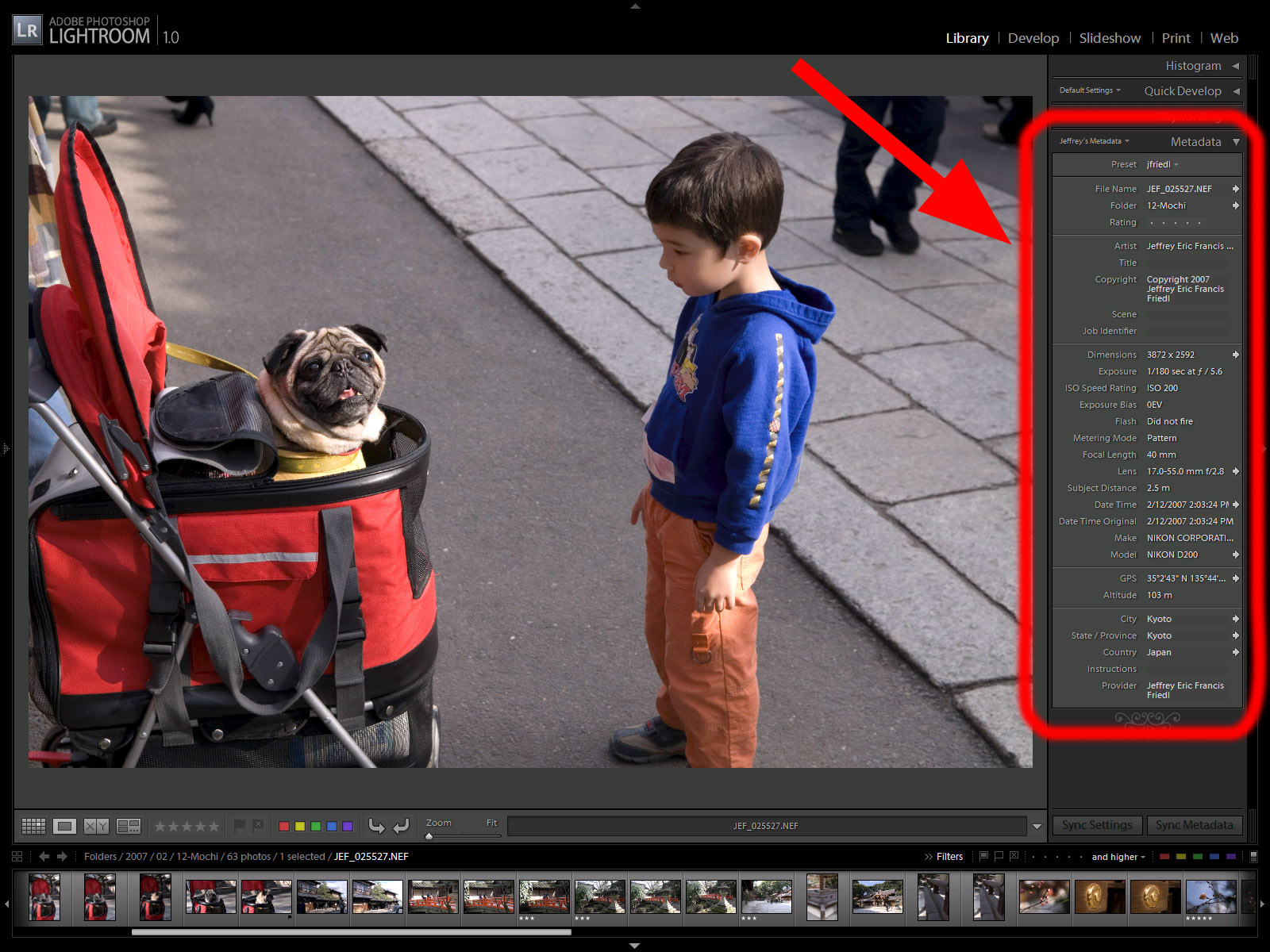
Embedded metadata is another area to watch. Many digital cameras embed information into the image file relating to camera, shutter speed, lens, and time and date. If you look at the most recent versions, what the privacy types call PII (personally identifiable information) also shows up: latitude and longitude of the location, the photographer's name (handy for claiming artistic royalties), and other information that is not obvious when looking at the image. Various generations of Microsoft Word embedded sometimes embarrassing information relating to authorship, editorial changes, and the like: more than one consulting firm has been caught repurposing a proposal (or deliverable) when hidden layers of information told their tale.
As more bits are generated and stored in networked contexts, we will see a reinvention of the public record; just this week a D.C. circuit court judge ordered the White House to stop deleting e-mails, given that 5 million are alleged to be missing. At the level of less prominent individuals, we will see extremes from privacy fanatics that try to commit as little as possible to digital media, all the way to Microsoft researcher Gordon Bell, who is attempting to digitize his entire life, from birth certificate forward, the last few years in real time. (Here's a New Yorker story on Bell.) How the rest of us sort out the middle will be unpredictable.
7) The Human Peripheral
Traditionally, people connected to the computer through punch tapes or cards, keyboards, and screens. That list is getting longer, quickly.
-Haptics
It's been five years already since Cambridge and MIT researchers shook hands across the Atlantic. Haptic (3-D touch-based) interfaces are entering the mass market, most visibly via the Nintendo Wii, which is outselling conventional game consoles from Sony and Microsoft.
-Thought
The Audeo system processes human intentional thought and converts it to speech. That is, it acts on "I want to say 'hello'" rather than broadcasting one's daydreams.
-Electrodermal
Vyro has developed a Bluetooth device about the size of a gum eraser. It measures stress through sweat gland activity in the skin, so one application is a clever game in which two players race their cars on a Bluetooth phone, the winner being the one who's more relaxed.
-New screens
Organic Light Emitting Diode (OLED) technology is coming to market soon, in Sony televisions for instance. Compared to LCD, OLED is brighter, more power efficient, and thinner - but it reacts badly to water. E-ink and other flexible displays are making similar progress.
-Devices
While Microsoft's SPOT technology has not made much of an impact, datacasting is still viable. Ambient Devices make products that convey information at a glance. Those who have been to Boston know that the Prudential building's spire tells the weather: steady blue for clear, blinking red for rain. Ambient's Orb conveys weather, stock market performance, and other complex information by its color, and there's an energy monitor that tracks the price of electricity, weather forecast, and other information relevant to deciding whether or not to run the dryer or air conditioner.
8) Education
Officially, we now live in a services economy: at the global level, the switchover from agriculture happened only last year, which means that at scale, manufacturing was never earth's dominant economic activity. Education systems everywhere are struggling to adapt to digitization, to services, and to new demographic realities. In the U.S. for example, in 2050 there will be a huge blip of elderly women who are now just finishing childbearing. Who will support them, what will they do for both economic and other rewards, and how will they learn to do those things? In the developing world, projected demographic pyramids are even more striking as life expectancy changes dramatically in just a few decades.
How do schools prepare young people for jobs and organizational designs that have yet to be invented? To take two current examples, where did today's generation of sushi chefs and yoga teachers get their training? Where will robot mechanics, Internet addiction counselors, and Chinese lawyers get started? Getting computers (possibly through One Laptop Per Child or Project Inkwell) to the masses will start a process but by no means finish it.
As online course delivery ramps up, questions arise about architecture: what should a virtually-enabled classroom look like? Where should schools be built, particularly in developing environments? What should they look like? What is the role and function of a public library in a world in which the place of print is in major upheaval?
9) {Your Theme Here}
As blogging, social networking, and user-generated content proliferate, we're seeing one manifestation of a larger trend toward delegitimization of received cultural authority. Doctors are learning how to respond to patients with volumes of research, expert and folk opinion, and a desire to dictate rather receive treatment. Instead of trusting politicians, professional reviewers, or commercial spokespeople, many people across the world are putting trust in each other's opinions: Zagat is a great example of formal ratings systems being challenged by masses of uncredentialed, anonymous diners. Zagat also raises the issue of when crowds can be "wise," cannot possibly be "wise," or generally do not matter one way or the other.
Information markets hold great potential, but like real markets, suffer from bubbles, information asymmetry, and other externalities. Nevertheless, such exemplars as Hollywood Stock Exchange (now owned by financial information giant Cantor Fitzgerald), the Iowa Stock Market, and startups like Fluid Innovation are leading the way toward wider implementation. At the same time, we've seen markets process information for a long time: when the NBA addressed its betting referee, the situation highlighted the secrecy with which the league assigns refs to games. Referees are prohibited from telling anyone but immediate family about travel plans, because the Las Vegas point spread moves if the reffing crews are revealed ahead of game time. That point spread is a highly nuanced information artifact of a market compensating for new information.
So-called crowdsourcing will bear watching. Gracenote, the service that lists a CD's track names when you load them into iTunes, began with volunteer labor. What would happen with Wikipedia if Jimmy Wales followed Gracenote's history and monetized all of the volunteer labor? Another new business, Satisfaction applies crowdsourcing to customer service issues. As Google moves away from the idiot-proof search bar into applications, who delivers tech support? Two Google employees currently answer queries at Satisfaction, but it remains unclear who pays whom for what in various tiers of service, who's liable for the consequences of advice, and how might the system be gamed.
Clay Shirky has suggested that flame wars are essentially inevitable outcomes, rather than side effects, of social software. Many blogs have comments turned off because of abuse that imply takes too long to monitor and manage. Given that more people will be in contact with more people in new ways, how will new rules of behavior take shape? Will the lack of interpersonal civility (exemplified in the golden age of the ad hominem attack, offline and on-) evolve? If so, in which direction?
10) Silicon Emotion
People are interacting with other people with multiple layers of computing and communications in between. The nature of emotional expression is changing as a result.
-Dancing alone
What does it mean when tens of millions of music lovers listen in isolation, through headphones, rather than in rooms, or concert halls?
-Friend-nodes
Back when the average MySpace user had 347 "friends," what did that really mean? Might Facebook, which has suffered in the eyes of some users from its retreat from exclusivity, be surpassed by a Ning or other network with express provision of firewalls between sub-communities?
-Inhibition deficiency
In addition to flaming, people will say things electronically they would be much more
hesitant to articulate verbally. Watching teenagers IM each other fluently and unabashedly, then stand with each other awkwardly after school, is a fascinating exercise. In the Nordics, the second-most prevalent use of text messaging (after coordination), is "grooming" - flirting.
-Robot love
The Roomba has inspired tremendous affection in its brief lifetime. (See the fascinating paper by Ja-Young Sung, Lan Guo, Rebecca E. Grinter, and Henrik I. Christensen, all of Georgia Tech, entitled "'My Roomba is a Rambo': Intimate Home Appliances" for compelling evidence on this point.) Sony's Aibo dog and Honda's Asimo can trigger similarly rich emotional responses in some people. iRobot, the Roomba folks, recently introduced a beta version of ConnectR, a "virtual visiting robot" projected to sell for $499. According to the website,
"Combining the latest in Internet communications and robot technology, ConnectR lets you virtually visit with loved ones, relatives and pets anytime you wish – seeing, hearing and interacting with them in their home as if you were there in person."
I can't imagine that this kind of technology will do anything but surprise people with its unintended consequences.
***
One final word: ten years is probably too long a time horizon for some of these areas, but institutional change, in education for instance, is always the slow part that will balance out some of the blink-of-an-eye things we’re about to witness.
Wednesday, October 24, 2007
October 2007 Early Indications II: Ten big technology-related busts in the past ten years
Earlier this month we marked ten years of this newsletter's publication by noting ten developments that quickly permeated the market after being nonexistent or invisible in 1997. This time out, I'll list ten big failures that at one time or another looked like can't-miss propositions.
1) Online grocery
Grocery is a notoriously tough retail category, with thin margins, fickle and price-sensitive customers, and perishable inventory. At the same time, it's an enormous market -- absolutely everybody eats -- so in the late 1990s, the perceived invincibility of online grocery made for failure of dramatic proportions. Webvan combined aggressive expansion, a long leash from investors, and questionable management to create an $800 million sinkhole. The firm was operating in Chicago, Los Angeles and Orange County, Portland, San Diego, San Francisco, and Seattle at the time of its demise, and many customers were disappointed at the loss of a convenient, time-saving service, particularly after Webvan undid many of the successes of the HomeGrocer chain it acquired. The customer base remains tantalizing, particularly as commutes grow longer and free time shrinks, but the logistics of automating picking out a cart-load of groceries from among 200,000+ SKUs, some fresh, makes this a daunting entrepreneurial challenge.
2) AOL and Excite@Home
For a time, AOL ruled the world of dial-up Internet access. Its carpet-bombed floppy disks (later CDs) helped introduce millions of Americans to the Internet, or at least an isotope thereof. It combined access with content (in some measure, in the form of other people) to reach an astonishing price/earnings ratio of 700. But when broadband delivered by incumbent telcos and cable companies split AOL's access from its content, the supposed synergy broke down and the bubble burst.
Beginning slightly later than AOL, the Excite search engine (like Yahoo and Google, a Stanford creation) was bought by the @Home broadband startup in hopes of another content+pipes goldrush. The merger was a disaster: $7 billion of market capitalization vaporized. Cox, TCI/AT&T, Comcast and the other cable companies who owned physical plant and had operational responsibilities, were ill matched with the Silicon Valley engineering culture that emphasized features and glamour over reliability and customer service. That Kleiner Perkins owned stakes in both @Home and Excite compounded the enthusiasm for a rush to synergy, but the operational realities of rebuilding physical infrastructure, combined with the regulatory scrutiny drawn by @Home's proprietary relationships with one of several competing portals, meant that the cultural and leadership issues helped precipitate a train wreck of epic proportions in 2001.
(On AOL, see Kara Swisher, There Must Be a Pony in Here Somewhere (2004); on Excite/@Home, see Frank Rose, "The $7 Billion Delusion")
3) Iridium
Motorola was a major shareholder in and primary supplier to this satellite telephony venture. After its 1997 IPO, Iridium faced loan covenants that required it to sign up 213,000 customers soon after it began offering service in 1999. When only about 10% of that number materialized, Iridium filed for bankruptcy: $5 billion in assets was liquidated for $25 million, and only last month Motorola -- itself Iridium's largest creditor, to the tune of $2 billion -- appeared to have escaped further liability with a court ruling in New York. The service was never aimed at a mass market, with phones costing $3,000 and calls $7 per minute. Coverage was good in open oceans and deserts, but not in moving cars or cities -- and the handset, while technically sophisticated, was big, heavy, and sported an antenna "the size of a toothbrush," in the words of the Wall Street Journal. Satellites, meanwhile, have been similarly costly to rival radio providers XM and Sirius, which between them have accumulated historic losses of $8 billion and are now trying to merge.
4) Super Audio Compact Disc/DVD-Audio
Roughly 20 years after the launch of the compact disc audio format, which itself came about 35 years after the introduction of the LP record, the entertainment industry brought out competing high-resolution optical disc formats for audio. Sony and Philips introduced SACD in 2000, while the DVD Forum, led by Panasonic and Toshiba, brought out DVD-A at about the same time. Audio quality is much higher than CD from both formats, but market confusion has been a major limiting factor. Customers of a certain age who already had to buy music collections twice over were reluctant to commit to one of two competing formats, and while hybrid players now support multi-channel audio playback from either source, software is not widely available: artists and labels had to bet on one standard or the other, and the slow market penetration has resulted in relatively few, and expensive, titles being available. The format war coincided with the explosion of digital file sharing (hence strict and cumbersome copy protection schemes for both SACD and DVD-A), and customers have widely defected to portable, lower fidelity media such as MP3 files. The net result is that both high-resolution audio formats are essentially irrelevant, and the DVD standard itself is in the early stages of a similar format fight, with potentially similar results.
5) Quokka Sports
Rereading ten years of Early Indications and its predecessors, I was struck by how amazed I was by three or four software demos. One was Keyhole, the technology that became Google Earth after the company was acquired. Another was Quokka, which was devoted to delivering data-rich sports coverage over the web. From its origins in Australia, Quokka began with immersive feeds of long sailing races such as Sydney-Hobart: data relating to biometrics, meteorology, speed, absolute and relative position, and participant narratives made for engrossing viewing. Quokka bought the Internet rights to the Sydney Olympics in 2000 after moving to San Francisco, but the lack of a viable advertising model combined with common dot-com management failures to force a shutdown in April 2001.
Partnerships with NBC and Major League Baseball, along with further Olympic rights, cost money but failed to deliver returns. In retrospect, Quokka was probably better aligned with low-viewership sports like sailing and mountain-climbing that could find Webcast niches than with big-audience events with established television techniques and politics. Sports remains unevenly instrumented: NASCAR races are data-rich, but the single biggest predictor of a pass play's success on a football field -- how long the quarterback holds the ball -- is not recorded. Baseball, meanwhile, has generated hugely popular online fantasy leagues, with football following suit, in ad-supported models of which the Aussies could only dream.
6) OpenFund
If open-source works for software, why not try the model elsewhere? MetaMarkets, founded by two veterans from Barclays Global Investors, launched in August 1999 on the basis of full transparency as fund managers disclosed every trade, often with commentary. The fund started fast out of the gate: at year-end 1999, it was up 91% (by comparison, the NASDAQ was up nearly 50% in the same period). The fund fell 42% in 2000, and dropped another 26% between January and August 2001, when it shut down. In part, the fund was a victim of small scale: whereas most mutual funds need to run at least $100 million in assets for viability, OpenFund was at about $10 million when it was liquidated. Both management and critics compared OpenFund to a finance chatroom with real money: a Morningstar analyst noted after the fund's demise that "the entertainment, the gimmick, doesn't really have anything to do with investing." This sounds plausible: if my money is in free fall, I'm not sure chatting with the fund managers is going to help either my mood or the fund's performance.
7) General-purpose Speech Recognition
Ever since at least 1997, Bill Gates has been predicting that speech recognition will be an integral aspect of the PC experience. In his 5-to-10-year timeframe, it never happened, but not for lack of trying: Dragon Systems, headquartered in the U.S., was losing money selling speech recognition software before it was bought by Belgian competitor Lernout & Hauspie in the spring of 2000, just after L&H paid $1 billion for Dictaphone. The Dragon founders, however, had the misfortune of watching their company go into reorganization after accounting irregularities made the L&H stock worthless. Revelations of fictitious transactions in Korea and over-stated earnings elsewhere eventually sent the L&H founders as well as CEO Gaston Bastiaens (an industry veteran who helped launch the compact disc at Philips and later worked on the Apple Newton) into criminal proceedings that remain ongoing six years later: before Enron, Lernout & Hauspie was the archetype of corporate scandal. ScanSoft, which made optical character recognition products, bought the assets, but even now, neither Nuance (as ScanSoft renamed itself) nor Microsoft has made speech interfaces work for general-purpose computing. In vertical domains, however, speech interfaces -- particularly telephonic customer service and medical transcription -- are working well.
8) Digital Appliances
From high-profile efforts at Oracle (the NC) and Sun (JavaStation) to consumer efforts from the likes of Uniden, the late 1990s witnessed a variety of efforts to displace the personal computer with a network-intensive, easy-to-use, easy-to-manage device. The ideal of plugging a device into the Internet without need for hard-disk-resident applications or storage was motivated by a variety of factors, but ten years on, the vision has yet to catch on. For one thing, wireless devices allow much of the NC's functionality to be experienced on the go (cf. the Blackberry). Terminals and emulators never left the list of enterprise alternatives, as Citrix-based Windows systems illustrate: the PC remains a flexible platform that can be configured into diskless, mobile, or other alternatives. The relentless improvement in PC performance, particularly from 1990 until 2002 or so, made the PC's price-to-performance ratio continually appealing, until processing began to outstrip most of the application stack's needs. Finally, the lack of true broadband, until recently, made the devices slow in many environments.
9) Business-to-Business Exchanges
Talk about a shakeout: from 1520 exchanges in 2001, only about 10% were still active only two years later. VerticalNet, one of the first B2B exchanges, had 1700 employees and a $10 billion market capitalization at its peak; shortly afterward the CEO was faced with keeping 50 people on the payroll, using about $11 million that remained in the bank. Covisint, designed to make automobiles parts-buying more efficient, had a similar fate. That both survive today, albeit operating at minute fractions of their projected volumes, illustrates that while business-to-business commerce is huge, it is also difficult to reinvent.
Sellers stayed on the sideline as auction models presented the specter of purely price-based competition. Buyers, while wanting the price leverage, also realized that a) customer service and relationships matter and b) that bankrupt suppliers (as in the auto industry) are not in the buyers' long-term interest. Many exchange providers turned into merchants of purchasing efficiency inside the firewall, relying more on software and process expertise than on convening power. Running a market is also not necessarily attractive: as this newsletter noted in April 2000, in 1998 the New York Stock Exchange only made $101 million on 169 billion trades totaling $7.3 trillion.
10) Business Models Based on "Free"
At one time, at least two dozen Internet Service Providers offered free connections, usually over dialup. Free-PC was one of multiple attempts to get consumers to watch ads in return for hardware. Netscape famously gave away browsers to sell server software, a strategy that backfired for a number of reasons, one of which was Microsoft's anti-competitive behavior with Internet Explorer. Stocks in VA Linux, a company with real hardware sales but ample "free" hype, rose from $30 to $320 on December 9, 1999, the first day of trading, but later fell to 54 cents in July 2002.
More recently, eBay has encountered major difficulty making Skype pay off; Sunrocket and other VoIP providers are either shuttered or weathering tough times. There are also many businesses that have been collateral damage in free scenarios, some of them illegal or otherwise of dubious ethical standing. Music companies that have been slow to respond to file-sharing with appealing alternatives are the most visible of these. Even so, it has been repeatedly proven that you can in fact "compete with free" and in fact usually win.
1) Online grocery
Grocery is a notoriously tough retail category, with thin margins, fickle and price-sensitive customers, and perishable inventory. At the same time, it's an enormous market -- absolutely everybody eats -- so in the late 1990s, the perceived invincibility of online grocery made for failure of dramatic proportions. Webvan combined aggressive expansion, a long leash from investors, and questionable management to create an $800 million sinkhole. The firm was operating in Chicago, Los Angeles and Orange County, Portland, San Diego, San Francisco, and Seattle at the time of its demise, and many customers were disappointed at the loss of a convenient, time-saving service, particularly after Webvan undid many of the successes of the HomeGrocer chain it acquired. The customer base remains tantalizing, particularly as commutes grow longer and free time shrinks, but the logistics of automating picking out a cart-load of groceries from among 200,000+ SKUs, some fresh, makes this a daunting entrepreneurial challenge.
2) AOL and Excite@Home
For a time, AOL ruled the world of dial-up Internet access. Its carpet-bombed floppy disks (later CDs) helped introduce millions of Americans to the Internet, or at least an isotope thereof. It combined access with content (in some measure, in the form of other people) to reach an astonishing price/earnings ratio of 700. But when broadband delivered by incumbent telcos and cable companies split AOL's access from its content, the supposed synergy broke down and the bubble burst.
Beginning slightly later than AOL, the Excite search engine (like Yahoo and Google, a Stanford creation) was bought by the @Home broadband startup in hopes of another content+pipes goldrush. The merger was a disaster: $7 billion of market capitalization vaporized. Cox, TCI/AT&T, Comcast and the other cable companies who owned physical plant and had operational responsibilities, were ill matched with the Silicon Valley engineering culture that emphasized features and glamour over reliability and customer service. That Kleiner Perkins owned stakes in both @Home and Excite compounded the enthusiasm for a rush to synergy, but the operational realities of rebuilding physical infrastructure, combined with the regulatory scrutiny drawn by @Home's proprietary relationships with one of several competing portals, meant that the cultural and leadership issues helped precipitate a train wreck of epic proportions in 2001.
(On AOL, see Kara Swisher, There Must Be a Pony in Here Somewhere (2004); on Excite/@Home, see Frank Rose, "The $7 Billion Delusion")
3) Iridium
Motorola was a major shareholder in and primary supplier to this satellite telephony venture. After its 1997 IPO, Iridium faced loan covenants that required it to sign up 213,000 customers soon after it began offering service in 1999. When only about 10% of that number materialized, Iridium filed for bankruptcy: $5 billion in assets was liquidated for $25 million, and only last month Motorola -- itself Iridium's largest creditor, to the tune of $2 billion -- appeared to have escaped further liability with a court ruling in New York. The service was never aimed at a mass market, with phones costing $3,000 and calls $7 per minute. Coverage was good in open oceans and deserts, but not in moving cars or cities -- and the handset, while technically sophisticated, was big, heavy, and sported an antenna "the size of a toothbrush," in the words of the Wall Street Journal. Satellites, meanwhile, have been similarly costly to rival radio providers XM and Sirius, which between them have accumulated historic losses of $8 billion and are now trying to merge.
4) Super Audio Compact Disc/DVD-Audio
Roughly 20 years after the launch of the compact disc audio format, which itself came about 35 years after the introduction of the LP record, the entertainment industry brought out competing high-resolution optical disc formats for audio. Sony and Philips introduced SACD in 2000, while the DVD Forum, led by Panasonic and Toshiba, brought out DVD-A at about the same time. Audio quality is much higher than CD from both formats, but market confusion has been a major limiting factor. Customers of a certain age who already had to buy music collections twice over were reluctant to commit to one of two competing formats, and while hybrid players now support multi-channel audio playback from either source, software is not widely available: artists and labels had to bet on one standard or the other, and the slow market penetration has resulted in relatively few, and expensive, titles being available. The format war coincided with the explosion of digital file sharing (hence strict and cumbersome copy protection schemes for both SACD and DVD-A), and customers have widely defected to portable, lower fidelity media such as MP3 files. The net result is that both high-resolution audio formats are essentially irrelevant, and the DVD standard itself is in the early stages of a similar format fight, with potentially similar results.
5) Quokka Sports
Rereading ten years of Early Indications and its predecessors, I was struck by how amazed I was by three or four software demos. One was Keyhole, the technology that became Google Earth after the company was acquired. Another was Quokka, which was devoted to delivering data-rich sports coverage over the web. From its origins in Australia, Quokka began with immersive feeds of long sailing races such as Sydney-Hobart: data relating to biometrics, meteorology, speed, absolute and relative position, and participant narratives made for engrossing viewing. Quokka bought the Internet rights to the Sydney Olympics in 2000 after moving to San Francisco, but the lack of a viable advertising model combined with common dot-com management failures to force a shutdown in April 2001.
Partnerships with NBC and Major League Baseball, along with further Olympic rights, cost money but failed to deliver returns. In retrospect, Quokka was probably better aligned with low-viewership sports like sailing and mountain-climbing that could find Webcast niches than with big-audience events with established television techniques and politics. Sports remains unevenly instrumented: NASCAR races are data-rich, but the single biggest predictor of a pass play's success on a football field -- how long the quarterback holds the ball -- is not recorded. Baseball, meanwhile, has generated hugely popular online fantasy leagues, with football following suit, in ad-supported models of which the Aussies could only dream.
6) OpenFund
If open-source works for software, why not try the model elsewhere? MetaMarkets, founded by two veterans from Barclays Global Investors, launched in August 1999 on the basis of full transparency as fund managers disclosed every trade, often with commentary. The fund started fast out of the gate: at year-end 1999, it was up 91% (by comparison, the NASDAQ was up nearly 50% in the same period). The fund fell 42% in 2000, and dropped another 26% between January and August 2001, when it shut down. In part, the fund was a victim of small scale: whereas most mutual funds need to run at least $100 million in assets for viability, OpenFund was at about $10 million when it was liquidated. Both management and critics compared OpenFund to a finance chatroom with real money: a Morningstar analyst noted after the fund's demise that "the entertainment, the gimmick, doesn't really have anything to do with investing." This sounds plausible: if my money is in free fall, I'm not sure chatting with the fund managers is going to help either my mood or the fund's performance.
7) General-purpose Speech Recognition
Ever since at least 1997, Bill Gates has been predicting that speech recognition will be an integral aspect of the PC experience. In his 5-to-10-year timeframe, it never happened, but not for lack of trying: Dragon Systems, headquartered in the U.S., was losing money selling speech recognition software before it was bought by Belgian competitor Lernout & Hauspie in the spring of 2000, just after L&H paid $1 billion for Dictaphone. The Dragon founders, however, had the misfortune of watching their company go into reorganization after accounting irregularities made the L&H stock worthless. Revelations of fictitious transactions in Korea and over-stated earnings elsewhere eventually sent the L&H founders as well as CEO Gaston Bastiaens (an industry veteran who helped launch the compact disc at Philips and later worked on the Apple Newton) into criminal proceedings that remain ongoing six years later: before Enron, Lernout & Hauspie was the archetype of corporate scandal. ScanSoft, which made optical character recognition products, bought the assets, but even now, neither Nuance (as ScanSoft renamed itself) nor Microsoft has made speech interfaces work for general-purpose computing. In vertical domains, however, speech interfaces -- particularly telephonic customer service and medical transcription -- are working well.
8) Digital Appliances
From high-profile efforts at Oracle (the NC) and Sun (JavaStation) to consumer efforts from the likes of Uniden, the late 1990s witnessed a variety of efforts to displace the personal computer with a network-intensive, easy-to-use, easy-to-manage device. The ideal of plugging a device into the Internet without need for hard-disk-resident applications or storage was motivated by a variety of factors, but ten years on, the vision has yet to catch on. For one thing, wireless devices allow much of the NC's functionality to be experienced on the go (cf. the Blackberry). Terminals and emulators never left the list of enterprise alternatives, as Citrix-based Windows systems illustrate: the PC remains a flexible platform that can be configured into diskless, mobile, or other alternatives. The relentless improvement in PC performance, particularly from 1990 until 2002 or so, made the PC's price-to-performance ratio continually appealing, until processing began to outstrip most of the application stack's needs. Finally, the lack of true broadband, until recently, made the devices slow in many environments.
9) Business-to-Business Exchanges
Talk about a shakeout: from 1520 exchanges in 2001, only about 10% were still active only two years later. VerticalNet, one of the first B2B exchanges, had 1700 employees and a $10 billion market capitalization at its peak; shortly afterward the CEO was faced with keeping 50 people on the payroll, using about $11 million that remained in the bank. Covisint, designed to make automobiles parts-buying more efficient, had a similar fate. That both survive today, albeit operating at minute fractions of their projected volumes, illustrates that while business-to-business commerce is huge, it is also difficult to reinvent.
Sellers stayed on the sideline as auction models presented the specter of purely price-based competition. Buyers, while wanting the price leverage, also realized that a) customer service and relationships matter and b) that bankrupt suppliers (as in the auto industry) are not in the buyers' long-term interest. Many exchange providers turned into merchants of purchasing efficiency inside the firewall, relying more on software and process expertise than on convening power. Running a market is also not necessarily attractive: as this newsletter noted in April 2000, in 1998 the New York Stock Exchange only made $101 million on 169 billion trades totaling $7.3 trillion.
10) Business Models Based on "Free"
At one time, at least two dozen Internet Service Providers offered free connections, usually over dialup. Free-PC was one of multiple attempts to get consumers to watch ads in return for hardware. Netscape famously gave away browsers to sell server software, a strategy that backfired for a number of reasons, one of which was Microsoft's anti-competitive behavior with Internet Explorer. Stocks in VA Linux, a company with real hardware sales but ample "free" hype, rose from $30 to $320 on December 9, 1999, the first day of trading, but later fell to 54 cents in July 2002.
More recently, eBay has encountered major difficulty making Skype pay off; Sunrocket and other VoIP providers are either shuttered or weathering tough times. There are also many businesses that have been collateral damage in free scenarios, some of them illegal or otherwise of dubious ethical standing. Music companies that have been slow to respond to file-sharing with appealing alternatives are the most visible of these. Even so, it has been repeatedly proven that you can in fact "compete with free" and in fact usually win.
Sunday, October 21, 2007
Early Indications October 2007 issue 1: 10th Anniversary Breakthroughs
In October 1997, the Ernst & Young Center for Business Innovation in Cambridge, Mass had just hosted its first meeting of a corporate consortium investigating emerging directions in e-commerce. Since that time, the newsletter that initially was called "Networked Commerce Update" and then "Early Indications" has appeared monthly. It has attempted to spot trends, situate developments in broader contexts, and share some of my excitement and occasional dismay over the state of information technology and the many uses thereof.
This month, we'll look at ten developments that, while feeling routine today, still lay in the future only ten years ago. We'll also review ten can't-miss technology stories that somehow went bad. Next month, look for a list of ten trends for the next ten years.
First of all, however, it's important to thank some of the many people who have helped make this ten-year run possible. Jamie Taylor, since before issue 1, and John Parkinson since soon thereafter have served as my go-to technical tutors. Christina Winquist and Dan Stevens from Capgemini, along with the ever-helpful John Parkinson, helped fill in the gaps in my archive as I reread the entire run this summer. My former assistant Lesley Livingstone helped assemble an earlier archive and kept the issues of that era carefully posted; Heather Weikel, my current assistant, is doing those jobs now. My Capgemini research colleagues, particularly Tim Simcoe (now a professor at the University of Toronto), Geoff Cohen, and Karina Funk, guest-wrote columns, tracked down obscure but valuable facts, and saved me from errors of many sorts. Andy Mulholland, Lanny Cohen, Stew Bloom, and John Parkinson delivered executive air cover, market observations, and sage advice. Finally, Lawrence Baxter has been the most visible of a very small number of readers who have been on the list from issue 1, but thanks go, in the end, to the many readers around the world who have found the newsletter useful, told their colleagues, and kept me honest.
And now to the list: Ten breakthroughs that have become mainstream since 1997, in no implied order, and not of equal magnitude.
1) Distributed infrastructure
The power of the personal computer and its associated hardware has given millions of individuals and small businesses the ability to perform tasks that not long ago required technical skills and expensive capital goods. The list of newly technically sophisticated establishments is getting longer every year. Initially, compact disks could be broken apart and recombined, much like mix tapes but at higher quality, so CD pressing plants were supplemented: some record chains in 2001 estimated they sold one recordable blank CD for every four music titles. At the same time, prices for audio and video production facilities are now falling from hundreds of thousands of dollars into the nearly free category: last week I bought Apple's iLife software, which includes a reasonably powerful video editing and DVD authoring platform, for $39 at academic discount. Millions of YouTube videos are being made outside a/v production houses. Whether with travel agencies with their formerly prized ticket printers, recording studios, photo labs, or printing of various kinds, the capital base is becoming lighter and cheaper. Capabilities are being distributed at the edge of the network rather than consolidating as they used to. In short, if someone wants to make a demo (or production) music disk, produce a TV commercial (Heinz recently asked for exactly this, paying over $50,000 to a context winner), manipulate a color image, print a book, broadcast an editorial, print a boarding pass, or create an animated short, he or she can likely find an inexpensive desktop production environment.
2) Offshoring
In 1997, the Year 2000 bug was beginning to be addressed. As volumes of code rewrites climbed, several firms discovered the excellent quality and low prices offered by Indian firms in particular. After the turn of the century, several astute businesspeople began repositioning the offshore firms from code remediators to code writers, architects, and business process outsourcers. At the same time, India's heritage of English-language education helped drive call center business in much the same way. By 2005, it was impossible to find any sizeable services company or software company that had not moved aggressively into India. The industry will never be the same: whether the low-cost producer of the moment is the Philippines, China, Vietnam, Estonia, Portugal, or someplace else, services-labor arbitrage, made possible in large measure by the Internet and voice over IP, has become perhaps the dominant factor in tech-sector economics.
3) Always-on People
The phrase is Chris Shipley's, but the phenomenon is widely observed: countless newspaper articles have focused on the etiquette of checking your mobile message device away from the office, whether at home (one guy ducked into his closet), out socializing, or in business meetings. That the RIM device is so often called the "Crackberry" gives some sense of the addictiveness in play, but the phenomenon is as broad as it is intense: in April of this year, Rim broke the 8 million subscriber barrier, and millions of GSM phones allow their owners to maintain seamless global connectivity. In 1997, by contrast, text pagers were in their earliest stages, only plumbers and doctors had beepers, and world phones were strictly a niche luxury. Now, whole negotiations are carried out in motion, with little regard for time or place. For millions of managers, the notion of being “out of the office” is almost quaint, and the blurring of work and personal time is less clear than ever before.
4) Architectures of Participation
The phase is, I believe, Tim O'Reilly's. The Internet has allowed entirely new kinds of social groups to identify themselves, assemble, mobilize, and persist. Whether it's Linux and the associated Internet infrastructure tools and environments, Wikipedia, the social networking businesses, or user feedback currencies at Craigslist, eBay, or Amazon, we are seeing the voices of identifiable individuals connected to much larger assemblages to build fashion, trust, and, sometimes, insight. In addition, one in four eligible Americans (and many ineligible Americans as well) uses an online dating service, of which there are now over 1,000. According to one measure, the average MySpace account-holder had 347 "friends," which begs the question of what indeed a friend is as opposed to an acknowledged network contact. In such settings, opting out is known as "Facebook suicide," suggesting that we are also witnessing the emergence of new architectures of exclusion.
5) The Telephonic Inversion
Despite (or perhaps because of) being some of the oldest tech firms on earth, telecommunications companies have had a tumultuous decade. Customers are defecting from landline service at staggering rates: according to the Telecommunications Industry Association, U.S. landline subscriptions declined by over 20 million in the five years to 2005, and perhaps another 10 million since then. But 2005 was the year U.S. wireless subscriptions surpassed wireline -- and on the global scale, this is pretty late. Technical developments such as dense wave division multiplexing made infrastructure investments in fiber optics stretch farther, and new revenue sources -- particularly texting and ringtones -- helped offset the wireline decline. Any way you slice it, however, the telecom business model of 2007 is upside down from what it was a decade ago as mobility surpasses fixed connections, data traffic outpaces analog (goodbye fax machines), and perhaps the most troubling competitor -- Skype and its 200 million users of nearly free international calling -- is itself a major headache to eBay, which has yet to monetize its original $2.6 billion investment.
6) The Digital Home
According to the U.S. Consumer Electronics Association, DVD players went from zero in March of 1997 to 132 million a decade later, in roughly 100 million households. Broadband penetration (using an admittedly generous definition of the term) went from zero to 84% of connecting U.S. households in that same period. HDTV penetration is currently between 25% (2006) and will hit an estimated 50% in 2008. Five years after launching, iPods can be found in one in five US households. Digital video recorders, which hadn't been invented in 1997, are estimated by Jupiter to be in one third of US homes by sometime next year. Digital cameras were estimated to reach 70% market penetration in 2007 by IDC. Roughly 10% of U.S. households have a wireless data network. Taken together, the uptake of all these new technologies represents a wholesale reinvention of the entertainment platform in just a few years.
7) Search
Remember Lycos? It began as a research project at Carnegie Mellon in 1994, went through an IPO in 1997, and was sold in 2000 to the Terra Networks arm of Spanish Telefonica phone company for $5.4 billion. Four years later, Terra sold Lycos to the Korean Daum Communications firm for $95 million - less than 1% of the purchase price. What about Altavista? Originally a research project inside Digital Equipment, it was for a moment the troubled company's most powerful brand, making it logical to extend the search engine's name to . . . firewalls and other products. After DEC was sold to Compaq, CMGI (remember them?) bought Altavista for $2.3 billion. AltaVista was subsequently sold to Overture, and then Overture was bought by Yahoo. Prime mover Louis Monier remains a force in the industry, recently having left eBay to join Google.
The rapid grown in the scale of the web presented new challenges to the search companies, making Google's page rank and related algorithms particularly valuable: rather than focusing on text-matching, Mssrs. Page and Brin looked at the structure of networked documents, cracking the problem in an elegant and, from a subsequent advertising-centric perspective, extremely profitable form. In the meantime, advancements in image, geospatial, video, and domain-specific search continue to advance both the state of the art and the potential for new business models.
8) Mapping
In 1996, GM introduced the OnStar navigation and assistance service in high-end models. The division has yet to drive significant revenues for the parent company, but there's no question that GPS and related technologies have exploded in the intervening decade. The widespread use of Google Earth in television is one indicator of the underlying trend, as is the fact that the top two sites ranked by traffic (Yahoo then Google), as well as #4 Microsoft and #13 The Weather Channel rely heavily on interactive mapping. Handheld GPS units are doubling in sales every year, in North America anyway, to an expected total of five million this year. As the technology is integrated into mobile phones, the social networking market is expected to drive far wider adoption. Google's Dodgeball and other capabilities, numerous startups, and the telecom carriers are expected to deliver applications linking "who," "where," and "when." A powerful indication of this tendency came earlier this month when Nokia bought Navteq, the "Intel inside" of many online mapping applications, for $8.1 billion.
9) Peer-to-Peer
It's impossible to envision what the 2007 Internet would look like without peer-to-peer file distribution. While the business model disruption of the music and telecommunications industries has been significant, the sheer volume and velocity of information in motion (much of it admittedly of the copyrighted variety) staggers the imagination. In a recent Siemens patent application, it was claimed that 50 to 80% of all Internet traffic is handled by p2p arrangements. Starting in 1999 with Napster and Gnutella, continuing through Kazaa and BitTorrent, and now through Morpheus, BearShare, Skype, Joost, and dozens of others, it's clear that these services are a permanent part of the landscape.
10) Networked Pestilence
Not all the developments have been improvements. Spam was certainly with us in 1997, entering as it did Oxford English Dictionary in 1998, but the volumes have skyrocketed: according to the IEEE, spam increased 100,000% between 1997 and 2004, but recent trends, including remote enlistment of so-called "zombie" computers, is raising the total to the point where legitimate e-mail could be only 5% of total traffic. Phishing is a newer blight, but potentially more profitable; the potential for identity theft is higher as well. Data breaches have been well cataloged, whether from a local government agency that prints personally identifiable information in directories, to the 47 million names exposed in the break-in through one TJX store's wireless network, to lost data backup tapes, to the infamous (and unencrypted) 26 million records lost on a Veterans Administration laptop.
It's clear that the last ten years have been a time of momentous change, but it's also sobering to see what hasn't happened: we have no cure for AIDS or malaria, commuting times get longer rather than shorter, incarceration is up, bridges and other critical infrastructure are decaying, air travel is in many ways quantitatively and qualitatively worse. Before we look ahead to the next ten years, in the second October letter we'll look at some of the biggest busts of the past decade.
This month, we'll look at ten developments that, while feeling routine today, still lay in the future only ten years ago. We'll also review ten can't-miss technology stories that somehow went bad. Next month, look for a list of ten trends for the next ten years.
First of all, however, it's important to thank some of the many people who have helped make this ten-year run possible. Jamie Taylor, since before issue 1, and John Parkinson since soon thereafter have served as my go-to technical tutors. Christina Winquist and Dan Stevens from Capgemini, along with the ever-helpful John Parkinson, helped fill in the gaps in my archive as I reread the entire run this summer. My former assistant Lesley Livingstone helped assemble an earlier archive and kept the issues of that era carefully posted; Heather Weikel, my current assistant, is doing those jobs now. My Capgemini research colleagues, particularly Tim Simcoe (now a professor at the University of Toronto), Geoff Cohen, and Karina Funk, guest-wrote columns, tracked down obscure but valuable facts, and saved me from errors of many sorts. Andy Mulholland, Lanny Cohen, Stew Bloom, and John Parkinson delivered executive air cover, market observations, and sage advice. Finally, Lawrence Baxter has been the most visible of a very small number of readers who have been on the list from issue 1, but thanks go, in the end, to the many readers around the world who have found the newsletter useful, told their colleagues, and kept me honest.
And now to the list: Ten breakthroughs that have become mainstream since 1997, in no implied order, and not of equal magnitude.
1) Distributed infrastructure
The power of the personal computer and its associated hardware has given millions of individuals and small businesses the ability to perform tasks that not long ago required technical skills and expensive capital goods. The list of newly technically sophisticated establishments is getting longer every year. Initially, compact disks could be broken apart and recombined, much like mix tapes but at higher quality, so CD pressing plants were supplemented: some record chains in 2001 estimated they sold one recordable blank CD for every four music titles. At the same time, prices for audio and video production facilities are now falling from hundreds of thousands of dollars into the nearly free category: last week I bought Apple's iLife software, which includes a reasonably powerful video editing and DVD authoring platform, for $39 at academic discount. Millions of YouTube videos are being made outside a/v production houses. Whether with travel agencies with their formerly prized ticket printers, recording studios, photo labs, or printing of various kinds, the capital base is becoming lighter and cheaper. Capabilities are being distributed at the edge of the network rather than consolidating as they used to. In short, if someone wants to make a demo (or production) music disk, produce a TV commercial (Heinz recently asked for exactly this, paying over $50,000 to a context winner), manipulate a color image, print a book, broadcast an editorial, print a boarding pass, or create an animated short, he or she can likely find an inexpensive desktop production environment.
2) Offshoring
In 1997, the Year 2000 bug was beginning to be addressed. As volumes of code rewrites climbed, several firms discovered the excellent quality and low prices offered by Indian firms in particular. After the turn of the century, several astute businesspeople began repositioning the offshore firms from code remediators to code writers, architects, and business process outsourcers. At the same time, India's heritage of English-language education helped drive call center business in much the same way. By 2005, it was impossible to find any sizeable services company or software company that had not moved aggressively into India. The industry will never be the same: whether the low-cost producer of the moment is the Philippines, China, Vietnam, Estonia, Portugal, or someplace else, services-labor arbitrage, made possible in large measure by the Internet and voice over IP, has become perhaps the dominant factor in tech-sector economics.
3) Always-on People
The phrase is Chris Shipley's, but the phenomenon is widely observed: countless newspaper articles have focused on the etiquette of checking your mobile message device away from the office, whether at home (one guy ducked into his closet), out socializing, or in business meetings. That the RIM device is so often called the "Crackberry" gives some sense of the addictiveness in play, but the phenomenon is as broad as it is intense: in April of this year, Rim broke the 8 million subscriber barrier, and millions of GSM phones allow their owners to maintain seamless global connectivity. In 1997, by contrast, text pagers were in their earliest stages, only plumbers and doctors had beepers, and world phones were strictly a niche luxury. Now, whole negotiations are carried out in motion, with little regard for time or place. For millions of managers, the notion of being “out of the office” is almost quaint, and the blurring of work and personal time is less clear than ever before.
4) Architectures of Participation
The phase is, I believe, Tim O'Reilly's. The Internet has allowed entirely new kinds of social groups to identify themselves, assemble, mobilize, and persist. Whether it's Linux and the associated Internet infrastructure tools and environments, Wikipedia, the social networking businesses, or user feedback currencies at Craigslist, eBay, or Amazon, we are seeing the voices of identifiable individuals connected to much larger assemblages to build fashion, trust, and, sometimes, insight. In addition, one in four eligible Americans (and many ineligible Americans as well) uses an online dating service, of which there are now over 1,000. According to one measure, the average MySpace account-holder had 347 "friends," which begs the question of what indeed a friend is as opposed to an acknowledged network contact. In such settings, opting out is known as "Facebook suicide," suggesting that we are also witnessing the emergence of new architectures of exclusion.
5) The Telephonic Inversion
Despite (or perhaps because of) being some of the oldest tech firms on earth, telecommunications companies have had a tumultuous decade. Customers are defecting from landline service at staggering rates: according to the Telecommunications Industry Association, U.S. landline subscriptions declined by over 20 million in the five years to 2005, and perhaps another 10 million since then. But 2005 was the year U.S. wireless subscriptions surpassed wireline -- and on the global scale, this is pretty late. Technical developments such as dense wave division multiplexing made infrastructure investments in fiber optics stretch farther, and new revenue sources -- particularly texting and ringtones -- helped offset the wireline decline. Any way you slice it, however, the telecom business model of 2007 is upside down from what it was a decade ago as mobility surpasses fixed connections, data traffic outpaces analog (goodbye fax machines), and perhaps the most troubling competitor -- Skype and its 200 million users of nearly free international calling -- is itself a major headache to eBay, which has yet to monetize its original $2.6 billion investment.
6) The Digital Home
According to the U.S. Consumer Electronics Association, DVD players went from zero in March of 1997 to 132 million a decade later, in roughly 100 million households. Broadband penetration (using an admittedly generous definition of the term) went from zero to 84% of connecting U.S. households in that same period. HDTV penetration is currently between 25% (2006) and will hit an estimated 50% in 2008. Five years after launching, iPods can be found in one in five US households. Digital video recorders, which hadn't been invented in 1997, are estimated by Jupiter to be in one third of US homes by sometime next year. Digital cameras were estimated to reach 70% market penetration in 2007 by IDC. Roughly 10% of U.S. households have a wireless data network. Taken together, the uptake of all these new technologies represents a wholesale reinvention of the entertainment platform in just a few years.
7) Search
Remember Lycos? It began as a research project at Carnegie Mellon in 1994, went through an IPO in 1997, and was sold in 2000 to the Terra Networks arm of Spanish Telefonica phone company for $5.4 billion. Four years later, Terra sold Lycos to the Korean Daum Communications firm for $95 million - less than 1% of the purchase price. What about Altavista? Originally a research project inside Digital Equipment, it was for a moment the troubled company's most powerful brand, making it logical to extend the search engine's name to . . . firewalls and other products. After DEC was sold to Compaq, CMGI (remember them?) bought Altavista for $2.3 billion. AltaVista was subsequently sold to Overture, and then Overture was bought by Yahoo. Prime mover Louis Monier remains a force in the industry, recently having left eBay to join Google.
The rapid grown in the scale of the web presented new challenges to the search companies, making Google's page rank and related algorithms particularly valuable: rather than focusing on text-matching, Mssrs. Page and Brin looked at the structure of networked documents, cracking the problem in an elegant and, from a subsequent advertising-centric perspective, extremely profitable form. In the meantime, advancements in image, geospatial, video, and domain-specific search continue to advance both the state of the art and the potential for new business models.
8) Mapping
In 1996, GM introduced the OnStar navigation and assistance service in high-end models. The division has yet to drive significant revenues for the parent company, but there's no question that GPS and related technologies have exploded in the intervening decade. The widespread use of Google Earth in television is one indicator of the underlying trend, as is the fact that the top two sites ranked by traffic (Yahoo then Google), as well as #4 Microsoft and #13 The Weather Channel rely heavily on interactive mapping. Handheld GPS units are doubling in sales every year, in North America anyway, to an expected total of five million this year. As the technology is integrated into mobile phones, the social networking market is expected to drive far wider adoption. Google's Dodgeball and other capabilities, numerous startups, and the telecom carriers are expected to deliver applications linking "who," "where," and "when." A powerful indication of this tendency came earlier this month when Nokia bought Navteq, the "Intel inside" of many online mapping applications, for $8.1 billion.
9) Peer-to-Peer
It's impossible to envision what the 2007 Internet would look like without peer-to-peer file distribution. While the business model disruption of the music and telecommunications industries has been significant, the sheer volume and velocity of information in motion (much of it admittedly of the copyrighted variety) staggers the imagination. In a recent Siemens patent application, it was claimed that 50 to 80% of all Internet traffic is handled by p2p arrangements. Starting in 1999 with Napster and Gnutella, continuing through Kazaa and BitTorrent, and now through Morpheus, BearShare, Skype, Joost, and dozens of others, it's clear that these services are a permanent part of the landscape.
10) Networked Pestilence
Not all the developments have been improvements. Spam was certainly with us in 1997, entering as it did Oxford English Dictionary in 1998, but the volumes have skyrocketed: according to the IEEE, spam increased 100,000% between 1997 and 2004, but recent trends, including remote enlistment of so-called "zombie" computers, is raising the total to the point where legitimate e-mail could be only 5% of total traffic. Phishing is a newer blight, but potentially more profitable; the potential for identity theft is higher as well. Data breaches have been well cataloged, whether from a local government agency that prints personally identifiable information in directories, to the 47 million names exposed in the break-in through one TJX store's wireless network, to lost data backup tapes, to the infamous (and unencrypted) 26 million records lost on a Veterans Administration laptop.
It's clear that the last ten years have been a time of momentous change, but it's also sobering to see what hasn't happened: we have no cure for AIDS or malaria, commuting times get longer rather than shorter, incarceration is up, bridges and other critical infrastructure are decaying, air travel is in many ways quantitatively and qualitatively worse. Before we look ahead to the next ten years, in the second October letter we'll look at some of the biggest busts of the past decade.
Sunday, September 30, 2007
Early Indications September 2007 - Web 2.0 and the Enterprise: Beneath the Surface
As managers of enterprise computing environments confront both perennial and emerging challenges, a new set of technologies is complicating the situation. While so-called web 2.0 was born of such consumer-driven sites as Wikipedia, del.icio.us, YouTube, and various blogs and blog-related efforts, a growing number of observers and participants is arguing for the utility of Web 2.0 principles and tools in workplace computing. At the end of the day, the question is more subtle than it may appear at first glance.
Rather than hedge with the standard "it depends" conclusion, I believe that the various tools will prove to reinforce existing competitive advantages rather than confer new ones. That is, the cultural attributes necessary for successful Web 2.0 behavior are in and of themselves powerful differentiators, and the tools will amplify either the presence or absence of such traits as accountability, openness, receptiveness to change, sensitivity to customer needs and preferences, and the like.
The term and concept of "enterprise 2.0" appear to have originated with Harvard Business School professor Andrew McAfee, most explicitly in a Sloan Management Review article from this past spring. He argues that "the new technologies are significant because they can potentially knit together an enterprise and facilitate knowledge work in ways that were simply not possible previously." (p. 22; citation below) Specifically, McAfee points to search, links, "authoring" (blogs and wikis), tags, "extensions" (algorithmic extrapolation), and "signals" (mostly RSS) as the primary enabling technologies.
On its face, much of the argument seems straightforward and even exciting: having the ability to develop nuggets of business functionality quickly, from the edge of the organization inward, presents a stark contrast to many software development efforts. Being able to identify the right people with relevant skills and knowledge in minutes makes many document-centric "knowledge repositories" feel frustratingly ill-conceived. Assuming that experts on a subject would voluntarily articulate their expertise and create metadata would have been naive only a few years ago.
In the right situation, any of the above behaviors may, in McAfee's word, "emerge" as the result of bottom-up self-organization and effort rather than the mandated top-down kind. But emergence is a very tricky business -- the sciences of understanding its sources, implications, and results are still immature. Let's look at a few complicating factors that could stand between certain flavors of corporate reality and the ideal of enterprise 2.0.
-Of Computation and Communications
Corporate IS organizations have traditionally been responsible for the electronic automation of business tasks and processes: order entry, accounts receivable, warranty service, and more recently customer contact management and new product development. In contrast, web 2.0 technologies don't automate much; they facilitate richer, sometimes better organized and more widely distributed, communications. The first complication comes as IS organizations look at conventional questions that have surrounded application development: what is the ROI, what are the payoff metrics, where is the audit trail, who will manage access and permissions. More simply, issues of control show up almost immediately, as the need to specify goals, metrics, and chains of responsibility encounter notions of wide participation, of distributed authority, and of "shoot first, aim later (if at all)."
-Of Signals and Noise
The core assumptions of web 2.0 -- that users own the content they create, and that said content is of interest to someone else in a long tail of taste and proclivities -- have led to a veritable explosion of original and republished (in a variety of forms) content: whether as a Myspace profile, a YouTube video, a self-published movie review or political rant, or a wiki entry, content is everywhere. The larger problem of editing remains an issue even at "formal" publications, but it's intensified in a workplace where people may not have the same ability to opt out, and who, at 5:00 pm or whenever, really want to go home with more rather than fewer tasks completed. The incessant blurring of personal and work time, and personal and businesses modes of behavior, is playing out vividly in the Web 2.0/Enterprise 2.0 debate. As long as the tools for publishing and distribution develop faster than the tools for managing and filtering, web 2.0 has the potential for unpalatable signal-to-noise ratios, particularly with captive or semi-captive audiences.
-Generationality
This emphasis on communication is already having dramatic effects, according to 40- and 50-something peers of mine, particularly in knowledge-driven industries such as advertising, accounting, and consulting. I frequently see generational differences working with university students, but from the reports of many colleagues, the sharp differences in communications platforms across generations are radically complicating the task of management. It's not unheard-of for senior executives to have admins print off their e-mails, and voicemail remains the medium of choice in some firms. At the other demographic extreme, e-mail is often disregarded in favor of some combination of twitter, text messaging, PC-based instant messaging, and social-network message tools.
People who grew up with a web-centric social sensibility often communicate rather more freely than their elders (or regulators, in some cases) would prefer. Enterprise IS has the unenviable task of logging all material communications, and sometimes of turning off some of the most powerful web 2.0 exemplars. The aforementioned middle-aged managers, meanwhile, must communicate across an increasingly wide variety of technologies, each with particularities of convenience, cultural norms, interoperability, and security and privacy. Add to this cultural dynamic the technical incompatibilities among communications tools. It feels a bit like the days of Compuserve vs. Prodigy: my Facebook message won't cross over to your Myspace page. Being a contact on LinkedIn doesn't mean I can see you on Spoke.
-What's the platform Kenneth?
Once upon a time, a phone was a phone and a computer was a computer -- even when it connected to phone lines. Then phones went mobile but it was still easy to tell a Star-Tac from a Thinkpad. These days, however, gaming devices, smart phones, ultra-mobile PCs, and other hybrid devices have blurred the old easy distinctions. The iPhone is a computer, no question, but is neither marketed nor used like a PC. 200 million Skype users have proven powerfully that voice is just another data type over the network. More in Asia than in North America, the mobile phone is a television "set" -- even the old words are antiquated. In the enterprise setting, this proliferation and polymorphism of devices combines with the content explosion and communication imperative to create unprecedented complexity: complexity for users of various tools and platforms, complexity for application specification, complexity for network design and security officers.
***
The many costs of these multiple layers of complexity begin to illustrate how web 2.0 tools can, in the wrong setting, extract far more than they contribute. Flame wars provide an accessible case in point: even though there may be wisdom in crowds (whether through various forms of voting, prediction markets - which McAfee doesn't mention, or simply an unexpected discovery of domain expertise), there will be more far instances of threadjacking, name-calling, bad information, and other forms of noise.
At the same time, in the right organization, web 2.0 tools can enhance existing forms of positive dialogue. Given the technologies' emphasis on communication, for example, the contradiction between operations and marketing might be creatively discussed and addressed. Why does marketing so highly value (and expensively pursue) depth and duration of customer interaction while call centers are designed and run to minimize the company's contact with precisely the people marketing is struggling to reach? In such fluid, indeterminate situations, McAfee's characterization of "emergent collaboration" may indeed be realized.
So the question comes down not to "are web 2.0 technologies applicable to enterprise IT?" but rather "in what kinds of cultures and in the context of what kinds of business processes can wikis, tags, blogs, and their associated tools make a difference?" That is, once we shift the focus of inquiry from the technologies to the locus of their deployment, the believers and doubters can both begin assembling the relevant evidence for what promises to be a long, strange experiment and discussion.
Andrew P. McAfee, "Enterprise 2.0: The Dawn of Emergent Collaboration," Sloan Management Review 47:3, 21-28.
http://sloanreview.mit.edu/smr/issue/2006/spring/06/
Rather than hedge with the standard "it depends" conclusion, I believe that the various tools will prove to reinforce existing competitive advantages rather than confer new ones. That is, the cultural attributes necessary for successful Web 2.0 behavior are in and of themselves powerful differentiators, and the tools will amplify either the presence or absence of such traits as accountability, openness, receptiveness to change, sensitivity to customer needs and preferences, and the like.
The term and concept of "enterprise 2.0" appear to have originated with Harvard Business School professor Andrew McAfee, most explicitly in a Sloan Management Review article from this past spring. He argues that "the new technologies are significant because they can potentially knit together an enterprise and facilitate knowledge work in ways that were simply not possible previously." (p. 22; citation below) Specifically, McAfee points to search, links, "authoring" (blogs and wikis), tags, "extensions" (algorithmic extrapolation), and "signals" (mostly RSS) as the primary enabling technologies.
On its face, much of the argument seems straightforward and even exciting: having the ability to develop nuggets of business functionality quickly, from the edge of the organization inward, presents a stark contrast to many software development efforts. Being able to identify the right people with relevant skills and knowledge in minutes makes many document-centric "knowledge repositories" feel frustratingly ill-conceived. Assuming that experts on a subject would voluntarily articulate their expertise and create metadata would have been naive only a few years ago.
In the right situation, any of the above behaviors may, in McAfee's word, "emerge" as the result of bottom-up self-organization and effort rather than the mandated top-down kind. But emergence is a very tricky business -- the sciences of understanding its sources, implications, and results are still immature. Let's look at a few complicating factors that could stand between certain flavors of corporate reality and the ideal of enterprise 2.0.
-Of Computation and Communications
Corporate IS organizations have traditionally been responsible for the electronic automation of business tasks and processes: order entry, accounts receivable, warranty service, and more recently customer contact management and new product development. In contrast, web 2.0 technologies don't automate much; they facilitate richer, sometimes better organized and more widely distributed, communications. The first complication comes as IS organizations look at conventional questions that have surrounded application development: what is the ROI, what are the payoff metrics, where is the audit trail, who will manage access and permissions. More simply, issues of control show up almost immediately, as the need to specify goals, metrics, and chains of responsibility encounter notions of wide participation, of distributed authority, and of "shoot first, aim later (if at all)."
-Of Signals and Noise
The core assumptions of web 2.0 -- that users own the content they create, and that said content is of interest to someone else in a long tail of taste and proclivities -- have led to a veritable explosion of original and republished (in a variety of forms) content: whether as a Myspace profile, a YouTube video, a self-published movie review or political rant, or a wiki entry, content is everywhere. The larger problem of editing remains an issue even at "formal" publications, but it's intensified in a workplace where people may not have the same ability to opt out, and who, at 5:00 pm or whenever, really want to go home with more rather than fewer tasks completed. The incessant blurring of personal and work time, and personal and businesses modes of behavior, is playing out vividly in the Web 2.0/Enterprise 2.0 debate. As long as the tools for publishing and distribution develop faster than the tools for managing and filtering, web 2.0 has the potential for unpalatable signal-to-noise ratios, particularly with captive or semi-captive audiences.
-Generationality
This emphasis on communication is already having dramatic effects, according to 40- and 50-something peers of mine, particularly in knowledge-driven industries such as advertising, accounting, and consulting. I frequently see generational differences working with university students, but from the reports of many colleagues, the sharp differences in communications platforms across generations are radically complicating the task of management. It's not unheard-of for senior executives to have admins print off their e-mails, and voicemail remains the medium of choice in some firms. At the other demographic extreme, e-mail is often disregarded in favor of some combination of twitter, text messaging, PC-based instant messaging, and social-network message tools.
People who grew up with a web-centric social sensibility often communicate rather more freely than their elders (or regulators, in some cases) would prefer. Enterprise IS has the unenviable task of logging all material communications, and sometimes of turning off some of the most powerful web 2.0 exemplars. The aforementioned middle-aged managers, meanwhile, must communicate across an increasingly wide variety of technologies, each with particularities of convenience, cultural norms, interoperability, and security and privacy. Add to this cultural dynamic the technical incompatibilities among communications tools. It feels a bit like the days of Compuserve vs. Prodigy: my Facebook message won't cross over to your Myspace page. Being a contact on LinkedIn doesn't mean I can see you on Spoke.
-What's the platform Kenneth?
Once upon a time, a phone was a phone and a computer was a computer -- even when it connected to phone lines. Then phones went mobile but it was still easy to tell a Star-Tac from a Thinkpad. These days, however, gaming devices, smart phones, ultra-mobile PCs, and other hybrid devices have blurred the old easy distinctions. The iPhone is a computer, no question, but is neither marketed nor used like a PC. 200 million Skype users have proven powerfully that voice is just another data type over the network. More in Asia than in North America, the mobile phone is a television "set" -- even the old words are antiquated. In the enterprise setting, this proliferation and polymorphism of devices combines with the content explosion and communication imperative to create unprecedented complexity: complexity for users of various tools and platforms, complexity for application specification, complexity for network design and security officers.
***
The many costs of these multiple layers of complexity begin to illustrate how web 2.0 tools can, in the wrong setting, extract far more than they contribute. Flame wars provide an accessible case in point: even though there may be wisdom in crowds (whether through various forms of voting, prediction markets - which McAfee doesn't mention, or simply an unexpected discovery of domain expertise), there will be more far instances of threadjacking, name-calling, bad information, and other forms of noise.
At the same time, in the right organization, web 2.0 tools can enhance existing forms of positive dialogue. Given the technologies' emphasis on communication, for example, the contradiction between operations and marketing might be creatively discussed and addressed. Why does marketing so highly value (and expensively pursue) depth and duration of customer interaction while call centers are designed and run to minimize the company's contact with precisely the people marketing is struggling to reach? In such fluid, indeterminate situations, McAfee's characterization of "emergent collaboration" may indeed be realized.
So the question comes down not to "are web 2.0 technologies applicable to enterprise IT?" but rather "in what kinds of cultures and in the context of what kinds of business processes can wikis, tags, blogs, and their associated tools make a difference?" That is, once we shift the focus of inquiry from the technologies to the locus of their deployment, the believers and doubters can both begin assembling the relevant evidence for what promises to be a long, strange experiment and discussion.
Andrew P. McAfee, "Enterprise 2.0: The Dawn of Emergent Collaboration," Sloan Management Review 47:3, 21-28.
http://sloanreview.mit.edu/smr/issue/2006/spring/06/
Subscribe to:
Posts (Atom)

 Posts
Posts